 By Matt Jabs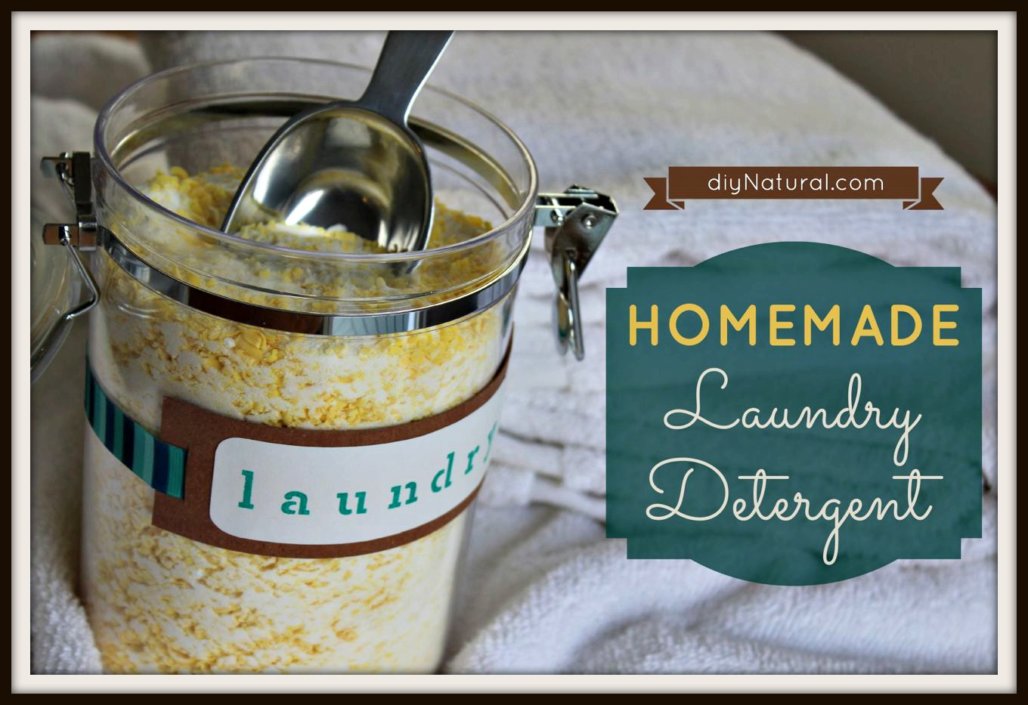
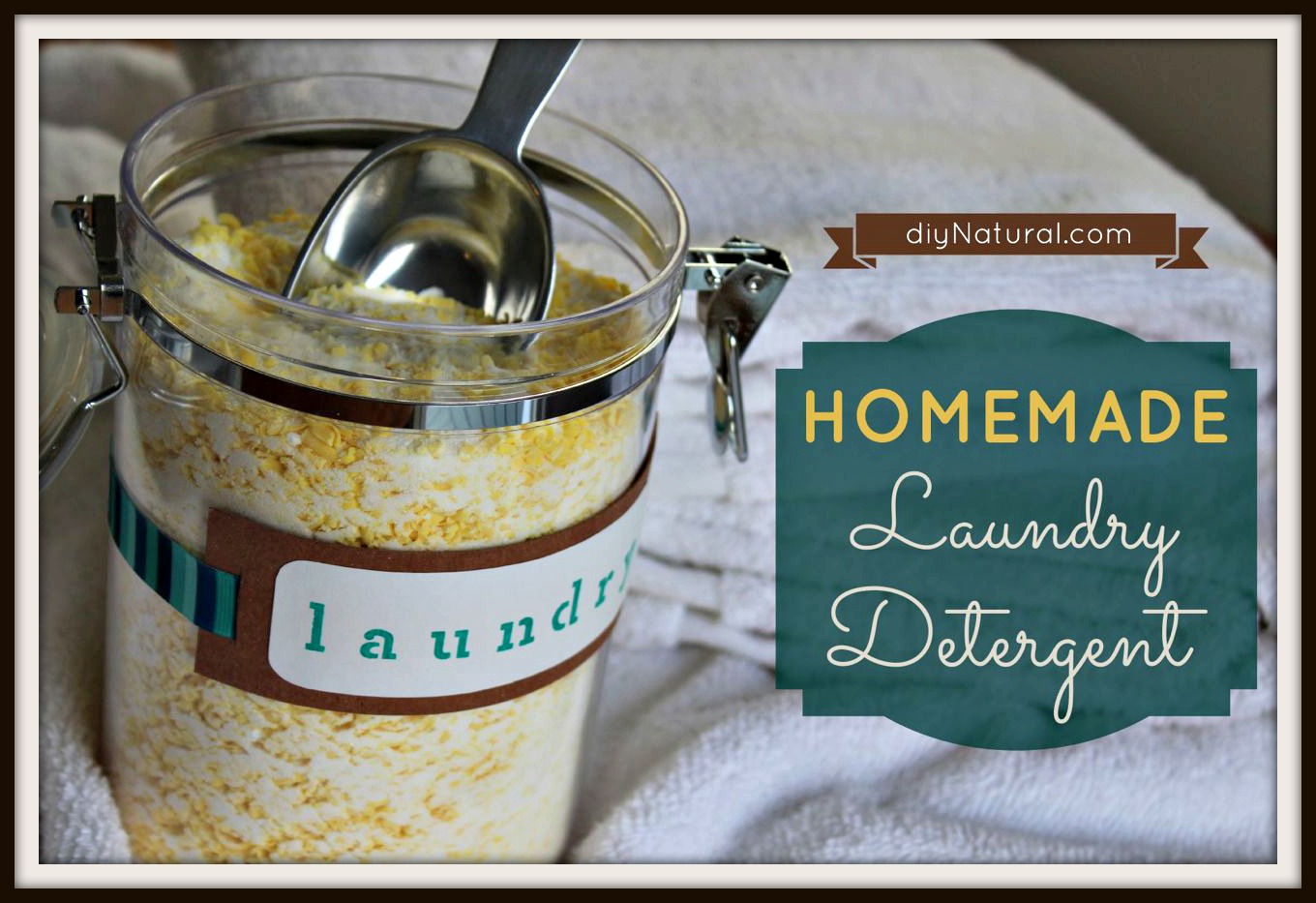
Homemade laundry detergent is simple, cheap, and effective in all washer types. Save money and avoid chemicals with DIY laundry detergent.
This is the ORIGINAL homemade laundry detergent recipe, all others only imitate what you’ll find here.
This is a fun project that will save you money and help you rid your home of toxic chemical cleaners. When you’re done making this check out these other related articles:
- If you prefer liquid, we have 2 recipes for Homemade Liquid Laundry Detergent
- Make your own Homemade Fabric Softener and Dryer Sheets
- And Homemade Dishwasher Detergent
- Or Homemade Dish Soap
- And Learn How To Make Wool Dryer Balls
Note: No time or desire to make homemade laundry detergent? You can always purchase a great natural brand like this.
When we first set out to make our own homemade laundry detergent we thought it would be difficult and time-consuming – turns out it’s neither. Further, making your own laundry powder is fast, easy, and inexpensive.
Why Powdered DIY Laundry Detergent?
We opt for powder over liquid with respect to opportunity cost, storage, and simplicity. Specifically, the liquid variety takes longer to make, requires more storage space, and is more complicated. Finally, years after making our first batch, thousands of others have tried it and loved the results.
Moreover, this powdered DIY laundry detergent recipe requires just three simple ingredients and takes only a few minutes to make.
To illustrate, the instructions and pictorial instructions follow, along with the cost savings breakdown, notes on HE washers, septic tanks, and borax safety.
Note: This homemade laundry soap/detergent works in all HE front-load washers; read more below.
Homemade Laundry Detergent
Homemade laundry detergent is simple, cheap, and effective in all washer types. Save money and avoid chemicals with DIY laundry detergent.
- Prep Time
- 5 minutes
- Active Time
- 5 minutes
- Total Time
- 10 minutes
- Servings
- 32 ounces
- Estimated Cost
- $5
Ingredients
- 4.5 ounces shaved bar soap (a homemade laundry bar, Dr. Bronner’s, Kirk’s Castile Saop, Ivory, ZOTE, or Fels-Naptha)
- 14 ounces borax
- 14 ounces washing soda
Instructions
-
Thoroughly stir together for several minutes and enjoy the results!
-
You can take this a step further and blend the mixture in a blender or food processor to create a powder that will dissolve easily even in cold water. (Just be sure to let the dust settle before removing the lid of your blender or food processor so you don’t inhale the fine particles.)
-
Store in a sealed container with a small scoop.
Recipe Video
Notes
Each batch yields approximately 32 ounces (between 32-64 loads based on how many Tbsp used per load).
Use 1 Tbsp per small load (or 2-3 Tbsp for large or heavily soiled loads).
Made this recipe?
Mention @diynatural or tag it #diynatural!
Homemade Laundry Ingredients
Generally, you can purchase all these DIY laundry detergent ingredients at your local grocery store:
- A 55-ounce box of Arm & Hammer® Super Washing Soda = $3.99
- 76-ounce box of 20 Mule Team® Borax = $4.99
- 10 pack of 4.5-ounce bars of Ivory® Bar Soap
Note on ingredients: use whatever ingredients you are comfortable with. To explain, some people are comfortable with popular brands that are not totally natural, while others prefer to make their own.
Some commonly used bar soap brands include Kirk’s Original Coco Castile®, Pure & Natural®, Fels-Naptha®, and/or ZOTE®. Also, both ZOTE® and Fels-Naptha® are made for and sold as a “laundry bar.”
In contrast, if you’re looking for a pure, natural solution you’ll need to go with a handcrafted soap so you can be sure of its ingredients. Also, you can purchase a natural bar of soap. Because everyone is on a different level we encourage everyone to do what they’re comfortable with.
As previously mentioned, all items can be found in the laundry aisle of most grocery stores. However, if you cannot find washing soda, you can learn to make your own here!
Homemade Laundry Detergent Pictorial Instructions
Visual learners, like myself, enjoy these pictorial instructions.
1. Start with these ingredients and utensils:
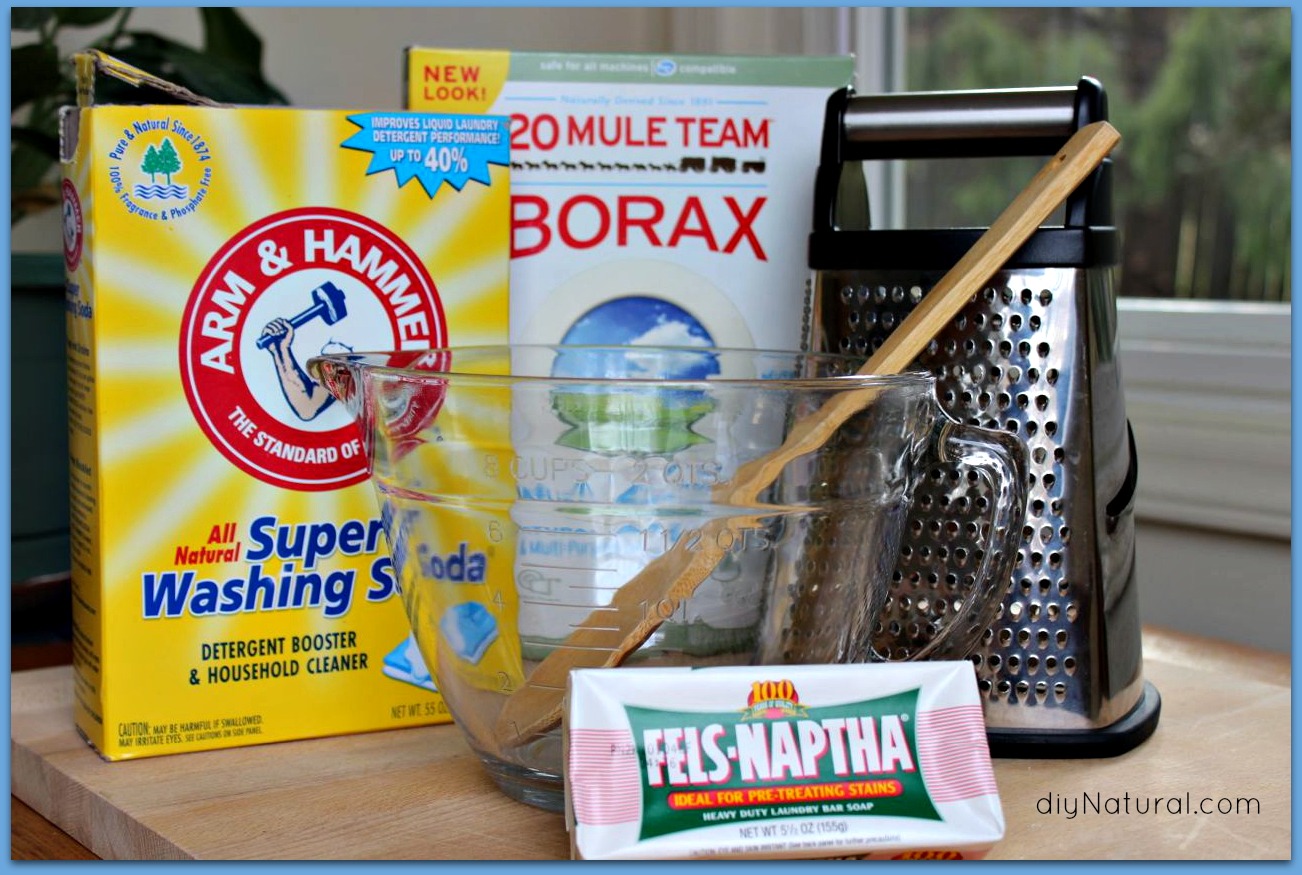
2. Shave 1 bar of soap. I used a simple hand grater:
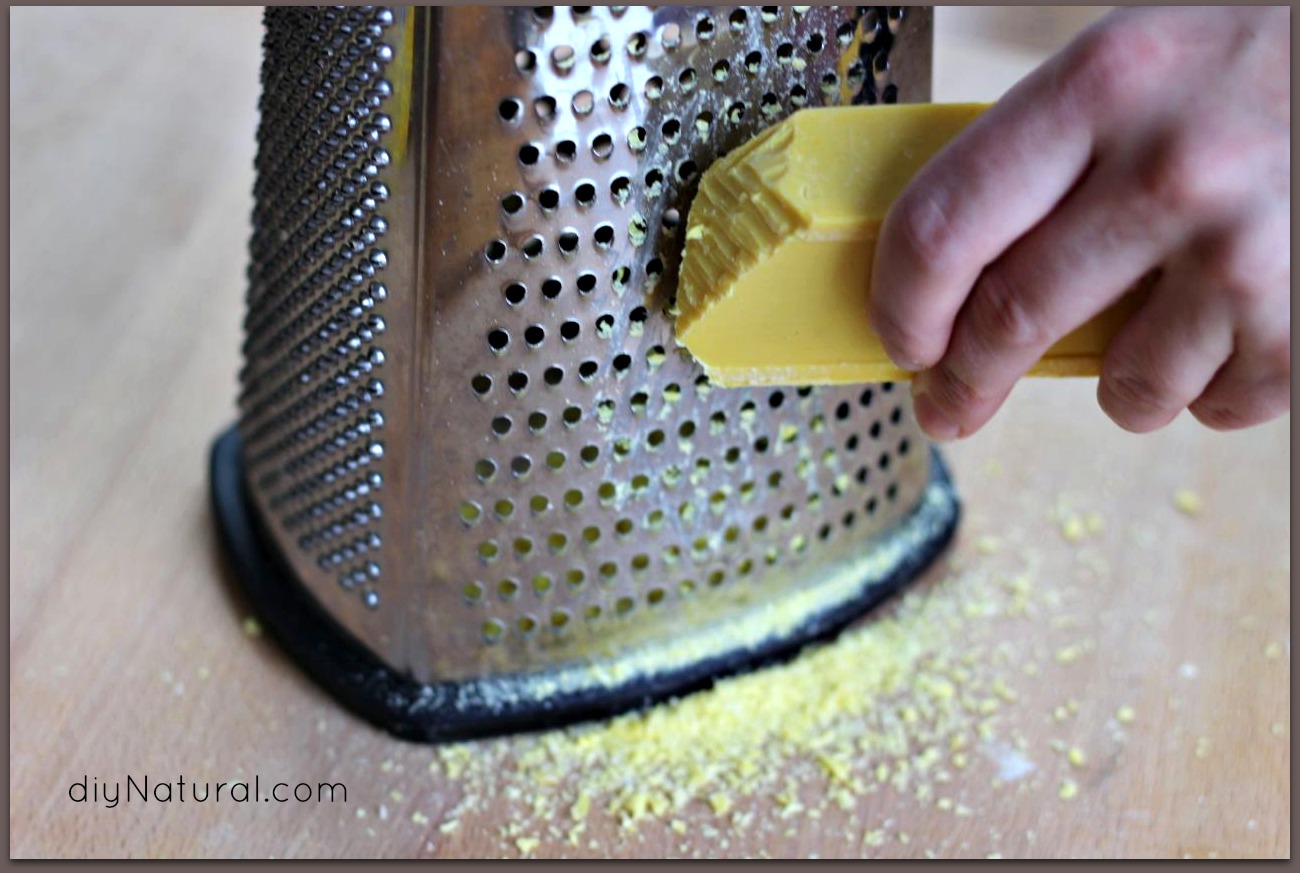
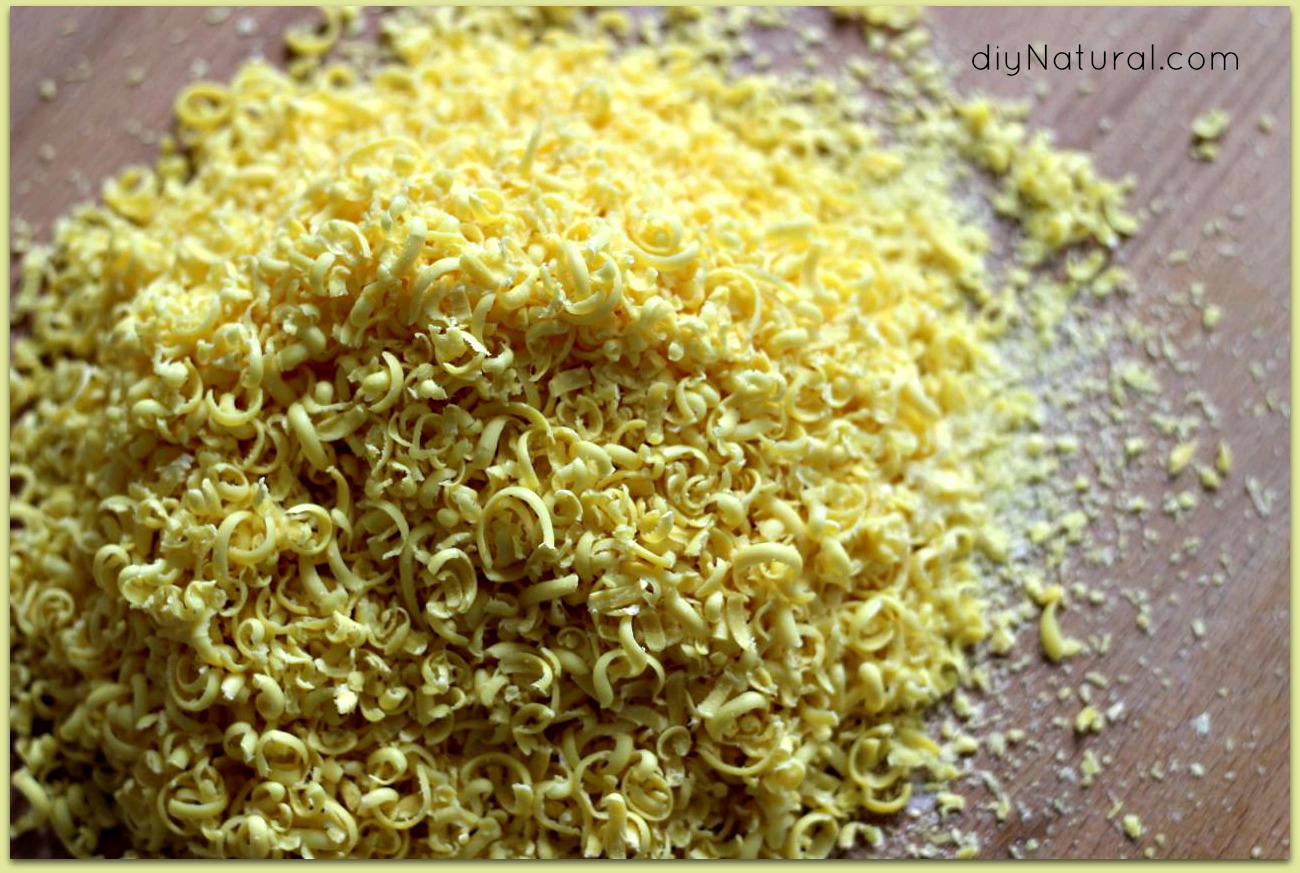
3. My shaved bar looked like this:
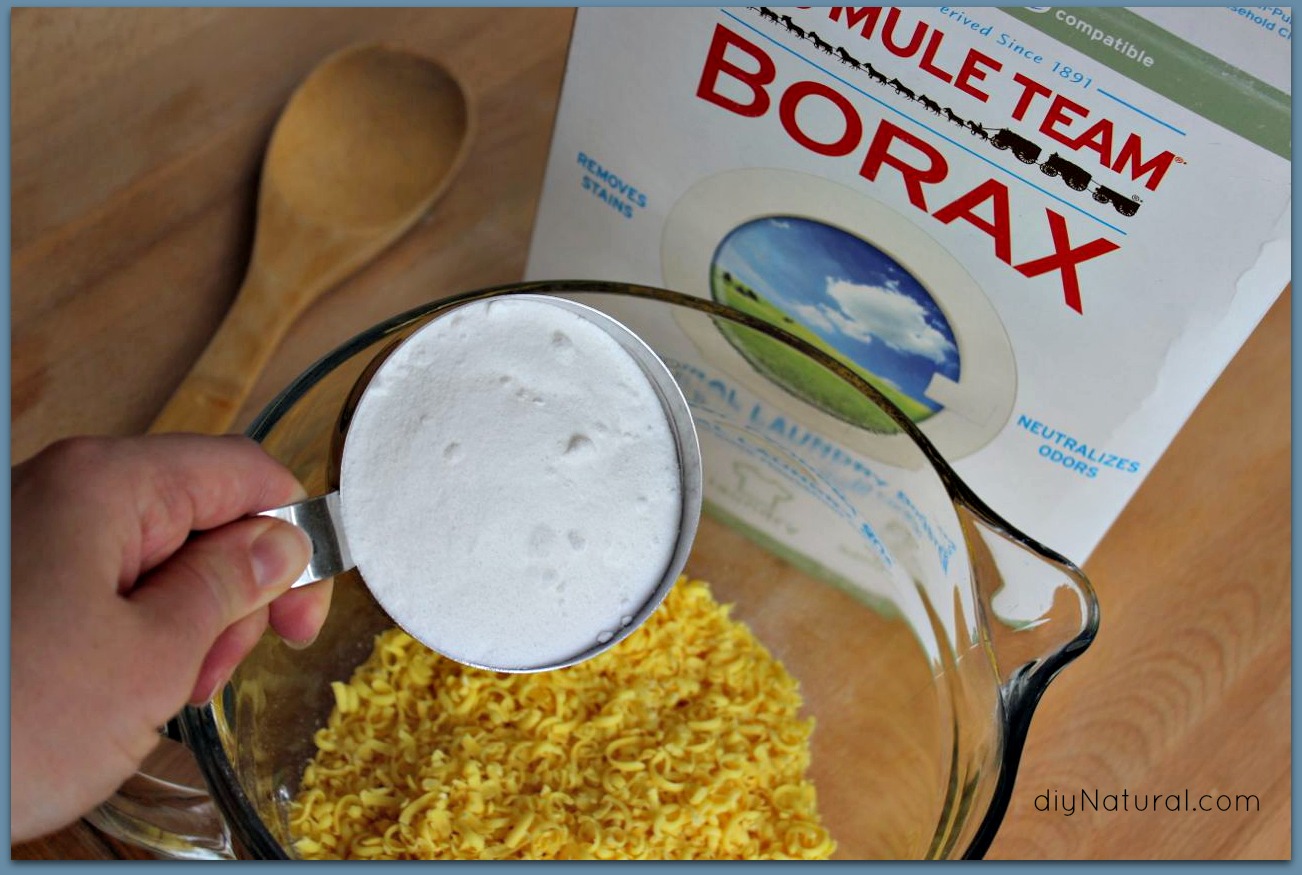
4. Add 14 ounces of borax:
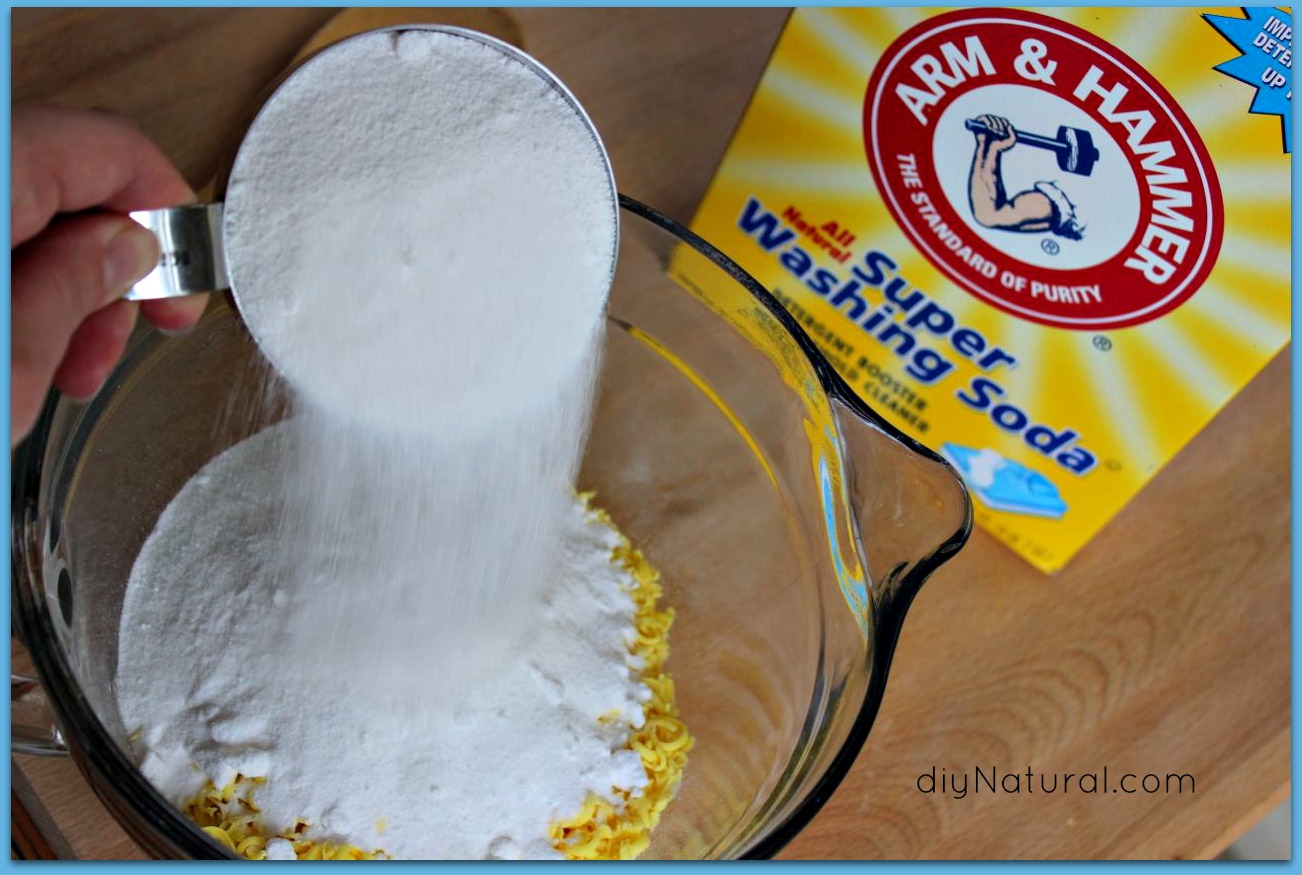
5. Add 14 ounces of washing soda:
6. Stir thoroughly:
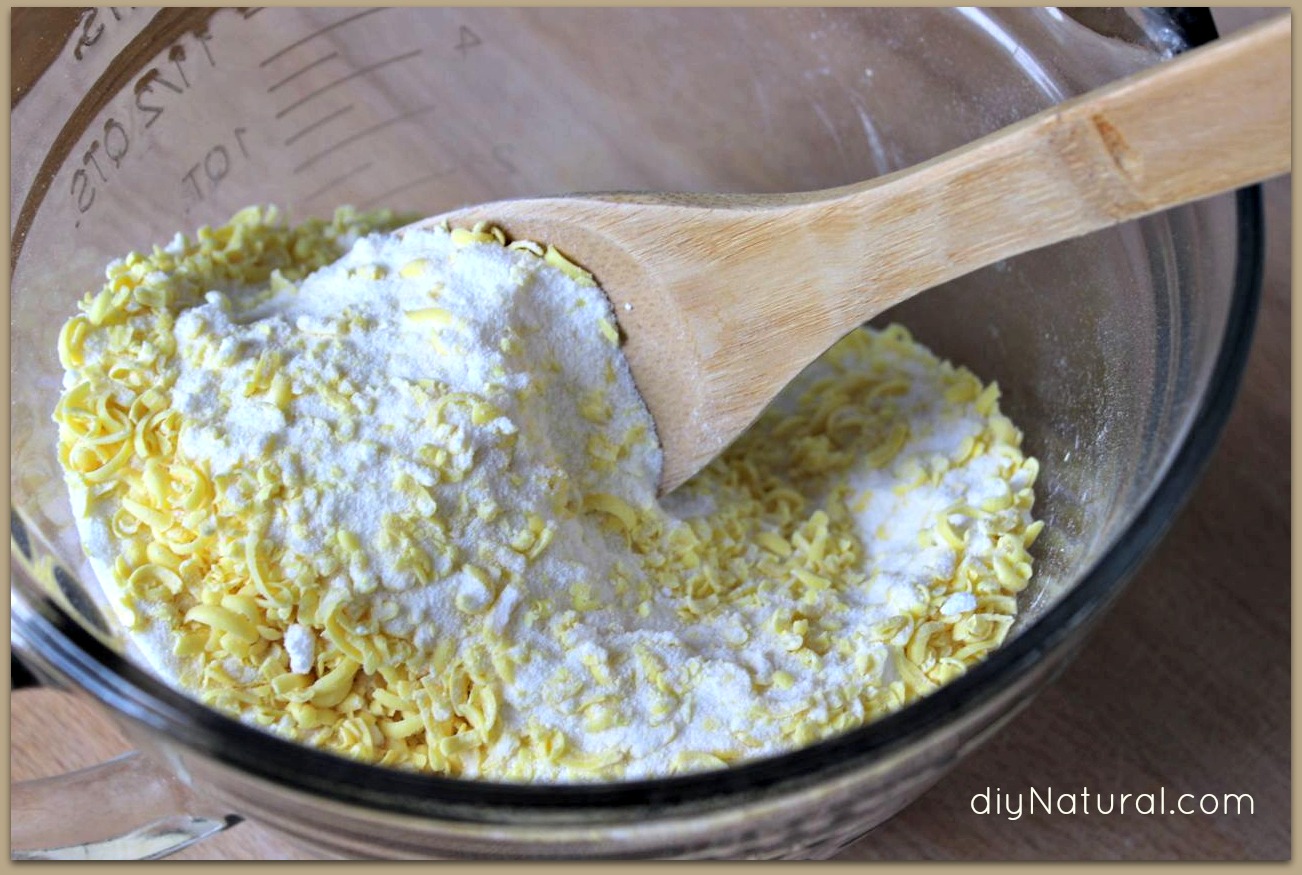
7. Stirring is complete when you have a powder-like consistency:
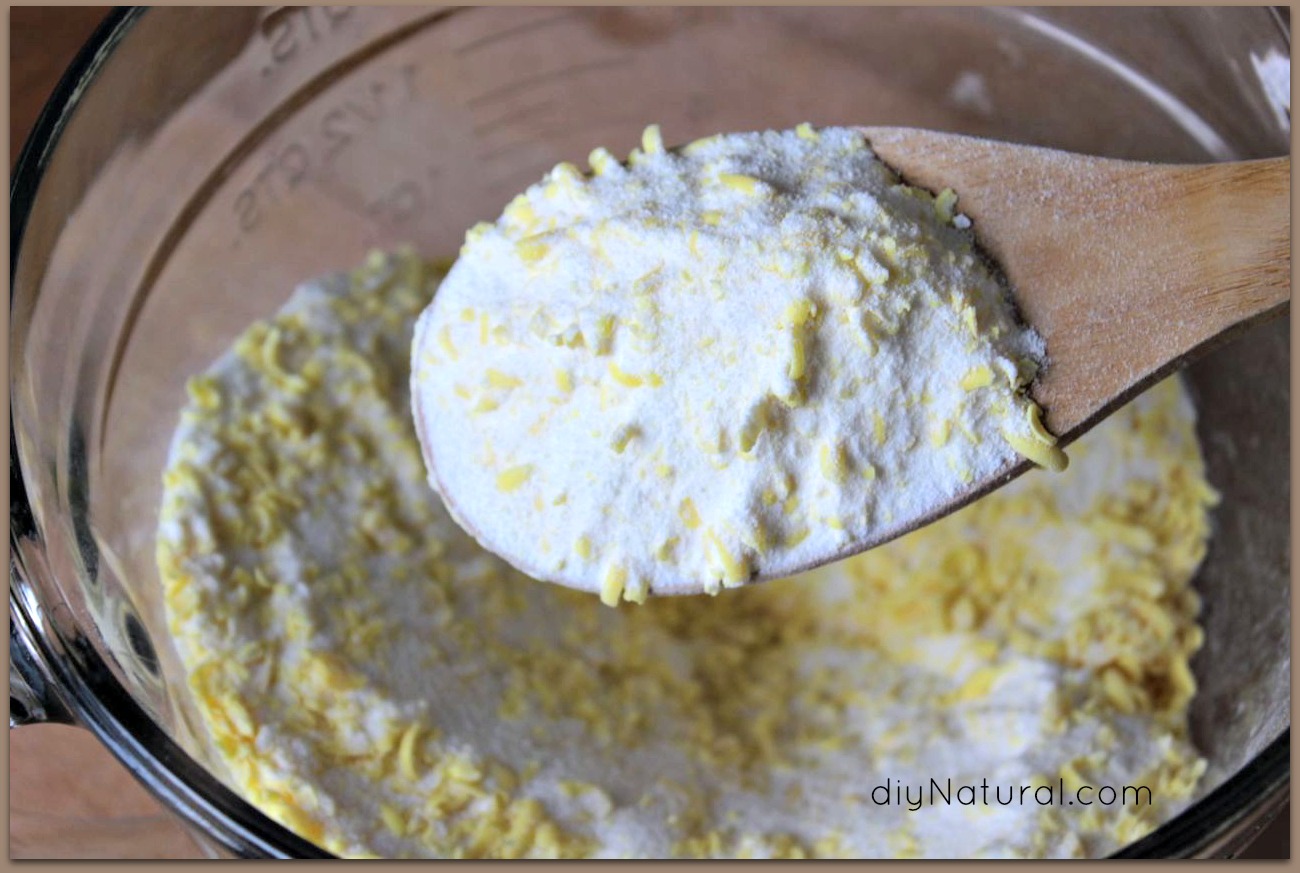
8. Store your detergent in an airtight container and enjoy!
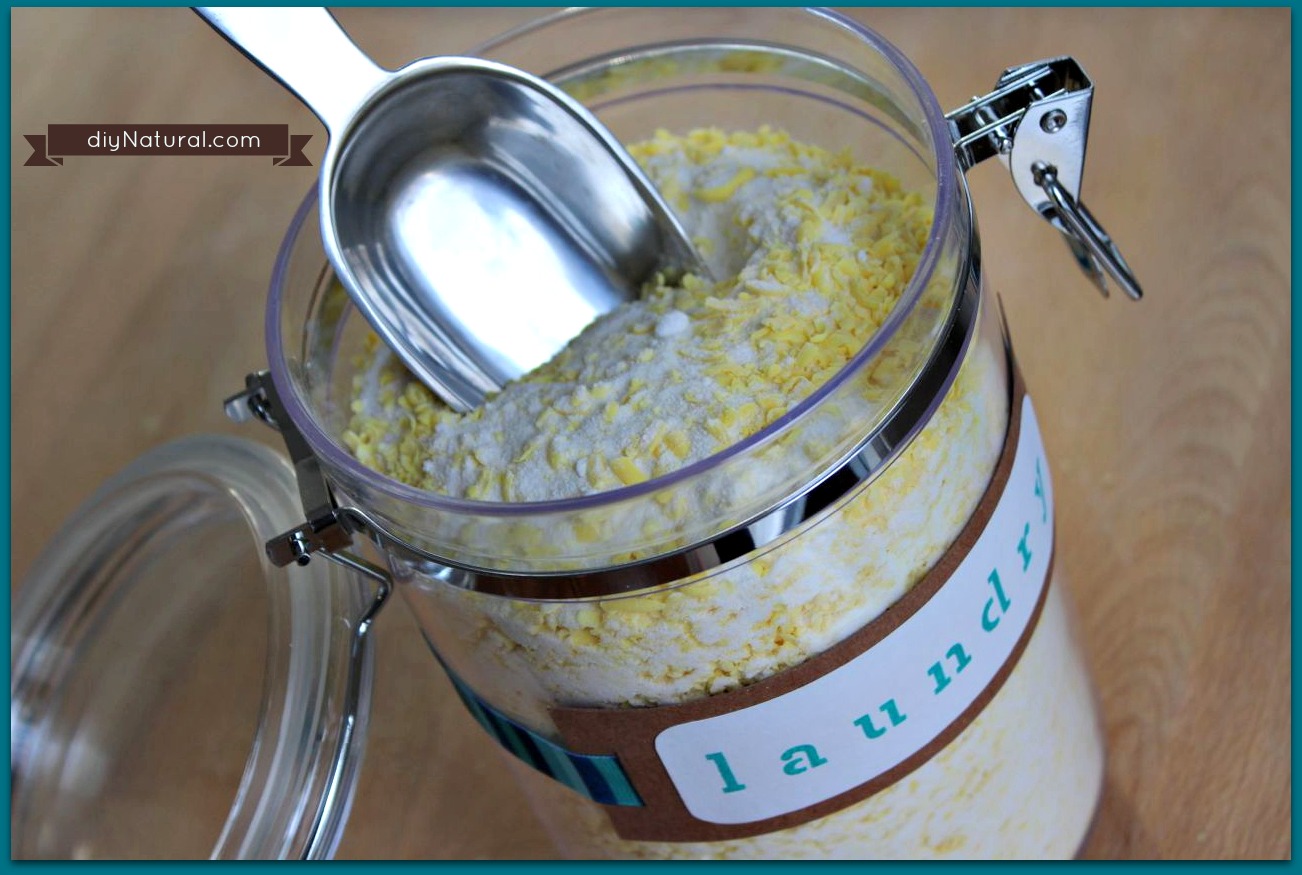
Use 1 Tbsp per small load or 2 -3 Tbsp for large or heavily soiled loads. If you have really hard water, you may need to use more. Experiment with your water and washing machine to determine the best amount for your situation.
You can blend the mixture in a blender or food processor to get a fine powder that will dissolve easily in cold water loads. If you don’t want to do this extra step, you can also just dissolve the detergent in a pint of warm water before adding it to the washing machine.
There you have it folks – simple, easy, fast, and efficient homemade laundry detergent!
When you’re done making this check out our article on homemade fabric softener/dryer sheets!
Note: No time or desire to make homemade laundry detergent? You can always purchase a great natural brand like this.
Cost Savings Breakdown
Prior to making our own, we were using Arm & Hammer liquid detergent. Here is the breakdown in cost analysis:
Use 1 Tbsp per load or 2 -3 Tbsp for large or heavily soiled loads.
- Arm & Hammer® liquid 100-ounce detergent – $6.79 – 32 loads = $0.21 per load
- Tide® with Bleach powder 267-ounce detergent – $20.32 – 95 loads = $0.21 per load
- Jabs Homemade powder 32-ounce detergent – $2.98 – 64 loads = $0.05 per load
As you can see, whether I compare it against traditional store-bought liquid or powder, I am saving $0.16 per load!
High Efficiency (HE) Washers
HE front-load washers require “special soap” for one reason alone – low suds. Because they use less water, they require soap that is less sudsy. The good news is this homemade detergent is VERY low suds. The “special” HE detergent is just another advertising mechanism to push consumers to buy “special soap” for unnecessarily high prices.
Regardless of your washer type, just make your own in confidence.
Safe for Septic Tanks and Fields
This is the best laundry soap to use with septic tanks because it contains zero phosphates and zero fillers (like montmorillonite clay) that cause commercial powder detergents to clog lines. It is also completely non-toxic so it will not harm necessary septic bacteria like toxic detergents and antibacterial soaps. Use with confidence.
Is Borax In Homemade Laundry Detergent Toxic?
After thorough research, I have concluded borax is only as toxic as baking soda or table salt; if you ingest it in high quantities, it may make you sick. If you use it as described in our recipes, it poses no toxic threat.
Just make sure you don’t confuse borax with boric acid, the two are NOT the same. Use borax (I recommend 20 Mule Team brand), and steer clear of boric acid.
For those of you who want more info, read this excellent Crunchy Betty article where she expounds on the toxicity levels of borax; I couldn’t have said it better myself – thanks, Crunchy Betty.
At the end of the day, decide for yourself to use it or not, and afford others the same courtesy.
What are you waiting for? Go get the ingredients and make your homemade laundry detergent today!
*******
References and Resources
- Borax on Wikipedia
- Toxicity reports for Borax on PesticideInfo.org
- Washing Soda (a.k.a. Sodium Carbonate or Soda Ash) on Wikipedia
- International Chemical Safety Card for Sodium Carbonate at the Center for Disease Control
- Sodium Carbonate on the National Center for Biotechnology Information PubChem
- Fels Naptha on Wikipedia
- Fels Naptha Material Safety Data Sheet MSDS L-101 on Prosarcorp.com

I tried this and it didnt clean a lot of the clothes. So researched online and adjusted the recipe to 8oz bar soap, 2 cups borax and 2 cups baking soda wash. Then it called for 1/8-1/4 cup per load. This seems to work well. The soap doesnt seem to dissolve before I put the clothes in but I never had chunks left on them when its done. Maybe it dissolves as the clothes are swished around. We have really hard water, which may be why I had to increase the recipe and use more. I added 1/2 cup vinegar with lavender oil to my downy ball. Not sure if it made a difference or not.
Our machine has the tray on the outside of the machine at the top left. It slides out for adding detergent and fabric softener and then slides back in before you start the machine. I would say that it should work if it has a place for both. I would think the machine would separate the input of the detergent and the fabric softener as one is used in the wash cycle and one is for the rinse cycle. Our machine is a Maytag HE machine that we bought in 2006 (we are in Canada).
Matt, thanks and blessings on you and your family as well.
Hi Colleen,
Thanks for that ! The machine we have has one tray towards the rear inside of the machine with a divider. The left section is for liquid fabric softener while the right section is for liquid detergent. In the front left corner of the machine there is a receptacle for powdered detergent. I mention that only to clarify what may have been a confusing earlier post. Would I still be able to utilize both if using powdered detergent in the front along with only liquid fabric softener in the rear tray ? I happily admit to having zero in the way of mechanical aptitude so not sure if it really matters.
Hi Matt,
I’ve been looking for exactly this for our new HE machine but I do have what may be a dumb question. We’ve been using liquid detergent as well as liquid fabric softener since we purchased the new machine. There is one ” tray or drawer ” inside the machine with two compartments into which you pour both, shut the tray door, and let the machine do its thing. If I switch over to your powder detergent using the powder receptacle in the machine would I still be able to simultaneously pour the liquid fabric softener into the liquid receptacle without problems ?
Our HE machine also has one tray with separate sections for detergent (that has a divider to set it for liquid detergent or powdered) and fabric softener as well as one for bleach. We use this recipe for powdered detergent and liquid fabric softener (or vinegar sometimes) all the time with no problems. We do have to take the tray out now and then to clean it but we did this when we used store bought laundry soap as well. PS: there is no such thing as a dumb question. 🙂
We have always used top-loaders so thanks for answering Colleen. Blessings.
I love the laundry soap recipe and have made it a few times. I am though having trouble with the ivory soap. I have been grating it and then mixing it in but see little chunks of it on my clothes when I pull them out of the washer. How can I prevent this? Thank you
Try blending the ingredients together or use a grater that yields finer shavings. Blessings Angela.
Matt, I just grated it, and then put some of the washing soda/borax mix in my food processor along with the grated soap. Took some extra time, but worked nicely! Do you have a recipe for some sort of dryer sheet? I was thinking a mixture that you could use along with a wash cloth (reusable) Thank you & blessings back!
Yeah, that’s what many others did as well Angela, good stuff. Yes, we do have a dryer sheet/fabric softener article. Enjoy!
I’m still microwaving the soap until it puffs up, then dropping it into the blender or food processor until it’s a ground up to the size of coffee grinds. After that mix everything together using whatever method you prefer.
However another contributor (Sandy maybe?), suggested cutting soap into 4 or 6 pieces, and freezing it, which makes it easier to grind or grate.
One tool I haven’t heard anyone mention are those hand graters in a jar, which operate by pressing down on the lid… has anyone used them for soap?
So I tried the laundry detergent today pretty easy to make and seemed to work fine for me. No residue was left and I washed some pretty nasty stuff with only using 1 tbsp. thanks for sharing!
Awesome, glad it worked for you. Blessings.
I have made and used this soap recipe. I washed my washable floor cleaner pads and they just didn’t come out clean, I had to wash them twice. I don’t have hard water but I’m thinking of grating another bar of hard soap into the mix. What do you think?
I have been using this recipe for several months. Our laundry is never heavily soiled. I have found that on sheets there is a white residue left from time to time and the fragrance of deoderant is left in t-shirts.
I have started using a 1/4 of the amount of liquid laundry detergent that I used to use and 2 tablespoons of this recipe to boost. That seems to help.
I have begun using 2 parts hydrogen peroxide to 1 part Dawn dish soap mixed in a spray bottle. I spray it on the armpit area of tshirts, and the smell is gone. (Be careful not to breathe it in.)
Fascinating..I’ll have to try that.
i am using the little slivers and leftover pieces of bath soap. how much measure wise of grated soap should i have/ one cup, two cups, a half cup?
Hi,
Just found your recipe for home made laundry soap and love it, made two batches now and find that it works really well. The only thing I am not sure of is how much to use in a regular sized top loader machine? We have very soft water so I am thinking not much, but it must be more than two tablespoons?
Thanks
PM
Glad you found us PM. We have a top-loader too, just use 1-2 Tbsp. Blessings.
Yup ~ one to two TBLS
Thank you Zi, I just made a batch and am trying it right now.! 🙂 Hope it works out okay, with a family of 5 we are always looking for ways to save money and live as natural as possible.
Hi Cheryl,
In my laundry soap recipe, I use 1/2 the borax to 1 bar of soap and i cup of washing soda. Then I always add at least 1/2 cup of white vinegar to the rinse cycle. Not only does vinegar disinfect equally as well as clorox, but it dissolves mineral deposits in hard water, and removes any soap residue on the clothing.
Please note, this recipe is extremely concentrated. The recommended amount per load is 1-2 tablespoons, since it has no additives. So you could make a small batch: an ounce of flaked Ivory or Kirk’s Castile (the others have too many harsh chemicals) plus an ounce of washing soda and 1/2 ounce of borax.
Even if your kid’s skin has a bad reaction, these same ingredients will make great household cleaners. I wish you success.
I know No-One who has skin as sensitive as mine, and this recipe has saved me. Why not try a very small load just to see if the recipe works for your children?
My kids all have sensitive skin and we have always had to keep everything unscented. I was wondering if anyone knows if the laundry soap is okay for sensitive skin. I bought all the ingredients the other day to make it, I can’t find anywhere on the boxes that say they are scented. I also can’t seem to find a recipient for homemade fabric softener without fragrance.
I think most use vinegar as a fabric softener substitute.
My husband has sensitive skin with eczema. This soap doesn’t bother his skin. We live in Canada so I use Sunlight bar soap as we don’t seem to have fels naphtha or zote.
PLEASE READ THE FOLLOWING EXCERPT FROM WIKIPEDIA’S ENTRY FOR BORAX, UNDER THE HEADING OF TOXICITY:
Boric acid solutions used as an eye wash or on abraded skin are known to be particularly toxic to infants, especially after repeated use, because of the slow elimination rate. [22]
Borax was added to the Substance of Very High Concern (SVHC) candidate list on 16 December 2010. The SVHC candidate list is part of the EU Regulations on the Registration, Evaluation, Authorisation and Restriction of Chemicals 2006 (REACH), and the addition was based on the revised classification of Borax as toxic for reproduction category 1B under the CLP Regulations. Substances and mixtures imported into the EU which contain Borax are now required to be labelled with the warnings “May damage fertility” and “May damage the unborn child”. [23]
I went online to search for Borax substitutes, and ended up becoming convinced that it was safe for laundry detergent, particularly since I rinse with white vinegar (as a water softener) as well as set my clothes-washer for an extra rinse (my skin is wildly sensitive; that’s why I went looking for an hypo-allergenic DIY laundry soap in the first place).
Not only did I learn from many different sites that the toxicity is pretty much the same as table salt, but also that many, many people ingest a very small quantity daily as a remedy for arthritis, lupus, rosacea, hormone-balancing, candida, and osteoporosis, to name a few.
Below are links and some excerpts from my afternoon’s research.
…………..
http://educate-yourself.org/cn/boraxconspiracy03jul12.shtml
The European Chemicals Agency gave as reason for their reclassification of boron products (paraphrased):
‘The available data do not indicate major differences between laboratory animals and humans, therefore it must be assumed that the effects seen in animals could occur in humans as epidemiological studies in humans are insufficient to demonstrate the absence of an adverse effect of inorganic borates on fertility. 17.5 mg boron/kg/day was derived as a NOAEL (no event level) for male and female fertility. For the rat decreased foetal weight occurred at 13.7 mg boron/kg/day, and a safe limit of 9.6 mg/kg/day has been derived.’ (22)
What they are really saying is this: ‘While we have no human data, animal studies suggest that for adult reproductive functions a daily ingestion of about 2 teaspoons of borax is safe. But to be absolutely sure that no-one is harmed, we will ban it totally.’ Importantly, this ruling is not related to borax in foods or supplements where it is already banned, but only for general use as in laundry or cleaning products or as insecticides.
Because borax is not readily inhaled or absorbed through intact skin, it is difficult to see how even a few milligrams daily could get into the body with the conventional use. If the same standard would apply to other chemicals, there would be none left.
The key study in this assessment was published in 1972. Why is this being dug up now to justify banning borax when it was of no concern for the past 40 years? It does not make any scientific sense, especially if you consider that the main chemical in the new borax substitute, sodium percarbonate, is about three times more toxic than borax.
Acute oral LD50 values for animals are from 1034 to 2200 mg/kg/day (23). Even the commonly used sodium bicarbonate, with an animal LD50 of 3360 mg/kg, is nearly twice as toxic as borax (24). Both of these chemicals have not been tested for long-term reproductive toxicity at the high doses that caused fertility problems in rats and mice.
The same applies to washing powders [laundry detergents], it has been stated that no toxicity is expected if used in the approved way, or that reproductive tests have not been done. Ingredients in these products are more toxic than borax, why can they be used in the approved way but not borax? And how about really toxic items such as caustic soda and hydrochloric acid? Why do they remain available to the public when one of the safest household chemicals is banned despite the fact that it is absolutely impossible to cause any reproductive harm with the approved use?
Regardless of the lack of any scientific credibility, the stage has been set for borax and boric acid to be globally removed from public sale at short or no notice. Even low-level and less effective boron tablets are now tightly controlled by the pharmaceutical industry, and may be restricted at any time through Codex Alimentarius regulations. With this, the medical-pharmaceutical system has safely defused any potential danger that borax may have posed to its profitability and survival.
……………..
http://crunchybetty.com/getting-to-the-bottom-of-borax-is-it-safe-or-not
Looking through the ToxNet studies on the NIH website, I see very few that are concerning for any major danger (unless ingested in high quantities). In addition, the Material Safety Data Sheet lists borax as a health hazard of 1, the same as baking soda and salt.
Here’s one more bit of info for you:
Boron is an essential mineral that the body needs for bone building, immune function, and brain function. Plants need it to grow. But, like anything, it’s needed in small moderation. Much like salt.
Boron is found aplenty in borax. People even take borax as a supplement and swear by it (I am NOT recommending you do this). That’s a little extreme, but I use it as a gauge as to how harmful borax really is.
I’m putting to rest my late-night concerns about whether – all along – I’ve been using some kind of dangerous(!), toxic(!) poison(!).
For me – and this is my personal determination after months of searching, wondering, and compiling information – borax is just fine to use in my household cleaning routine. ESPECIALLY as a laundry detergent. It’s also fine to use, occasionally, as a hair treatment … or even in a lotion.
I’ll just be keeping it out of the reach of kids and my two cats. Not that any of those beings would want to eat it anyway. Ick.
……………..
http://www.earthclinic.com/Remedies/borax_questions.html
Whether borax is safe or not appears to be the dosage. Let’s see, flouride is at least ten times more toxic than borax, but yet many people use it everyday in toothpaste. How can you explain that? Its toxicity is a bit less toxic than cyanide, and arsenic toxicity is close to flouride. Not only is fluoride NOT an essential mineral, but yet boron or borax IS an essential mineral. Take for instance drinking water in Israel, is several milligrams per liter of water. Most fruits are about 1 mg/liter of borax.
……………..
http://theecofriendlyfamily.com/2011/10/diy-dishwasher-detergent-without-borax/
Also — and not said sarcastically, but seriously wanting to know…..anyone know what the real deal is with Borax? I keep seeing people say its toxic if ingested….but I wasn’t planning on eating it, I was just planning to wash my dishes with it. I imagine drinking the soap I use to handwash my dishes would probably be toxic if I drank enough of it, too….but I still use it to wash my dishes! Anyone try eating washing soda??? It says on the side that if ingested, you should start drinking milk or water and contact a physician. Just wondering if Borax is getting an unnecessarily bad reputation — when it would be MUCH cheaper to use. Anyone with a chemistry or medical degree that can shine some light on this??
Reply, February 14, 2012 at 10:37 pm
As I previously said, add vinegar to the final rinse. That will eliminate the haze left by the alkaline components of your wash mix. The haze is left behind because the alkaline ingredients are not as soluble in tap water that contains high concentrations of minerals and is most likely slightly alkaline itself. Acidifying the rinse water with vinegar will dissolve the alkaline ingredients and they will drain away with the rinse water.
Cleaning Tip: To remove rust stains from garments, wet the rusty area with lemon juice, rub area with table salt (no it doesn’t matter what kind), and place in direct sunlight. The magic of photochemistry will cause the reduction of the oxidized Iron and the rust stain will be gone.
DIY Dishwasher Detergent without Borax!
by Amanda on October 17, 2011
I’ve been playing around with a dishwasher detergent recipe for a while now, and finally worked out one that leaves my glasses clear and does not use borax. I am happy to use borax in my laundry detergent, but I feel that using it on my dishes is probably not the best choice.
For some time now I’ve been stuck using uneco-freindly options, mostly. I’ve been using Cascade packs with Lemi-Shine. It was the only thing that cleaned my dished and left my glasses clear from film and yuck. I have been using this DIY recipe with success. It used Lemi-Shine, which is completely safe and eco-friendly. The only thing I wish is that I could buy it in tubs. I simply will not do a load of dishes without it.
1 1/2 Cups Lemi-Shine (They come in 12 oz containers, so this is a full one) 1 1/2 Cups Washing Soda 1/2 Cup Baking Soda 1/2 Cup Sea Salt (any will do I’m sure)
Use 2 Tablespoons per load and if you like, vinegar can be added as the rinse agent in the event that you have any cloudiness.
A nice Sunday jaunt through the web. Cheers!
Well put Zi.
I know this is the laundry detergent site, but because you quoted Amanda and she mentioned Cascade, I thought I’d toss this in. If you look at the ingredients in Cascade liquid, the #1 ingredient is sodium carbonate (washing soda), next is sodium hydroxide (lye), next is sodium silicate, and then the kicker is chlorine bleach and this is to clean the plates and flatware we eat off.
As for the Cascade remarks wouldn’t you think it’s not such a big deal since it’s all rinsed off before we eat from the dishes? Especially when I consider restaurant dishes, none of those ingredients scare me. It makes me feel safer. 🙂 I mean consider that most people swim in chlorine bleach that goes in their eyes and ears and occasionally their mouths. And doesn’t tap water have tiny amounts of bleach?
Also, boric acid is not the same thing as borax (sodium tetraborate).
LOVE THIS!!!!! It got the deer blood stains out of my husband’s clothes! No pre-treating!
I have been using the base recipe for laundry detergent for many months now and am very happy with the results. I use an Ivory Soap bar shaved on a smaller grater which makes it easier to mix with the Soda and Borax. I know some of you like to do this with your food processor, but I simply spend a few minutes blending everything with my potato masher! Those extra few minutes of hand-blending are worth everything to me knowing that I am saving lots of money in the long run. And, my clothes are just as clean as they ever were with commercial products.
I do add a small amount of bleach to the wash for my white towels. And I presoak some heavily-stained items, just as I would do for any load when I was previously using commercial detergents. For anything particularly “smelly” I add 1/4 cup of baking soda to the load and that takes care of it.
I will also add that my laundry is noticebly softer…(particularly my towels), without even using fabric softener or dryer sheets.
I will have to try this recipe! I use a liquid detergent recipe… but it’s “no grate” because I agree. Most recipes are too time consuming.
Here is my recipe:
http://lifes-greatest-blessings.blogspot.com/2012/11/tutorial-no-grate-homemade-laundry-soap.html
So far, so LOVE! I experimented with a batch of the powder…Kirk’s Castile bar soap is wonderful, but boy does it take forever to grate! I’m hoping the Vitamix will work without making too much of a clean-up nightmare! I use it with the Borax and washing soda and just love the results…fresh, clean, bright. Thanks to all for sharing!
Try cutting the soap in some pieces and freeze for a few hours before putting in the Vitamix – or a regular food processor.
Vicki ~ Thanks for the info. What is Biz?
Angie – do you do anything else besides cut up the soap bar before blending in the Vitamix? How difficult is it to clean the blender after? Thanks!
After doing some research on the laundry soap thing, which I had made a batch just like everyone else, fels naptha, washing soda AND BORAX, it’s almost time to make another, well after looking at the clothes closley they just didn’t seem to be as bright as I wanted, then the researce began, I found out that Borax does no good at all in Cold water wash UMM……it does however work when used in hot then it releases it’s cleaning power, glad I found that info, so when making soap I’m going to try replacing the borax with Biz, just thought I’d let you ladies who wash in cold water know this.
I tried the mixture using the Ivory bar (3.1 ounces vs the 5.5 ounce Fels Naptha bar) and although I didn’t do a rigourus comparison the results were as good or better than the larger Fels Naptha bar.
I’ve been making this laundry soap for almost two years and haven’t looked back. I use the Fels Naptha bars. I bought a case (I think it was 24 bars) and still have 13 left! Of course, there are only two of us in the house, but the savings is incredible. By the way, I use my Vitamix blender to blend it up. I break up 1/2 bar or so at a time into pieces, then pulverize it! I add the soda and borax and mix it all up. Love it!
I found the site and the book about a week ago. Waiting on my essential oils to come in to go with the other ingredients I just bought to make more cleaning products!
I use Murphy’s oil soap or any old fashioned bar laudry soap and cold water. It works well for most delicate clothing, and for things that are not very dirty or smelly.
If I need to clean someting dirty or smelly, I bring out the Tide (or equivilant).
This way, my clothes get clean, not just clean-ish.
.
Hi Everyone,
Thank you all for your great and informative comments.
I’ve been using this recipe with Kirk’s Coconut Castile (Soap Bar) for at least 3 years. Another website whose link I’ve lost, suggested putting the bar on a plate in the microwave. It puffs up and becomes crumbly (once it cools)–easy to put in blender or food processor then. I can’t remember how long to zap it, so I’ve been checking it at 1-minute increments until it’s done. My one BIG suggestion is to do this when you can air out the house and microwave for an hour or so afterwards; it smells great but very strong. By the way, decades ago we used Kirk’s for washing when we camped. It is so non-toxic that minnows would swim up in droves and nibble away at the suds.
Oxyclean doesn’t bleach clothing unless you soak them in it for a few days (know from experience). My choice on tough sweat smells is to spray the offending fabric area with rubbing alcohol, or even ammonia, and let set for 15-30 minutes, then wash.
If I have a questionable load, then I’ll drop in some hydrogen peroxide or a few drops of health-food store ‘liquid/food grade oxygen’ which is more-or-less a concentrated version of oxyclean or peroxide. I’ve been using the same bottle for years, so the cost, under $10, is no big deal. Just be very careful to keep this away from children and others with poor judgment. Add this in with the very first washing cycle.
For folks wondering about cold water washes and whether the DIY recipe will leave a film, may I suggest using less of it? Or using white vinegar as a rinse agent?
Victoria, why do you use the salt do in your laundry soap recipe?
Re deodorants: After years of being allergic to commercial brands, and failing embarrassingly with most health-food store brands, I have fallen in love with ‘Tom’s’ deodorant stick. It works fantastically!
Hi Zi – thanks for all the great tips! I’d like to offer one – instead of microwaving your soap bars – cut them in small squares, freeze for several hours and then put them in the food processor with other ingredients. This works even better than microwaving.
I’ve been using the Fels Naptha soap and the bars are 5.5 ounces per bar, but I want to try the Ivory soap and the bars are 3.1 ounces, should I use a bar and a half of Ivory or will one bar be enough? Thanks
This recipe sounds great – I am wondering about an Australian equivalent brand of soap – am I looking for 100% natural soap bar? I think our “Sunlight” soap might be similar.
I was also wondering about essential oils, have noticed a few people have asked already – I think you could add a couple of drops to the mix without making it damp. I often use pure eucalyptus oil in my wash to freshen the loads, a capful as it’s not oily like essential oils and it works wonderfully 🙂
Hi Belinda:
I live in Canada and I use Sunlight soap to make this recipe. It is a yellow bar that is lemon scented. It has been around in Canada for years. Works great for us. I haven’t tried adding any essential oils as I love the lemon scent but eucalyptus would be nice too! Good luck!
I found this on google: http://www.domesticdivaunleashed.com/washing-powder-and-gel-in-the-thermomix
Thanks for the reply Colleen, I will get some today and give it ago, yes you can’t beat a citrus scent!
I like that website, I think I will try that recipe!
Cheers 🙂
Glad it helped. 🙂
I used Kirk’s Castile soap and so far, so good!! I haven’t washed in COLD yet, but did wash in COOL and all dissolved and really washed better than the environmentally friendly liquid I had been using. I’ll let you know how it goes in cold!
A friend rec’d this site because I was looking to make my own laundry detergent so I’m going to give the powder a try (i prefer liquid, but we’ll see). I was researching the different soaps listed, thankfully, because Zote has cocount oil and my son is allergic to coconut. Just a reminder to everyone to check ingredients of products, just in case!
Colleen, what temp water do you wash in? Hot, warm, cool, cold?
Thanks!
Warm or cold depending on the clothes. Rarely do we wash in hot water.
I have a family of 12 and have tried this laundry soap and wouldnt use any other this product cleans our cloths well deoderizes perfectly and we are greatly satisfied with a family this large it have save 40.00$ per month and laundry soap alone and our clothes look , smell and work fine even with some allergies most of the family have thanks greatfully
The powder soap doesn’t fade or leave residue on dark clothing?
What is the shelf life for this recipe? Also can I add essential oil?
We have been using his for several months now. I don’t add oxi clean or anything else. We have a front load HE washer. I put the powder in the dispenser and start the washer. I have never dissolved the soap in any temperature of wash water and we have no problems with film or residue. . Our clothes are clean and smell great.
I use this in cold water all the time and never have a problem. Maybe it has more to do with the water. My water is fairly hard. I also haven’t noticed any problems with fading and I do use the Oxi-Clean.
Thank you, Sandie! Mine does as well (both liquid & powder), but I guess I need to dissolve the soap in warm water first because I do most of my washing in cold…as warm or hot is unnecessary, wears out clothes faster, and costs more $.
Thanks again!
Hi Lisa – No, I don’t have an HE washer. Others with an HE washer might be better able to advise you, but I would think if there is a liquid soap dispenser, you could use that. My daughter has an HE washer that has both a liquid soap dispenser and a powdered soap dispenser.
Sandie,
Do you have an HE washer? And if so, do you put the dissolved soap directly into the washer bin or in the liquid soap dispenser?
Thanks!
Hi Sandie-
Unfortunately I cannot use oxiclean in the wash as my husband reacts to it. I do already use vinegar in my rinse cycle. I have tried Fels Naptha, White Zote Soap, and am currently trying the pink Zote Soap. I do not have any Ivory. I suppose I could try that next, but I have not been successful yet. Perhaps it is the addition of the Oxiclean that helps with fading and such. I have not had issues with film on my clothes since I started dissolving the detergent in warm water. I just want people to be aware of the fact that you can’t throw the detergent in with cold water. It needs to be dissolved in warm first. Thanks.
I’m sorry you can’t use oxi-clean. I prefer the ivory soap so far. It’s so easy to cut up, freeze and then put in my food processor. Adding vinegar to your rinse will also help with any residue.
This has probably been asked and answered previously.
Does the oxi-clean tend to fade clothing? Do you use it with colors as well as whites? What about delicates?
Thanks for your help.
Hi Patti – I use the oxi-clean in every wash and for all clothing types. I haven’t noticed any fading from it.
I have to respectfully disagree with Matt’s comments that the laundry detergent works well in cold water. It left a film all over my clothes and I had to rewash them in warm water. I have been using hot or warm water at first to melt or dissolve the soaps in the water, before turning the washer to cold. I like the smell of the detergent, it doesn’t have that chemical smell. However, it seems that it is fading my clothes and my daughter’s clothes, even when washing them in cold water. I have changed to baking soda instead of washing soda, and changed to the pink Zote soap for whitenessin the hopes of having better success. I have been using about 2 tblspns per load in my top loading washer. I will see what happens. I have not been 100% pleased with this unfortunately, and I really wanted to be. I hate the smell of chemicals, but gotta have a detergent that cleans well, gets the smells out, and does not fade my clothes.
Hi Eileen – I’ve been using this powdered formula for many months now and I’ve had no problems with it in cold water. I dissolve it in warm to hot water in a cup first then put it into the wash with cold water. I use vinegar in my final rinse and have had no residue or unusual fading problems at all. I’ve used both Ivory soap and Fels-Naptha, both of which seem to work equally well, although I prefer the Ivory. I also add about 1/4 cup of Oxi-Clean to each wash load.
We also dissolve the detergent in warm water.
I have to say also that I experience no problems and I generally wash in cold too. I was dissolving it in hot water prior to putting it in but have recently got lazy and just thrown it in (1st thing into the machine as the water is starting, then the clothes) and I see no difference, no film on the clothes at all and the come out nice fresh and clean 🙂 I have also added 1/8c fine sea salt and 1/4-1/2c baking soda to my mix and I love it! I add 1/3c vinegar to my softener dispenser and I use 5 wool dryer balls in the dryer afterwards, such a difference in our clothes! The only thing I notice once in a while is deodorant stains on my husbands shirts but I have found remedies on the net of how to pre-treat these (havent tried any yet though!!) 😀
i agree. if u wind up having to buy new clothing or add a bunch of other ingredients to get your desired effect, it isn’t much of a bargain. i have 5 boys and am probably going to have to switch back to my tide w/ bleach. if i have to rewash the extra stinkys and soak it gets less cost effective and too time consuming. of course i was never worried about chemicals. i just wanted to save some money.
For me, I’d rather buy an environmentally friendly soap if I’m forced to wash in warm or hot, which isn’t necessary for most laundry items and is costly. Please advise if the dry mix can be used – successfully – in cold water. Thanks!
I was going to try this recipe, but then remembered a bag of similar “earth friendly” detergent that I bought years ago, which has been lurking in the back of my cupboard ever since since it didn’t work very well. It is made in Victoria, BC and contains borax, washing soda and “50% recovered soap powder” which means it uses discarded hotel room soaps that have been recovered & processed into laundry detergent (kinda icky I know). It suggests using 1/4-1/2 cup per load. I recall it left clumps of what I presume are soap bits on the clothes. Mind you, the instructions recommend warm or hot water & since I usually only wash in cold I didn’t heed the advice. Does your recipe require warm/hot water? If not, do you think the poor performance is due to higher ratio of soap vs borax/washing soda? I’m thinking of trying it again, cutting it with more borax & washing soda.
hi, i just made this using the ZOTE brand soap and it doesnt get super fine when stirring, will this cause any problems?
No one mentioned using this on coldwater wash/fine washables type clothing.
I can tell you I used the Sports Suds over the weekend on all our gym shirts. I went to the gym today and worked up a good sweat. Happy to report that smelling the shirt after my workout it did not have that awful smell I usually find. A small container that does 32 loads for top load – 64 HE front loads is approx $20.00 (depending on where you buy) – more then I would normally spend but it is cheaper then buying all new dry wick shirts. Google Sport Suds and check out reviews – I was impressed and my initial results are good. I would love an alternative but I would rather spend a bit extra and not be so self-conscious working out if I can’t find a home made alternative.
I’m interested in this subject too as I had a horrible problem over the summer with my clothes retaining the body odors even after washing. So if anyone comes up with a good solution, please let me know. I’d prefer not to try and save money on homemade laundry detergent only to have to spend extra money to make up for what it doesn’t do.
RLR Laundry treatment. All natural. Will work.
Thanks Doris – Soaking for me did not work. I did break down and buy the commercial stuff called Sport Suds – felt not too bad after reading this on their website – but wish it was not soo expensive – but cheaper then buying new clothes-
Earth and People Friendly
Sport Suds is made from natural ingrediants. It does NOT contain dyes, phosphates, UV brighteners, bleach or perfumes.� It is hypo-allergenic and ideal for infants and others with sensitive skin.� It is safe for septic systems, highly biodegradable and certified safe for use in small lakes and streams (OECD 301A).�Sport Suds has not been tested on animals. A
Ive noticed my boyfriends workout clothes really smell bad but only on his “dry fit” type of clothing (and just a few t-shirts, some of his other performance gear must be made differently). What I like to do is soak it in vinegar/water mixture for at least 30minutes before I wash them. The only reason I don’t boil it is because it’s synthetic and says it needs to be washed in cold water.
I was just wondering, can you add any kind of fragrance to the detergent? I have so many bottles of fragrance oils and was wondering if those would work.
I have been adding vinegar to my fabric softener compartment on my HE front loader, I also add about 20 drops of fragrance oils to the vinegar. My clothes come out smelling SOOOOO good! I am currently using a crisp linen scent. For the past dozen loads I haven’t had any issues. =)
Lol, Ginny. People sweat all over and when you workout hard, your clothes get soaked with perspiration. Deodorant won’t solve that problem. Better advice would be to stop working out. 😉
LOL. I guess I don’t know any better. 1) I don’t work out, and 2) I don’t really sweat much. I just starting using home-made deodorant (1 part corn starch and 1 part coconut oil) and was wondering what I would do if I perspired too much, but there was not much perspiration, just barely moist at times – mostly at night. I guess I’m not one to give advice. Thanks for being so sweet about it. I did think it was a funny comment, though. Made me laugh. Hehe.
I have been making my own laundry detergent for the last year or so and have no issue except for our gym clothes. The smell of prespiration is making some of the tops unwearable. I have found a product with great reviews that claims it will remove the smell but the price is high. We work out 5 days a week and I really don’t want to have to buy all new tops but that is what it is coming down to. I have tried soaking the clothes in a mixture of vinegar and washing soda and then washing (in a front load HE machine). When I take out of the washer and (always) hang to dry, they smell fine but as soon as I put them back on and start to prespire, the smell returns. Any suggestions or tried and true method would be greatly appreciated.
I have the same issue with my husband’s clothes. I wish I had a tried and true method but I don’t. I just thought I’d suggest regular baking soda and hydrogen peroxide. From what I understand, hp breaks down proteins like blood. I would think it’d have the same effect on sweat. If you notice the problem more in the armpit area, I’ve seen Dawn dish soap mixed with hydrogen peroxide sprayed onto the area then scrubbed with baking soda. Good luck.
Thanks – Won’t peroxide bleach out the clothes?
You know, that’s a good question because now that I think of it, I’ve only used it to brighten my whites, not in color loads. I have used it on single colored items with no bleaching but I couldn’t tell you for certain the effects it would have on a full load. I know the hydrogen peroxide in the medicine cabinet (and my laundry cupboard) is not the strength of the peroxide that is used for bleaching and dyeing hair. I’m sorry I suggested something that could actually be less than helpful. I assumed when I put it in my white loads that it was releasing the protein stains like dirt, blood and sweat, not bleaching them. That still might be what it’s doing but I am definitely unsure.
I shouldn’t, the main ingredient in color safe bleach is peroxide.
Thanks, Pam. Since my last post I’ve been using peroxide and Dawn to treat armpit sweat on shirts of all colors and have seen that no bleaching whatsoever takes place. I had no idea that it’s what makes bleach alternative work though.
I have three sons. Two play football and one does cross country track and JROTC. I use apple cider vinegar in the wash to combat the odor causing bacteria on their clothes.
It works well for us.
I use 6-8oz amonia. I start my washer add the amonia & soap let the water run for a few min. then add clothes. If you have to add the amonia after the clothes mix it with a little water first, straight on clothes can cause fading. The amonia helps with odors & grease/grime.
Use a better deodorant.
Janet, try a 1/4 cup white vinegar in the rinse cycle, or mix it with your fabric softener in the proper compartment. It sounds strange, but vinegar is a natural deodorizer and antiseptic. It also seems to help with stains and static. And don’t worry about the smell, once it dries you can’t smell any vinegar at all!
Thank Bekah – I do use vinegar as by rinse agent/fabric softener but does not help with this issue. Something in the fabric of the dryweave clothing just hangs on to the odour – but is great for working out in so have to combat this issue. We work out 5 or 6 days a week so we have a lot of money invested in these clothes
my friend has the same problem w/ her gym clothes and her son’s sport uniforms… she adds 1 c. of baking soda to the load and loves it
Hi Janet,
You need to try RLR laundry treatment. I use cloth diapers and the same thing happens to the diapers only much worse. I have done a lot of experimenting and it will work. Positively. I couldnt afford new diapers and ammonia build up will actually burn the skin if it becomes bad enough.
I bought the ingredients listed to make the laundry soap. Shaved the bar and mixed the Washing Soap and Borax together. After I took a better look at the box and saw that my friends box was different, I noticed that mine is the Boraxo Hand Soap… What is the difference between the 20 Mule Team Borax and the Boraxo Hand Soap (besides the obvious) and should I dump the batches I made? Wondering if it will hurt or discolor my laundry.
I’m on my second batch of this and LOVE it. In addition to the original recipe (1 cup borax, 1 cup washing soda & 1 bar of Ivory), I have found the BEST thing is to use the above recipe (1/8 cup per load for HE), with an additional scoup (1/8 cup) of OxyClean. Then for “scents” I’ve been using the Purex Crystals, and just use about the same amount, 1/8 of a cup or so, added into the same soap dispensing cup my washer has. I just put all three items in and start the wash. I use a fragrance free dryer sheet to help reduce static. Oh and also, after I pre-measure out the original recipe, I then use my large food processor and add all three ingredients in and let it swirl around for about 30 seconds. This reduces the size of particles of each ingredient, to make a finer “powder”.
I put it in the compartment for detergent. Water goes through there (at least on my HE Maytag) and releases it into the drum. You can also just add it to the drum before adding your clothes. From what I understand about HE washers is that they need low sudsing soap so dry detergent is perfect.
Please explain how to use the dry mix in an HE washer. Thank you!
I was Just checking…I just made some with this recipe exactly and bought some 4.5 cup containers and only one batch fits. 4 cups equals 32 ounces. Above, you say 2 batches fit in the 32 oz yogurt container…. how? Was just wondering if the above recipe was actually 2 batches? Appreciate your reply. :0) I just wanted to give these as Christmas gifts and planned to fill the containers, but only one batch actually fills it. Thanks!
Dawn
I have never used homemade cleaners before but am looking foward to giving them a try. I don’t have a HE washer though, do I still use just 1 or 2 tablespoons per load? I run large loads typically, and although this version seems more concentrated than liquid versions of the same recipe, there is a lot more water to dilute it than in a HE washer.
Yep, same amount for top-loaders.
I would like the direction on the liquid laundry detergent.\
Thank you.
There are several recipes. I tried one with Dawn, Borax, and washing soda. It worked okay but I feel the dry recipe above is more effective. Here’s a website that has lots of laundry recipes: http://www.onegoodthingbyjillee.com
Hi Deborah – I do the same thing. Soda ash is the same thing as the washing soda and so much less expensive…
When i make my laundry detergent i use soda ash that is used in swimming pools, in place of the soda wash. It is far less expensive especially in the summer months, and can be found year round at home depot or lowes, I have had great luck with it!
I have been researching DIY laundry soaps. They seem to all call for a bar of laundry soap whatever brand and then equal parts of borax and washing soda from 1 cup each to 3 cups each. One liquid recipe said to melt bar on stove in water and dissolve powders (1 cup each) in hot water, then mix together and add additional water to make a 5 gallon batch. I am just wondering how much without being overkill?
I’m not sure if you’re asking how much water to add? I think the soap is better not diluted by too much water since there will be plenty of water in the washing machine to do the job. Honestly, you’re better off just leaving it in its dry form. If you don’t have a food processor to grate the soap, I think lots of people do it by hand. The cooking method takes lots of time so grating is probably still quicker and less cumbersome. From what I’ve read, the fumes from cooking the bar soap are pretty strong too.
I have an easier way to “grate” your soap. If you use Ivory, put it in the microwave for a couple minutes. It will puff up into a soap cloud. I then take the soap cloud and smash it into pieces. (Truthfully, I let my four year old enjoy the smashing and squishing the soap. She is happy because she gets to help.) This way is easier to me than all the grating.
My daughter-in-law just introduced me to this new way of making laundry soap. It sounds great. I am a bit concerned about how well it stores after it is made. There is a lot of water mixed with the soap ingredients. Over time does the “soapy” water go bad and start to stink, or turn bad? Does anybody know how long a person can store the finished product?
This particular recipe is a dry recipe. I personally have made the liquid recipe as well and the water didn’t “go bad”. In my personal opinion I like the dry recipe better. It seems more effective than the watered down one.
Any feeling for whether or not you can use liquid hand soap and skip the grating and melting of the bar soap?
There’s liquid recipes you can try. I’ve tried one that called for Dawn dish washing soap. I didn’t love it and have since moved on to the dry recipe above but I might revisit it witha few changes in the future since I bought a rather large bottle of Dawn.
I know this is kind of unrelated b/c it does not apply to laundry detergent. However, it does apply to using the Dawn dish detergent. I also have a large bottle of the Dawn. To make it last, I use a foaming hand detergent bottle – fill it almost to the top with water – and then add a small amount of the Dawn liquid dish soap (I don’t measure – but it’s probably about 1 1/2 Tablespoons of Dawn). Then when I wash a few dishes by hand I use the foaming soap to wash my dishes. I do not have to fill a whole sink full of water and then add the detergent (thus wasting a lot). I just add that foam to my sponge or cloth, wash my dishes and rinse. It works very well! And I have had this bottle for over a year! I just wanted to share b/c it is an economical way to use Dish soap.
Hey, thanks! I do this with liquid handsoap because my kids use too much otherwise but it never occurred to me to do it with dish soap. Great idea!
Sorry, I just realized I didn’t exactly answer your question. I think it would become a paste if you mixed liquid hand soap with the 2 powders, which wouldn’t be so easy to add to your wash. That is why I suggested the liquid recipe (if you preferred to not deal with grating) which would then call for you to use hot water to dissolve the powders.
Can anyone tell me how we get a 32 oz batch yield from 1 cup, 1 cup and 4.5 oz? I just made my first batch and am super excited about it but the batch yields about 21 oz not 32oz. That would seem to throw off the budget scale substantially… Insight?
I’ve used both Ivory and Fels-Naptha and both seem to work about the same as far as I can tell. Even better than microwaving the Ivory, cut it into 8 pieces and freeze for a few hours, then put it all in your food processor. Works great!!
Do you have to have the “grater” disk for your food processor or do you just use the regular blades?
Thanks for your help.
After I freeze the soap, I just use the regular blades – I put the soap in with some of the powdered ingredients…whiz it up well then add the rest of the powders to it.
Would someone please tell me if the Ivory works as well as the Fels-Naptha or the Zote. I would love to just be able to microwave the soap and from what I have read the others don’t microwave as well.
Thanks for any and all help.
Love the recipes. I have purchased the PDF file and put it on my Kindle. I really like the ideas found in the book.
I just made your recipe yesterday and though mine is not nearly as powdery, so far it is working fine. I am hoping to eventually replace more of my cleaning products and appreciate your website as a great resource. I posted a link to your laundry recipe on my new blog. Thanks for all the work you do and mostly for passing the info on to those of us that are too lazy to figure it out ourselves!
HELP!! I have been using my homemade soap for a while now and find that the clothes still come out dirty and the shirts have a very noticable stale sweat smell in the armpit area that I never had with commercial detergent. I’ve tried doubling the amount of soap per load and switching between zote and fels naptha bars but neither seem to help….ideas??
I love your site but I was concerned to see that you have included ‘Borax’ in your laundry detergent. If you check out my site you will see I am a soap maker with a wee bit of street cred :-).
I realise that most of your guys are in the US but under European cosmetic legislation we are not permitted to use Borax in our soaps as it has been proven to be a very strong irritant particularly for babies and young children in some cases causing terrible rashes and sores. You could argue that your laundry wash is not a cosmetic product but the above laundry soap should not be used to wash nappies or baby towels/linen.
Okay, this might sound silly, but I’m sure it’s happened to several of us at some point…
I asked my husband to pick up the Arm & Hammer Washing Soda for me. I thanked him, and made the solution, only to recognize (too late!) that it was actually the detergent. Did this hurt the recipe, or can I continue to make the recipe this way, until we run out?
For those who can’t find the Washing Soda, I did run across directions on making it, which is way easy — you basically bake baking soda! (Don’t do this unless you’re reading the instructions!) So if I *need* to change the recipe immediately, I will. I’m just wondering, though, since I’ve got the laundry bar and Borax mixed together with the Laundry Detergent, won’t that simply boost its effectiveness? (It won’t help the cost, obviously, but then again, it’s already bought.)
Please, if someone knows, let me know as soon as possible! Thanks!
Hey Jen. I’m sure that will be fine, let us know how it performs. Blessings.
I discovered that “soda ash” that you buy at a pool supply is the same as the Washing Soda. I use that all the time now and it works great, plus it’s a lot less expensive.
Yep, it’s all sodium carbonate. And yes, you can create your own by baking baking soda. We’ll be publishing an article tutorial soon.
Hi, excited to try your recipes!! Found your site when looking for a natural dishwasher detergent. My question is:
I have a really sensitive kiddo, everything makes him break out into a rash, but my current detergent isn’t getting hubby’s clothes clean enough. He’s started washing his own with tide, but to me it just chemically covers up, and not that well if you ask me.
Thanks,
Jennifer
Anyways, would Dr. Bronner’s bar soap work!?!
http://www.amazon.com/Dr-Bronners-Mild-Organic-Ingredients/dp/B0001ZZPI6/
Yes, you can use Dr. Bronner’s. Many have had great success with it.
Curious is there a vegan substitute for soap that is affordable that you would recommend? Could I use some liquid castile soap (if yes how much) or would it mess up the mixture or should i stick with a bar?
Thank you very much in advance
I have a HE front loading machine I never have an issue w cold water loads. There isn’t any reason to dissolve powder beforehand. I use a tablespoon per load and clothes are clean.
Hello!
Quick question, will this homemade detergent work if you only use cold water? OR do the ingredients work better in hot water loads only?
I do not see the pictorial tutorial for making the laundry soap. I am excited to learn how. Do I need to purchase the book to learn? Thanks for this great information.
At the bottom of the article you’ll see “Pages: 1 2 3,” it’s on page 3.
Hello,
I’m new to making laundry detergent. I understand why it contains washing soda and borax. I would like to know why is a bar of soap needed? Sorry, I’m an engineer and always need to know why.
If the bar of ground up soap is needed, then why not use a liquid hand or dish soap?
Bill
No worries Bill. Soap is a surfactant capable of dispersing one liquid into another immiscible liquid. This means that while oil (which attracts dirt) doesn’t naturally mix with water, soap can suspend oil/dirt in such a way that it can be removed. This recipe is for powder so liquid soaps do not work.
I don’t have the grater attachment for my food processor. Do you think it would grind up ok with the blade attachment?
I don’t think it would work that well. I would grate it by hand then, and then put everything in the food processor together (maybe half at a time) to get them completely incorporated.
You can cut it up into about 8 pieces, freeze it for a few hours and then it will grind up just fine with the blade attachment. That’s the way I do it all the time now…I’ve done it with both the Ivory and the Fels-Naptha.
I just grate mine by hand with the box grater and then mix it in the food processor with the borax and washing soda as others have said. Works really well.
Hi Colleen – If you cut up and freeze the soap for a few hours, you can just put it in your food processor without grating it.
You know, I have tried that and I’m not sure if its because I use Sunlight laundry bars (haven’t found fels naphtha or zote here in Alberta Canada) or its my food processor but It didn’t work well for me. So far grating it on a box grater and then combining everything in the processor with the normal blade is what works best for me. It doesn’t take long to grate a couple bars at all. I just keep reminding myself of all the money I’m saving!
I’ve never used anything but either Ivory or Fels-Naptha, so I can’t tell you anything about Sunlight laundry bars. It’s definitely worth grating for all the money we are saving…LOL ☺
A lady at my kids school gave us samples of homemade laundry detergent. I tried it and liked it so now I make my own.it was 1 box borax 1 box of washing soda 1 box of baking soda 1 jar of oxi clean 3 bars of fels naphtha and Pyrex crystals for scent. Its about $15 but makes a bunch of detergent.
Kelly, what size of boxes do you use? Do you grate your fels naphtha? About how much does this make? Thank you.
It’s always good to get away from as many chemicals as possible. Have you ever tried soap nuts? They grow on trees & are a completely organic laundry detergent.
I used a regular cheese grater and thought the smallest holes would be fine. Even after stirring much and using a stick blender my Fels Naptha was still significant larger than “powder” size. (Smells wonderful, however!) I did read about the microwave and freezer trick — afterward. So, I threw caution to the wind and went for it.
Since I needed to do a cold load, I mixed the powder with hot water, hoping the soap chips would dissolve. Nope. The nice buttery chunks floated to the top. Oh, well. Threw in the clothes in and hoped for the best. They came out spectacular! Even the pits on hubby’s under armor work-out shirts smelled clean, and often I have to wash them twice. Ah-mazing!
The next load was hot. My HE does not have a niche for laundry powder. For years I have just placed my clothes in and sprinkled commercial powder right on top of them. Never had any problem. Did the same with this laundry soap and worked great, again. Hope this inspires someone else to take the leap!
Hello! I have seen a recipe for a liquid form of this detergent (same ingredients). Have you tried that before? And you say you can use any soap. Literally ANY soap? Ivory, Dial, …? How about Olive soap? Questions over questions
Can you grate the bar soap in a food processor?
Hi Lisa – Yes. First cut the soap into about 8 pieces and freeze for a few hours. Then put it into the food processor with the Borax and Washing Soda (soda ash). It works great.
I grate mine using the grating disc on my food processor with the small holes and it came out Perfect!!! (And tiny.)
Okay, I did my first load of laundry and there really is not a smell, but the clothes don’t have any odor in them. My husband and boys work construction so for there not to be the smell of sweat and dirt makes me happy. I’m going to start working on a liquid fabric softener today, because I LOVE SCENT in my clothes. I will let you know what I come up with. If anyone has some suggestions of how to get those clothes really smelling good let me know.
Christy
How about using Purex Crystals. I am going to buy some at Target or Walgreens this week. I read that it has great scent without the softener. Plus, you put it in at the beginning of the wash cycle with your detergent.
Thanks Ginny I will give them a try.
Christy
Can we just add a few drops to the washing water?
Sure.
How does it smell? I love for my clothing to have a long lasting fragrance…
Rory, my clothes do not have any odor or bad smell, but it is not fragranced. Although, when you walk out into my laundry room it smells real good. I used some peppermint oil and followed the directions that Matt gave in his recipe. I’m looking to find a way to get those clothes scented though. I think it will have to be in the softener.
Christy
Well, I did it !! Just like you said and it is wonderful!! Nice and smooth. Also, today I mixed some peppermint essential oil with distilled water to make air freshner. All I can say is my house smells so clean and fresh. Thanks so much for awesome advice and all the great recipes.
Christy
Yes, I want to make my own powdered laundry soap. I was wondering if anyone out there has used essential oils to scent the laundry soap? If so, how do you get it to mix in without clumping.
Christy
Just mix in 20-30 drops in each batch and mix. Go back and mix again every 15 minutes for an hour; it should be fine.
Thanks Matt. I’m going to try that out. I will let you know how it works.
Christy
Hi Allison, I would store it in a container with a lid to keep it from clumping in humid weather.
I’m sure this has been answered somewhere, but there are so many comments posted here I can’t seem to find it! Do you have to store this in a sealed container, or could you store it in an old laundry detergent box? Do you think humidity would adversely affect the mix?
im living here in the Philippines now,,just wanna ask if all the ingredients needed in making laundry soap and diswashing detergent soap are available here in the Philippines?
i really appreciated nowaday’s poverty is very alarming so we need to be practical, needly to save more money..thanks glad to knew all your knowlegde about homemade detergent soap and detergent dishwasher…it’s a great help to my family..maybe in the near future be fit to business..
Hello! I have seen a recipe for a liquid form of this detergent (same ingredients). Have you tried that before? And you say you can use any soap. Literally ANY soap? Ivory, Dial, …? How about Olive soap? Questions over questions 🙂
Ivory brand soap is microwaveable! This piece of information WILL save your sanity. No more grating soap by hand. You’re welcome!
I always have a problem with this dissolving so I turned it into a liquid solution. Melt the soap in four cups of water and remove from heat. Add twelve more cups of warm but not cold water to cool it down. Then add the borax and baking soda. The baking soda will react to hotter temperatures but the soap will re-solidify if you let it get too cold before all the water is added. It’s not the consistency of regular detergent because you’d need more water but I wanted it to fit in an old detergent (7th generation) bottle. You’d have to add a lot more water to get it to that consistency; the issue is just that it’s still not enough water for all the borax and washing soda to dissolve so you get a thicker, white liquid instead of thin and clear. I was having problems with the soap dissolving in my washing so I only care about having that dissolved ahead of time.
How much do you use per load? Thank you.
Try putting some marbles in the bottle and shake it really good each time.
Hi, just made a double batch of this laundry soap (excited to do a load of laundry now) and was wondering if it matters whether you need to use hot or cold water when you wash the laundry? Thanks!
If we’re washing a cold load we dissolve the soap in a few cups of warm water before adding it to the washer.
holes in clothing can be caused by many things from low quality tread to over uses BUT Bleach will cause them and so will fabric softer. SURPRISE!
Fabric softer is not recommended to be used on bathing suits compression garments like under armour anything high in elastic or nylon softer causes the thread to relax and actually stretch out rib t shirts are the worst to give softer to they will actually lose there shape. So sometimes soap and bleach is NOT the issue Downey is…….
Did you get holes in your clothes before, and now with homemade soap you do not?
Please comment, struggling with holes 🙁
K. Sitarski
I’m new at this diy natural living stuff. Slowing trying to replace one thing at a time in my personal care and cleaning regimen. Thanks for recipe on homemade detergent. I’m excited to try it! Question: How does it affect delicate fabrics and will it fade colors over time more than commercial detergents?
We’ve been using this recipe for about 6 months and haven’t had any problems with clothes fading. The only issue I have is my whites are not as white as I’d like them to be (but they werent before). I bought some oxiclean and mixed about a scoop and a half in with my latest batch. So far so good!
Also as far as delicates goes I havent had any problems. They wash up nice & clean. I do use vinegar in a Downey ball and I love that it makes my clothes soft but not greasy like I felt the conventional fabric softener did after several uses.
If you already have soft water, try replacing the washing soda in the recipe with baking soda. I believe I’ve nailed the dingy whites to the use of the washing soda.
Thanks for your reply Katie! Very helpful 🙂
I’ve had good results adding a half cup of hydrogen peroxide and a half cup of washing soda to whiten. If Matt thinks the washing soda is what’s responsible for the dinginess, I’m not quite sure what to think. Perhaps something else added with the hydrogen peroxide would deliver even better results! Another idea that I haven’t tried yet but have the soap ready for my next batch is a whitening bar that Zote makes.
Can I substitute Mrs. Meyer’s Clean Day All Purpose Soap Bar for Ivory Bar Soap?
Does anyone have recommendations for soaps other than Ivory, Fels-Naptha, or Zote? The reason is that they all have fragrance in them and it makes me break out in hives, just like Tide! I saw a few suggestions for Dr. Bronner’s, I’m just not sure what other non-liquid soaps out there would be suitable substitutes. Thanks!
Kirks Castile works great on my sensitive skin. Good luck!!
I have a front loading machine…Where do I put the powdered detergent? In the top tray or directly into the drum?
Thanks
I couldn’t find the laundry soap here in the UK, but whilst I was looking for borax online (borax substitute is relatively easy to find here, but expensive) I found a fab website that sells bulk quantities of all I need to make DIY cleaningmaterials and toiletries. (I was even struggling to find vinegar in any quantity, and ended up getting that off the net – this stuff used to be cheap and easy to find!).
So I got some pure vegetable soap flakes at a very good price (I also got some reasonably priced generic castille, which I actually prefer to the much more expensive Dr Bronner’s). The soap flakes ‘Contains no phosphates, bleaches, fragrance, enzymes or any harsh chemicals. Not tested on animals.
‘Ingredients: Sodium palmate, Sodium palm kernalate or sodium cocoate, aqua.’
My only concern now is the source of the palm as it can be a major player in deforestation. One step at a time though – that’s the next battle!
P.S. Let me know if you’d like me to post the link to the website for the UK supplies for any of your UK readers.
You can get oliva soap from holand and barret made from only olive oil ,water amd mineral salts. I use 1 bar grated finely,which makes 2 cups of soap,2 cups soda crystals,2 cups of baking soda and a few drops of essential oil for a nice scent.Works really well.
😀
The other thing to try is putting this batch in a larger container with a tight lid and roll it back and forth to mix it well. Use vinegar in the rinse to get rid of any residue on the clothes. My husband has eczema and the homemade soap doesn’t seem to bother his skin so far. Good for you for trying this!
Thanks Colleen and Matt! I remembered I had a little pulse blender for my protein drinks. So I used that a little at a time and it worked a treat!! Now as soon as my dishwasher quits running(with the DIY ingredients)I’ll do a load of laundry. Feels good to accomplish stuff like this.
CAT
Help please! I’ve just made a batch with the Fels-Naptha but my grater wasn’t small enough. I’ve stirred and stirred and nothing. I even tried to use the mixer because I don’t own a food processer. Is there anyway to fix this or do I just ditch this mix and try with the Ivory soap. The Fels-Naptha is way too strong smelling and I have eczema so I think the Ivory soap will work better for that. Thanks for any feedback. I’m new to the DIY lifestyle but I’m trying lots of new stuff and just don’t want to get discouraged.
Don’t get discouraged Cathy, just go about problem solving. Try putting it in your blender in small amounts at a time.
Lol sorry Matt I don’t have a blender either. I gave it away because I got in a mood to get rid of the stuff I wasn’t using. I think I will just try the ivory soap in the microwave trick. Or maybe borrow a blender. Thanks for this site! It’s wonderful to try and save money and think that maybe I’m helping the environment and avoiding so many chemicals that have invaded our lives everyday.
CAT
Yeah, borrow a blender or something, try not to waste the batch. Thanks for the kind words, getting started in DIY Natural is awesome! 🙂
If you use Ivory soap, you can actually microwave it. It expands tremendously, but doesn’t change the chemical properties of the soap. This makes it so much easier to grate into a powder.
Hello
I am curious how you use the powdered laundry soap in a HE washer, the detergent fill area seems to be made for liquid.
Thanks John
Either put it in the bottom of the washer first, before water and clothing, or take off the top part of the deterrent fill area.
And for those of you into cloth diapering, this is cloth diaper safe! Not sure about when you use Ivory, but Dr. Bronners castille soap is cloth diaper safe 🙂
I got Zote soap at a hispanic grocery store. The bars are large, though; 14 oz. Do you use the whole bar for a batch? Mine ended up still looking like coconut after I stirred, so next time I will freeze and run through blender before mixing. Can’t wait to try it on my next load of laundry. Thanks, Matt and Betsy, for all the great ideas!
Hey Matt, I wonder about this too. It doesn’t look like Valarie Petschulat’s question got answered. The Zote bar is 14oz while Fels Naptha is 5.5oz…and while both bars are for laundry, they are very different from each other in ingredients and texture. How does one know HOW MUCH soap to use?
On that note, WHERE did this recipe come from anyway? Do you know? HOW were the amounts of each ingredient figured out? It baffles me to see liquid recipes using so much water…it seems like it would be such a weak cleaning solution after adding 10 gallons of water.
The answer is to use about 4.5 ounces of shaved soap. This recipe came from a lot of trial and error on our end. Blessings.
We live in Red Deer, AB. About an hour and a half north of Calgary. I will have to check the health food stores here. I didn’t even think of checking there! We have a Once Upon A Child here too. Thanks!
Good to hear Jenn! We only have Sunlight laundry bars here in Canada. I’d love to try the fels naphtha some time though.
Good to hear Jenn! I’m in Canada and we don’t have the fels naphtha here or the zote. I’ve just used sunlight laundry bars. I would love to try the fels naphtha sometime though.
Where abouts in Canada are you Colleen? I’m in Barrie, Ontario and we have Fels Naphtha here, and I know my friend out in Calgary, Alberta has it there too! 🙂 Try your local Health food store, I know thats a great place to find it for sure and I know the Once Upon a Child near me sells it too.
Jenn, does your HE machine have a different ‘section’ for liquid and for powdered detergent in the actual dispenser? Our machine has a plastic piece that can be slid down in one slot for liquid and another for powder. When I first tried this detergent, I too found a lot of the soap left in the dispenser. Once I changed the plastic piece to where it showed for powder, the leftover soap was not a problem. Hope it helps!
Thanks Coleen when I took the soap dispenser part out to clean it,( it had stamped on it ” remove when using powder” LOL I have always used liquid. I am sold on the Naptha bar. I had a pillow sham that was dingy looking in my downstairs bedroom we always seem to lay on that side of the bed. I had washed it before but it still looked the same , even moved it to the other side of the bed to even them out 🙂 I rubbed it with the Naptha bar and let it soak a little then threw the other in with it didn’t rub the other one cause it looked ok. When they came out of the wash I was comparing them and thought well it still looks dingy but this one is nice and white , then I realized the dingy one was the one I had not rubbed with the Naptha, it now looked bad next to the other. The laundry detergent is Great now!!
Ok I was so excited to try this…Here is what I got clothes looked ok smelled fresh , actually smelled like Naptha but the problem is most of the Naptha is still sitting in the soap dispenser ( I have an HE machine)
I see that this works great for High Efficiency front-loading machines as well as regular machines… but I happen to have a HE top-loader. Any difference?
That’s what I have too. Personally, I don’t like them. Not enough water for my taste! And it seems the top article of clothing doesn’t get washed very well. Anyway, there’s no difference on which machine you have.
I have been wondering about the adding of the Oxi-Clean agent. Does it fade out your color clothing? Has anyone added a bluing agent for whites?
Just wondering.
This is the first time I have used the Oxi Clean. Some people have suggested it, so I decided to try it. Some people have used Baking Soda too, but have found that it has bleached their clothes somewhat in spots. Next time I will just stick to the three main ingredients.
I just made a batch and all I did was use the shredding disc on my Cuisinart, and grated the Fels Naptha soap, then took off the disc and put in the regular blade, and mixed the grated soap with the washing powder and borax. Worked perfectly! I also added Oxi Clean, so I will use 2 TBs in my wash.
Oh one more question! Has anyone tried using a meat grinder to chop up the soap? I have a grinder on my kitchen aid mixer and was curious if that might work…
I have 4 kids and hubby builds lawn mowers and other equipment ( lots of grease) so I typically make a tripple batch. My container isnt air tight and I have never had problems.
As for the grinder, I use my food processor. I cut the bar of soap into chinks and freeze it for a few.hours. Works great. Let us know how the grinder works! Good luck 🙂
Can you make up as much as you want at a time? I thought it would be nice to make a a few batches at one time and throw it all in together. Is it okay to do that with this? Will it stay fresh as long as it is in a sealed container?
I love this recipe! I haven’t used it yet but I just made some. Walmart didnt have any washing soap so I used unscented hypoallergenic dove soap with moisturizer. The hand grate I had was small enough but it took wayyy too long so I ended up taking a metal spoon and scraping the soap. I got longer but thinner pieces and it still ended up powdery. I can’t wait to try this out!
I have heard the moisturizer leaves build up. Walmart normally carries Zote or Fels Namptha in the laundry isle. The build up from dove can make things look dingy. I would make sure to put vinegar in the rinse to help remove the residue. Good luck!
Hi Nicole – I agree with Jess regarding the moisturizer leaving a build up on your clothing. Fels Naptha is even available at my grocery stores here and normally at Walmart & Target as well.
Also, rather than grating your soap (whichever you use), first cut it into about 8 squares, freeze for a few hours and then put in a food processor if you have one. Sure saves a lot of time.
I’ve been using Dr. Bonner’s, with success. Just don’t try the microwave method of drying out the soap. It doesn’t work because of the oil in it. Others have used Kirk’s Castile with success.
Hi Toni – you might try cutting the bar into 8 pieces, freezing for a few hours and then putting it in the food processor. I’ve had amazing luck doing it this way. No grating and no need to use the microwave.
I have done just that, Sandie. 🙂 It works very well!
I was wondering if you can use any bar soap, or if it has to only be 1 of the 3 that was mentioned? My sons skin is highly sensitive, and therefore he cannot use Ivory at all. Thanks!
Quick question??? We have a 5lb tub of soda ash we use in out pool is that the same thing as washing soda? Can I use it (I have an bunches) instead of buying more Washing Soda? I Love this stuff and I use straight vinegar in the rinse cycle our clothes look, smell and wear much better without all the extra additives. I use to use Downey like crazy but now I would NEVER use it in the rinse for my Ella’s (18mth old granddaughter) clothes.
THANK YOU for this site. I use many of your recipes and I love love LOVE the all purpose cleaner using the everclear. I had never heard of everclear until I signed up for your updates.
Hi Wanda…We purchased a large tub of soda ash and that is what I’ve been using. It is the same as the washing soda and so very much less expensive. Like you, I use the straight white vinegar in the rinse cycle and love the results. It removes any residues that might be left from washing.
I have been doing some research so I can begin making my own homemade laundry detergent. I am concerned to see so many recipes include Borax which is considered a toxic poison…..why isn’t anyone else on this site worried about using this product?
If you read previous comments you will see that this has been cussed and discussed earlier.
There are varying thoughts on the subject so you will need to read Matt’s comments and decide for yourself.
Ok people stop using google you can find nothing but negative stuff if you google . So this is not met to sound rude but probably will. Borax is a salt that is used in boriac acid now boriac acid is a nasty one BUT it is one of the best antifungals out there mix it and soak you toes in it it works way better then taking a pill the dr gives you that will kill your liver.
Everything has good and bad sided to it .
Do you eat cucumbers?? did you know that you can use the peel of a cucumber to rid your house of ants and other insects?? it is VERY toxic to them but not to humans unless u r allergic then that is a different subject.
Sometimes you have to take the lessor of the evils Borax is safe enough for cancer centers to use around cancer patients. and as a cancer survivor I must tell you I would much weather watch my clothing in this then use a store bought product if ya really wanna scare yourself google them ingredients!
The amounts of Borax used is very little and with a vinegar rinse you get rid of the build up it can cause try getting rid of a build up on clothing from Tide! Tide I loved it used it put its ingredients pollute our waters and if you have a septic tank OUCH
There are lost of stuff we eat and drink daily that can be toxic to others
I have a dog who has seizures from chemicals I would not sprinkle borax on the carpet to rid it of fleas with him but I have and if ya have bed bugs this will kill them too
even all natural products have toxic issues i nature the cure grown next to the cause in out over used to chemicals to rid the world of the cause we have killed the cure Poison ivy with in 3 feet of it you should find the plant to cure it but we have killed it with the use of chemicals this is one reason why saving rain forest is important so we can go and replant the cures .
BUT even the cure for ivy has issues of it own and what it will kill.
So you have to weigh the good and the bad and make informed decision based upon facts and not google web sits. or even this web sit and what we say. the finial choice is up to you. are you going to stop eating cucumbers cus it kills insects? now but you use this knowledge to plant crops betters and to rid your house of them pesky insects .
There are a lot of “green” people out there who do not know what green is.
So the only option that counts os what is right for you and your family weight all the options yourself and then you decied.
Well said, Julie. It’s always gonna be the lesser of two evils !
Forgot to say this: Any suggestions for how to improve this recipe naturally would be great. Thanks!
I add 1 cup of sodium percarbonate/sodium carbonate, which is the same thing as OxiClean, but costs about 0.05/ounce versus 0.20/ounce for OxiClean. I have very hard water, my Mother in Law tried it and found no difference, but she has soft water. I also use vinegar in the rinse cycle, which gets out any residual soap.
spay n wash u r your next persnal thag
////cemist
I have a question and am kind of confused. If the liquid recipe is the same as the powder with the exception of 2-1/2 gallons of water, and you use about the same amount, wouldn’t a tablespoon or 2 of powder be too much. Just wondering. I want to be sure I am understanding this correctly. I have an older model front loader, (HATE it) but until something happens this is what it is, and yes, it get’s musty smell. (told the new ones don’t) ~ appreciate any answers or comments ~ powder would be easier in my laundry area, but if it is cheaper/better for liquid I will do that. My family has sensitive skin issues so I have to be very careful as well. Thank you!!!
It/s all about confusss. make a spry n wash??
From Brazil I make your model . Fantastic, It is cheap and natural. Congratulations !
I was wondering how it works only using 1 tbsp. On both the washing soda and borax it calls for adding a 1/2 cup to enhance cleaning of laundry. I am starting to make all my stuff but an skeptical of it’s cleaning ability on a full load.
We use what you call HE washers in the UK exclusively and have only had side load washers or many years (a top loader is considered old school lol) and for the whole of my childhood in the (70’s and some of the 80’s) we only had powdered detergent or soap. I personally think this is yet another area where the repairmen are pulling your leg…you do need less powder than the horrid liquid…but considering side load HE low water washers have been around before liquid detergent was marketed to us..I would say its likely a crock…here goes the big corporations tied in with Tide making sure you cant do the green economical route
Our HE washer has different sections in the dispenser for liquid soap or powdered soap so it must depend on the brand of machine. I’ve made two batches of this soap with borax, washing soda and sunlight bar soap ( they don’t sell fels naphtha or zone here in Alberta Canada ). We have several bars of Ivory soap so I will try that next to use them up. The first batch I tried microwaving the soap with not wonderful results. The next batch I grated the soap first, then put it in the food processor with the other ingredients to blend it well and found it mixed well.
My co-worker makes her own powder detergent and was using it in her HE washer for about a year, it broke down the repairman came out and told her that she cannot use this in her HE that it will void the warranty. That he sees this problem all the time. The HE washer instructions specifically say not to use powder detergents.
OK my Personnalphshlizemn it say like this../. its the bubbles that soap creates ,,the inflimas soap. /.make’t ‘do’t try it ?
can’t breck it if it’;s allready. broke??? works for me i also make a spray and wash? but because washers are not as it seems .they way your clothes. yea they do which i make of hair clip .BUT that will be an xxxtra /`100.00 $ buy low cost the same FIX confussiss say???????????????????????????
I finally submitted to making the recipe but instead of making it a powder, I make it a liquid by using the same recipe but adding 3 gallons of water to the mix. I initially started using Zest bar soap, it was ok but not a fresh enough smell. So my next batch I tried Dove bar. Not a good idea as I had everyone in the household complaining of a stinky smell, not a fresh smell. So I went to a local Big Lots store and bought the Big pink bar soap Zote. This is an actual laundry soap bar that is soft and glycerine like. It had a pleasant smell and was easy to cut up and melt on the stove. I added the water and within 5 hours it solidified to a soft form. Oops. Well, I should have guessed that. BUT, all I needed to do was add more water to the bucket and stir it up. It had the best smell, very clean and fresh. Amazing. $.90 cents for the bar and I can get 10 gallons from one bar. My first load came out smelling so wonderful. I cant believe it took me three batches to figure it out, but has been very fun making it. I have told everyone in the laundry isle at wallmart how to make this. I wish I had this recipe when my kids were little. But never to late to learn.
I have been making the liquid version of the homemade laundry soap and using is in my HE front loader. My last batch, I doubled the soda and borax, and for some reason I had a solid form on the top of the bucket about an inch thick. I tried mixing it in, but hard to break up. Today my washer was oozing water, I checked and the soap has not been dissolving and left all the chunks in the top of the washer. Has anyone ever had their soap do this, and how can I prevent it. I do not want to waste ingredients and ruin another batch. Any suggestions???????/ Thanks
Could it be that I added the essential oil while it was hot?
Hi, I just wanted to comment. I have been using this laundry detergent recipe for several months now and I LOVE it!!! I make it in large quantities to last longer and I add a bottle of the Purex Crystals just for scent. Also, a little trick I learned about the Ivory soap ( and this only works with Ivory as far as I know) If you put it on a paper plate in the microwave for about 30-45 seconds it will expand (it looks like a science experiment) but take it out and let it cool. after it cools it will crumble into a powder. This makes it perfect to add to your laundry detergent. No shredding! I love that! Hope this helps.
I must say that I am surprised that the vinegar doesnt leave a smell. I washed and dried my first load. However I still had a little static when they were dry…am I maybe not using enough vinegar or do you still use a fabric sheet?
Hi Charity. I don’t use softener or dryer sheets anymore. The vinegar seems to take care of the static most of the time. However, here’s a trick I read about that I’m going to try. Put a ball of aluminum foil in with the wet load and it’s supposed to take care of any and all static. Just leave it in the dryer all the time.
Sorry in a hurry when I posted fabric softener destroys
Electric and high nylon content like swim suit
Compression garments like body armour pure soap like ivory
Will destroy on children’s sleep wear the fire retardemcy that is put in the
Clothing the vinegar actually help preserve clothing
Longer cus it pulls out let over soap and other chemicals that r on our clothing
Has anyone tried a different bar soap such as Dial? It is an antibacterial soap. I have never made the detergent before just thought if there is a musty smell problem if this would help:) I clean my front loader regularly by running a bleach cycle. It seems to help just a little bleach does the job.
I understand from others with front loaders that using vinegar (about 1 cup) in a cycle will get rid of the musty odors that can accumulate. Also, it is better to leave the door ajar after finished washing. I do this with my top loader as well to avoid moisture retention in the machine.
I have used the “Dial Naturals” soap with no problems. My skin.is sensitive so thats what I use in the shower too. Kirks is my favorite though 🙂
Thanks Sandie very helpful. One more question…How much do you put in the downy ball?
I don’t use a Downey ball. I fill the softener dispenser on my machine, so I’m guessing 1/3-1/2 cup. I would fill the Downey ball with whatever amount it holds. I also use the 2nd rinse option on my machine.
Is using the vinegar cost effective or is it just better to use regardless?
Hi Charity – I think the vinegar is both cost effective and better to use. It removes any residue that might remain and softens as well.
Works great on my under armoire if u use ivory soap then they only issue u will is any pure soap will get ride of the fire retatdency that is put on children’s clothing and also fabric softener will actually kill the elestiac on stuff but worst if all bathing suits and any compression garment like under armour
Please help me with what was said about swimming wear and under armour type gear.
I make this laundry soap recipe with Fels-Naptha. I also use vinegar as my fabric softener.
Did I understand the comment from Julie to mean it is damaging on swim wear, etc. unless you use Ivory?
Just need some clarification. Thank you.
Does anyone know if this type of laundry soap can be used on Lululemon and Under Armour (workout) clothing without ruining them or the wicking ability?
I have a question. I am going to use a borax free detergent because I am doing cloth diapers and I am currently pregnant. But can I add a soap to a detergent that is Washing Soda, baking soda, and oxygen cleaner? Or is it even necessary? I am new to this, but I just can pass up the savings and how much better it will be for my kids.
I use this recipe, borax and all with my cloth diapers and have no problems at all. I used it all while I was preggers and just as with anything, dont breathe it in when you mix it ( I still try not to).
Occationally to strip the diapers I add a tsp of Dawn dish detergent instead of bleach. Good luck!!
I have a question and I’m not sure how long this post has been here so I’m not sure if anyone will answer, but can I use different bar soaps? I bought several different kinds and was wondering if the color would mess anything up or should I stick with the white or pink colored ones. I was really looking for more of a fragrance to my laundry since we don’t have any allergies in my household.
It has to be true soap. Make sure it says that on the label. A lot of what you see in the stores will say ‘bar’ instead of ‘soap’ and the bar won’t work.
Hi there!
I started making my own laundry detergent a couple of years ago with almost the same exact recipe you have above, and, in time, I had people approach me/let me know that since Ivory was meant for skin, it contained oils that you don’t necessarily want on your clothes. It doesn’t do much harm, but your best bet is to go with Fels Naptha, since it’s formulated specifically for laundry (and it’s a natural stain treater, too). After that, I also had someone share this tip with me: place your bar of soap (regardless of what kind) on a plate and put it in the microwave for 2-3 minutes (all microwaves are different, so just watch it). The bar of soap will expand 3-4 times its normal size. Leave it to cool in the microwave or place it in a ziploc and set it aside to cool (you won’t just want to leave it on the counter, the smell will be STRONG). Once it’s cool, you can crumble it into pieces with your hands and then throw it into a blender with all of the other dry ingredients. Not only have you saved yourself the time you would’ve spent grating the soap, but you also have a true powder detergent. Now you can run the washer with cold water (saving energy!) and not have to worry about pieces of grated soap sticking to and melting on your clothes in the dryer!
Those two tips improved my detergent and I LOVE it. Love you blog–keep up the good work!
Great tips. Even better than using the microwave on the soap, cut the bar into about 8 pieces, freeze for a couple of hours (or more) and then put into a food processor. This works great!
It doesnt mention if this is good to use with Cold water wash, so I was wondering if you knew if it would do the same job in cold or warm washes, as I usually wash in cold water to save $$ 🙂
Hi Victoria – It works great in cold water – just dissolve the powder in a cup or so of warm water first, then add to washer.
Thats fabulous and thanks for the tip, I cannot wait to try this! My sister-in-law has used it for a while and loves it, so I’m excited to give it a go 🙂
I’m sure you’ll love it too. I’m having a hard time convincing my mother to try it – she can’t get used to the idea of no suds…LOL. I’ve almost got her convinced, though. My daughter loves it!
I use it with cold water all the time, no problems.
Has anyone tried this with lye soap? My mother makes her own lye soap and has been for years. We are wondering if she did a bar with scent but no colour if it could be grated and used? We have already been using the soap as a stain remover…better than anything on the market truth be told…so thinking it might be good. Any thoughts?
Lye soap works best, in my opinion. I like a plain lard soap for laundry soap. Here is a recipe that I have used (the fourth recipe on the page): http://www.thefamilyhomestead.com/soaprecipes.htm
I didn’t read all the comments so this may have been mentioned but if you microwave a bar of ivory soap it turns into a “cloud”. You can break that up and it turns into very fine flakes. It perfect to use instead of grating! And kids love to watch the “cloud” form and break into flakes!!! Only microwave half a bar at a time if you have a smaller microwave!!!
The ivory soap “cloud” has been mentioned…I used that method on my first several batches, then decided to cut the ivory bar into 8 squares, freeze it for a couple of hours and then put it into my food processor…sooooo much easier. Definitely worth trying if you have a food processor.
I use only 1 Tbsp. in very hard water and it works fine. Can’t tell any difference in the storebought liquid I used to use and 1 Tbsp. of this recipe. I use the Fels soap. Somehow, at least in my mind, that would work better than just plain bathsoap. But, I’m no chemist! 🙂
I have a top loader super size I can wash a king size quit in it so I use 2 Tb spoons in a front loader u use less as u have less water then a top loader
Just wondering if only a Tbs really works for ordinary laundry? I have tried the liquid or gel’d soap and have found that on the really dirty laundry I have to use more soap or an additive (Oxyclean) to really get them clean. Caudia
Oh my! I just made a double batch of this laundry powder in a matter of moments. I took 2 bars of Ivory soap, cut into 8 squares each bar and froze them all for an hour or so. I tossed that into my food processor with 2 cups of Soda Ash to start and it whizzed up so quickly and easily. I then added the 2 cups of Borax and pulsed for a few seconds to blend that in. I can’t believe how much easier this is than using the microwave on the ivory first! Another user posted that they had frozen the fels-naptha and that had worked well, so I gave it a try. Thanks for the tip!!!
Actually, it was probably more like 2 hours that I froze them. Next single batch I made I only froze them for just under an hour and, while it worked, it worked better and faster frozen longer.
My parents have a front loader and all their towels and clothing have a musty smell and they do not use this recipe. It is their washer. I agree, you have to get it cleaned up and get rid of the mold that is growing in your machine and leave the door cracked so it can air out and dry properly.
I use this recipe with a top loader and have had no problems either.
patti,
I had this problem too. thought it was my machine but found that I was using Gain. When I switched back to Tide the smell went away. And the smell was in all of my clothes. It really made me sick.
-susan
It is from ur washer you need to add 2 cup vinegar to hot water run empty load then add 2 cup vin to the rinse this should clear up the issue also on a top loader u should always keep the lid open my friend keeps her front loader door cracked open too for they get smells real fast
I’ve use this formula because of my allergies and to save money. I also ran into the musty smell problem that just wouldn’t go away no matter how many times I washed my clothes with this soap. This issue is that this recipe is soap only. It will get the clothes clean, but it won’t remove some of the bacteria that produces the smell. That’s actually what detergents are for. Vinegar will also do that to a point, but you can’t use it on rayon or any other delicate fabric. What I’ve done to solve the problem is to use detergent once a month on all my laundry while I use this soap formula the other three weeks of the month. It still comes out cheaper and the smell problem is gone.
That’s weird, we’ve been using this recipe for the better part of four years and never had a single problem with musty smells.
Thank you! I have the musty smell too & stopped doing this. I will try your suggestion 🙂
It has taken me years to train my family to leave the washer lid open anytime the washer isn’t running. My OCD husband used to close it every time he passed by, and our clothes started smelling bad. Finally, I just posted a sign on the lid that had an angry emoticon on it that said “Open me!” and it reminded everyone to keep it open long enough to make it a habit. Never have had another smell problem.
Yes! I just have to make sure I do an extra rinse if I use vinegar ory little one gets a little rash. Ive used Dawn to strip them and it worms great. My favorite soap is Kirks Castile. I cut it into thirds, freeze it for about a half hour, then pulse it in my food processor. Works like a charm!
When my sons were small, I would rinse the diapers twice. I would add one cup of apple cider vinegar to the final rinse. They never had diaper rash.
Anyone tried to wash cloth diapers with this recipe?
Yep, I washed my son’s diapers using this detergent. I used 2 TBS of detergent and vinegar for the rinse. They always smelled clean. Other than having to sun bleach some bm stains (gonna happen…) I never had any issues with stains or smells.
Thanks! I saw another recipe that involved boiling the soap so I’m glad to have this alternative. FYI one suggestion made on the other site was to use regular old school Dawn liquid to strip diapers when needed.
if anyone is interested i order alot of my natural soaps and ingredients to make my own natural products off iherb.com…..i searched for awhile for an online company to get good quality products at a reasonable price…if u spend 20 bucks the 3-8 day shipping is free and if u spend 40 bucks the 1-3 day shipping is free, can’t beat that…they also have really good prices on Now Foods essential oils…hope this helps out
I get mine at Walmart or Ace Hardware. Good luck!
Can soneone tell me where to find these items?? I went to 5 stores yesterday and no one had Borax, Zote, OR washing soda. I want to try this, but I cant waste days and gas looking for this stuff. And I won’t order off line. Thanks.
I get mine at WalMart also. I’m in NE Oklahoma. I can find the Zote but not the Zote flakes there (so far anyway).
walmart
I found 20 Mule Team Borax, Ivory and Fels-Naptha at my local Albertson’s market – I had trouble finding the super Washing Soda, but have since realized that it is just “soda ash” which can be purchased at any local pool supply. Our local Walmart also carries Zote (but not the flakes here either). I live in Anaheim, CA
depending on where u live…walmart and target in my hometown sell the borax and super washing suds in the laundry isle…each r under 3 bucks for a big box
I got borax at target, Zote at the .99 cent only store
And washing soda at ace hardware.
Save a lot has it all. I use the Zotes I like the smell of it over another. However, you smell nothing after the vinegar rinse.
Try any Ace Hardware for the washing soda. I got all the other stuff at my local grocery store.
I have tried this recipe before and my husband asked that i stop using it because he could still smell old body odors/clothes did not feel fresh. Any suggestions on what to add to up the fresh ness?
try using straight vinegar as a fabric softener along with this recipe….the vinegar smell goes away after the clothes r done in the dryer and the vinegar is wonderful at taking away stains and brightening colors too…
Thanks, Emily – That’s what I do as well. The vinegar works beautifully!
Yep, what Emily said. Also, you can try a different soap (perhaps Fels Naptha).
Could this be used in a dish washer? I’m just curious…
I don’t think it would be appropriate for a dishwasher. There is a recipe for dishwasher detergent at https://www.diynatural.com/homemade-dishwasher-detergent-soap/.
I don’t have a dishwasher so haven’t tried it.
Oh my, don’t use it in the dishwasher because you’ll get soap scum all over your dishes! The link for the dish detergent Matt gave you will give you the perfect recipe for that.
How much vinegar did you all use as a fabric softener?
I just fill the fabric softener dispenser – so maybe 1/3 to 1/2 cup.
Thanks! 🙂
Have not made this soap yet but have added 20 Mule Team Borax to laundry to get body odor smells out of clothes.
I use Yardley lavender or lemon verbena, no complaints from the hubby so far on the smell! You could try that:)
Liz or Matt,
Do you think the Yardley lavender or lemon verbena work well to clean the clothes? As well as the Fels-Naptha? Just wondering. Thanks.
I have only ever used the Yardley soaps, so I have no basis for comparison, but I haven’t had any complaints yet!
It probably doesn’t wash as well because you have harder water. You can try using more washing soda in the mixture, that should help. When I use this recipe I usually just use more detergent, but the next time I make it I’m going to add more washing soda.
There are some different recipes out there. I do a liquid recipe using the same ingredients. It’s my first time using it, and it seems to be working well. There are no to low suds, so it’s safe for HE machines.
Grate 1/3 (2 cups) of a bar of your choice laundry soap.
Dissolve grated soap in 4 cups water in pan over medium heat on stove.
I use a “mop” bucket for the next part…
put 2 cups WASHING soda, 2 cups Borax, the 4 cups dissolved laundry bar liquid & 16 cups warm water into the bucket. Stir until washing soda and borax are dissolved. Mixture will begin to gel quickly.
I then use a funnel to pour the laundry detergent into two empty detergent containers (this recipe makes 2 gallons of detergent – perfect for two empty detergent containers). I put the lids on after the mixture cools. You can add essential oils after it cools if you want more scent. You will need to shake the mixture before each use. It resembles a sort of “egg soup” consistency. I think the liquid might work better than the powder because it doesn’t have to dissolve in the wash. Just my opinion.
Hey you may have your answers already but what I do is grind it all together in my little processer for about 10 mins or more. Seems like the longer you grind the better the bar soap becomes covered in the washing soda and borax. I use Zotes I got at save-a-lot grocery store it was 99c for a huge bar. I band ivory soap from my house years ago because it was to drying for our skin. Happy washing. Oh an important thing to remember is to use straight vinegar to the rinse for a reall clean chemical free laundry.
Hi! I just tried this for the first time and WOW! I used it to hand wash some hum, hum, unmentionables and I can’t believe how clean they are! I usually just use some detergent but everything usually feels kinda residuey (not a word but it should be;)) I actually had to do a few more washes than usual cause it got out more dirt than the other stuff too!
My only problem is that I can’t get the soap to incorporate into the powders like you did. I stirred a whole lot more than 5 minutes and even got in there with my fingers to squish it up. I cam back to the article and it looks like you may have a smaller size grater than I do. I used the smallest holes but maybe they weren’t small enough? Maybe next time I’ll try to zest my soap. Either way it still works wonderfully chunks or soap or not!
You might want to try mixing it all together in either a food processor or a Ninja blender…makes the particles all very fine.
I agree. I first used my food processor to shred the cheese – err, soap, using the shredding disc. Then poured it into a bowl with the other powders, and put in the regular blade and poured everything back in and ground it for about a minute or less until it all turned into minuscule pieces.
Worked great – no need for freezing, microwaving, or grating by hand. Actually, the clean up took longer than the actual making of the washing machine soap.
Ok, A few helpful hints when making this detergent:
1. you CAN blow up the ivory soap in the microwave!
2. Wear a mask when blending it all up (bad for asthma)
3. The Fels-Naptha bar smells like Pine Sol! (yuk) ~ who wants their laundry to smell like that??
Hi, I was checking out your laundry powder recipe and would love to give it a try, I have also read all the comments but still have a few question. I am not as concerned about going “green” or “all natural” as I am about saving money but I really love the smell of Downy and how soft it leaves my clothes and therefore was wondering if Downy can be used in the rinse when using this homemade laundry powder? If not could anyone please let me know of a good alternative to Downy that will keep my clothes soft and static free? My last question is about Clorox bleach, can it be used with this recipe and if not what suggestions does anyone have for getting and keeping whites clean & bright?
Many thanks!!
i have been making this for a while and LOVE it…between the borax and the super washing suds they do a great job of brightening my whites without using bleach….i use straight vinegar as a fabric softener, and it also helps brighten colors….there is no vinegar smell once the clothes come out of the dryer, and my towels have never been softer…word of caution tho, if u use vinegar u can’t use bleach because when the two mix they can create toxic fumes….good luck
I was wondering if anyone has tried microwaving Dr. Bonner’s or other castile soap? My concern is the oil content won’t allow the same results as with Ivory or Fels Naptha. I hate to waste a bar of soap if someone else has already experimented. 🙂
I would think if you used a soap that you knew he wasnt allergic to it would be worth a little try…you never know how people will react to certain things though so maybe make a small batch and give it a go on one of his tshirts…I am allergic to all kinds of weird things but I can do this as long as I use a soap I am not sensitive to…I use kirks coco castille its unscented…good luck
Leanna-
Thank you. I went and got all of the ingredients today. Except the castile soap i’snt unscented. : ( We’ll see what happens.
Thanks again.
Hi! I am so excited to try this detergent recipe BUT, I have one question. My husband breaks out from detergents that aren’t “free & clear”. Would I need to use the all natural bar soap to avoid the perfumes?
How do you get 32oz in your comparison?
1 cup borax
1 cup A and H powder
4.5oz bar of soap
oz is for liquid weight firstly. But, besides that even if you were to use your dry weight from tablespoons to oz it would still be very off. Even with the increase of air displacement from shredding the soap.
1 cup = 8oz (liquid)
2 cups + 4.5oz = 20.5oz
Where is this extra 11.5oz coming from?
I have been using this with Kirks Castile soap on cloth diapers and have had no problems with absorbancy. I do use vinegar in the rinse cycle, and about every 2-3 weeks I add a few drops of Dawn detergent to the second/hot wash to strip them. ( wash first in cold then once in hot)I havent had any problems with smell either 🙂
I use:
1 cup borax
1 cup washing soda
1 bar Kirks Castile ( I cut it in chunks then put it in my food processor a little at a time)
I add 1/4-1/2 scoop of Sun oxi-cleaner to each load of diapers for a small load ( and a full scoop on full loads of hubbys work clothes) but I dont use oxi in each load regular laundry since I have found it doesnt need it.
1/4-1/2 cup white vinegar in the rinse cycle.
So far I have had no problems with absorbancy or smell!
Ps to Matt and Betsy: Thank you for posting this recipie on your site. It made cloth diapering even MORE affordable ( I have only purchased 2 packs of disposables, when she was too small for thw cloth ones still) and on top of the cost benefit I dont have to worry about what is in my detergent. I do have sensitive skin myself and had tried everything comercially available…with little luck. I have had no reaction to this at all!
Sorry for the rant….hope it helps someone who uses or is considering cloth diapers 🙂
Someone earlier mentioned oxyclean…I do know you shouldn’t use this soap mixture on cloth diapers as the soap part of the mixture builds up and makes the diapers lose their ability to soak up liquids…so in that case many cloth diaper users use the recipe below.
Cloth Diaper Detergent (soap free)
1cup of oxiclean,
1cup of borax
1cup of washing soda
2 tablespoons for an average load gets them super clean.
Did anyone ever microwave the fels naptha…I might have to go try that
I use white vinegar in the rinse and it removes any residue.
I microwave the Fels Naptha for about a minute and then in smaller segments to get it to puff up as the water is driven off. After that I run the whole mix through a food processor to blend all the ingredients and get a more uniform mix. You might want to look for a generic brand of OxiClean. OxiClean around here runs about 20 cents/ounce, and the generic brand is around 5 or 6 cents an ounce.
Guys, for those wondering about the grated bar soap (dry detergent) dissolving completely in cold water here’s your solution. Microwave a bar of soap for 90 seconds in a glass bowl.. it turns into a complete cloud of fluff. Once you remove from micorwave it will cool and then crumble into a fine powder if you just mash with a fork… add to your other powdered ingredients and voila! No mo worries about those cold wash loads 🙂
I’ve done this with Ivory bar soap – does it work with Fels-Naptha?
Sandie,
I microwaved the Fels-Naptha and caution against it. I left it in too long (1 minute) and it burned to a literal, black crisp and filled the house with a horrible, noxious cloud of fumes. The weather here was hot that day and we had the ACs running. Even so we were forced to open the doors and let out all our cool air just to get relief from the terrible fumes. I had to set the burnt soap plate outside too until the odor went away so I could bring it in to wash. Learned that lesson the hard way!
However, I have since learned to open the Fels, let it sit out a few days to dry out and run it throught the food processor. When the soap is not as moist (like when it’s new) it will grind up into a fine powder pretty quickly in the food processor. Then, of course, the processor gets thouroughly cleaned.
Good to know. I was going to try it myself.
Do you think the Ivory soap cleans as well as the Fels?
I’m on my 4th batch of the laundry detergent and love it! My man has moderate to severe psoriasis, and this detergent does NOT irritate his skin (Hallelujah!) It does get all of our clothes very clean (even the very active 7 yo boy clothes!) After the first full batch, I bought the Kindle version of the DIY Natural Cleaners book and am so happy to have a chemical free, super clean house that smells great! Thanks Matt and Betsy!
I use the homemade washing power in my front loader with vineger in the bleach section and my clothes have never been cleaner!! Love it thanks so much for sharing and helping the environment!
i made this the other day, and LOVE it…..so easy and cheap….plus it cleaned my clothes and left no residue like some commercial powder soaps….i love your website, so many wonderful recipes and tips on here…..i went all green and chemical free a few months ago…the one downfall to that is the price for the all natural commercial products, this lets me make my own all natural products at a small fraction of the cost…..thank you
Ivory had perfume in it so that could be an issue but my daughter has senestive skin and as long ad I add vinugar to the rinse it gets rid of said and perfume residue but u can by soaps with no fragrance in it make sure it is soap and not a beauty bar like dove it had cream in it
If anyone is ever going to present a challenge, it’s me lol: there is one in the house with horrible skin allergies. And she is the only one who seems to be reacting to this recipe. I have (so far) only tried Ivory. Does anyone know if the other soaps mentioned are known to be better on sensitive skin? For now, I’ve had to go buy a separate bottle of detergent, which sort of defeats the purpose. I mean, I guess it could be the Borax too? I don’t know what it is. Any suggestions or ideas?
my kids have sensitive skin too….i made this the other day and have done quite a few loads already, so far no bad reactions…i used kirk’s original coca castile bar soap..it is 100% all natural, and very good for sensitive skin…i found it at my local walmart, u can also order it online…i also recently made homemade liquid hand soap using nubian heritage brand all natural soap, very easy on the skin also…maybe you need an all natural soap to avoid skin reactions….good luck
Thanks Emily & Julie, for the tips & suggestions. I will definitely need to try the coca castile. I really want to stick with the natural products…but it hardly seems worth it when you have one member of the family looking like she’s been hit by a plague 🙁
Beth, I do use the entire fels naptha bar, and it works wonderfully (love the smelll) My husband works on cars etc and my daughter is messy with her chocolate, so I wouldn’t skimp on it. Can’t say enough good things about the recipe, it’s saved me so much money, and I consider it a superior product compared to regular laundry soaps. Happy Tuesday, Cassie
Thanks Cassie,
I find the Fels-Naptha very strong and it’s a little over powering for me when I open my container. I actually had to take the bar outside to grate it! I just wanted to make sure I wasn’t using too much.
This recipe is PERFECT! My clothes came out clean and fresh. I loved the results. THANKS! You changed my life! Lol
Do you use the entire bar of Fels-naptha for this recipe? Just curious because it seems much bigger and stronger than a bar of Ivory.
Hi Cassie – let us know if the microwave trick works with the Fels-Naptha. I’ve been using Ivory and have had great results with that in the laundry. Great ideas here on this site as well as in their book, “diy Natural Household Cleaners.”
Oh, also I do disolve mine in hot water first then add into the tub and then add the clothes, that’s for when I’m washing in cold water. But there’s this whole experiment that works with Ivory soap, where you put the bar of soap in the microwave and it turns into a fluffy cloud that you can just crumble, then you don’t need to grate it. I’ll be trying that with the fels naptha next time, then if it does the same thing as the ivory, i won’t have to grate it or disolve in hot water first for a cold water load. By the way, you’ve got to check out this sites other diy things. I love that I’m becoming more self reliant everytime i use one of their tips. Not to mention, I’m saving a ton of money in the process!
Lori, I’ve made mine with fels naptha soap and zote,they both have great results, I’ve never used ivory, just because I love the wonderful clean smell of the fels naptha (both fels naptha and zote are in the laundry section with the borax and washing soda) hope this helps, Cassie
Hello All I just came across this tonight ans was wanderign if you can use any bar soap or just the IVORY? there are tons of bar soaps out there that smell great but I sure sont wanna try something and mess anything up with it. Also how do you use the powder in an HE washer? do you put it in where the liquid would normally go or in the tub part with the clothes? Do you disove it first? Sorry I am just full of questions. I am very excited to try this I just wanna be sure I do it right. THANKS!
This stuff is great! I have a lot of rust in my water, so I wasn’t sure how it would clean, but it does just as well as the SA8 I’ve been using except much cheaper. BTW, I used Fels Naptha soap and it grates like cheese giving longer shreds. So, when I made my next batch I ran it through my food processor and it’s nice and fine now. I’m so excited! I’ve been praying for practical ways to save money and do things more naturally. This is just what I’ve been looking for! Thanks!
For anyone having trouble finding Sodium Carbonate/Soda Ash/Washing Soda check the pool supply sections of the hardware stores/dept stores. Most ‘ph up’ products are sodium carbonate.
I guess I need to complete my sentence, I do not know how much of the liguid to use in my he washer? I have read 2 spoonfuls or 1 cup?
The homemade liquid laundry detergent, have always used 1/2 cup. Homemade powdered detergent, 2 tablespoons. 🙂 That’s just me and I have soft water. I don’t know if that makes a difference.
I am getting ready to make the he soap, the liguid, but I do not know how much to use.
I use this recipe and it works really well. I however have issues with course powdered detergents so I put it in the blender and made it a fine powder which dissolves in hot or cold water with no problems at all. Smells awesome going in and the clothes are not perfumed they just have a really nice fresh clean scent!
I made the homemade liquid laundry soap and I love it so far. However, for some reason I still have little bits of soap in the detergent. It dissolves fine out of my dispenser, but I’m scared that it may block up the washing machine if its building up somewhere I can’t see.
Has anyone been able to get the liquid detergent completely liquid with no soap pieces? I thought I had the soap shaved pretty fine, maybe I need to make it even more fine???
Thanks so much for this site, I’m fixin on trying the homemade dishwasher detergent here tonight.
Does anyone know how to add the oils to the mix. I do like a sent.
Does anyone know the (dry weight) # of grams in 1 TBS of the finished product?
Thanks.
Jaime
I made the detergent in January and am still using it! My recipe makes 10 gallons of the liquid version of the recipe. Because it lasts so long, I don’t mind that it takes a little bit longer to make. I am thinking of halfing the recipe next time so that I don’t have to create storage space for 10 gallons of the stuff. I have to boil the bar of soap in water on the stove, add to a 5 gallon tote with the powder ingredients and add copious amounts of water to the tote. It does gel up nearly solid. From that concoction, I dip out 2 quarts of the gel and pour into the gallon jugs and finish filling those up with water. So in all it creates 10 gallons.
I also experience the pit stains to my husband’s undershirts. A solution I found to that was I keep vinegar in a spray bottle at my washer and spray the entire underarm area. Works like a charm to neutralize the smell and also seems to work great as a fabric softener. So, I no longer purchase fabric softeners anymore! If you go to the Duggar family website, there is recipes for fabric softeners, dish detergent, and wash detergent.
Wow, Shannon, you remind me of my grandma! She was raised through the Depression Era, and that lady was my hero. She had tricks up her sleeve for EVERYTHING! That’s awesome that you’ve learned how to do so much with so little. People like you make living with less so much easier 🙂 Great tips, thanks!
Thanks Aimee. You’d be surprised at how many things I’ve had to learn “work-arounds” for since moving here. It’s definitely preparing me to be more self-reliant, that’s for sure.
I use baking soda as an alternative to borax because I live in Greece and you can’t get it here. You also can’t get washing powder here, but that’s easy enough to make on your own by baking the baking soda in the oven for awhile.
Do you find it works as well? And do you use the same amount of baking soda as you would borax?
I’ve been using this mix for laundry for a couple of months now, and I have no complaints. It even seems to make my clothes softer, especially the jeans. However when I started using this, I mixed with Oxy-Clean as was in the original recipe. I’ve been back 3 pages and can’t find when or why this was taken out of the mix. Is it not necessary or might it be harmful?
Hi Channahs, glad you’re enjoying the information. We never included OxiClean in the recipe, but some folks use it as a whitener/brightener. God bless.
Hi,
I am curious about the Oxi-Clean. How much do you put into the mixture? I’m guessing you put it into the original mixture and not into each load? Thank you! Dana
I use a cup of Oxi, along with a cup each of borax and washing soda and the Fels Naptha. However, around here Oxi-Clean is about 20 cents an ounce, so I checked the shelves and the generic version I got was about 5 cents an ounce. The ingredients are the same as Oxi-Clean. I have pretty hard water here and it helps. My Mother In Law has soft water and say’s it doesn’t seem to make a difference.
I have been reading about putting Ivory in the microwave for 2 minutes to create flakes instead of having to grate it.
Will this work for Fels-Naptha also?
Thank you for your assistance.
I cannot say Patti, I have not tried it and cannot remember if others have mentioned success or failure with it.
Patti and Matt,
Not sure how long it’s been since this comment, but I do place my Fels-Naptha in the microwave on 90 seconds. After it cools it breaks apart into fine particles then I go the extra mile place it in a ziplock baggie, roll it with a rolling pin into a powder. Blends very well with my other ingredients.
@Dana and Amber, we have used both and found both clean well.
Dana,
I have the same question. I have only used the Fels-Naptha soap and I want to try Ivory, since it is cheaper. I wandered if anyone has compared the effectiveness of the two and seen any difference. By the way, I use the dry mix and have never had any “armpit smell” problems; it seems to clean adequately.
Hi,
I’ve made this detergent just recently but I made the liquid kind. Same ingredients, just used boiling water and melted my soap. I used Dove soap. I have 2 questions. One is I notice that the smell in the armpit area is still there after washing, kind of the deodarent smell. Any suggestions on what to do? So I am wondering if my clothes are actually clean. I use 1/2 cup for each load. Second question: Do the “laundry soaps” you mentioned make the clothes cleaner than Dove or Ivory? Thanks!
To Dewana: As I said before, I use more than called for (partly because I also add Downy Unstoppables for freshness…I know, not exactly “green”). But I did see some fading when added right away…so I put in my clothes then fill the washer with water first before adding the detergent. Since then, no problems. And the pastels REALLY sprung back to life 🙂
I made this for the first time last week and it works great in our HE washer. I did try one other suggestion that worked great and is fun to boot. I put the ivory soap in the microwave for about 2 minutes on high. It poofs up like cotton candy and when it cools it flakes apart. It’s so much easier than shredding and in my online research it does not change the soap chemically at all and results in a finer product. This is so much easier than shredding and no nicked knuckles 😉
I’d like to try this but am concerned about fading bright colors and blacks. How to dark colors hold up?
Dewana, I haven’t noticed any fading at all, on our older clothes or the new summer clothes (reds, blues etc). However, I do use white vinegar in my Downy ball in every load. It removes any soap residue, softens AND sets the dyes.
have made washing powder havent used it yet wonering if can us other soap beside ivory and where can u find the esste oils at
Use whatever soap you’re comfortable with. Essential oil starter kit can be purchased here. Or you can pick up a few bottles at your local health food store, although they’re MUCH more expensive there.
In reference to the dingy, yellow whites: a friend of mine gave me some detergent she had made (the first I’d ever heard of people making their own). Only for some reason she only made hers with Ivory and Borax…but I would put about 1/8-1/4 cup in per load and I was astounded at how white my whites were, and how bright my colors were. It was like it woke up the old fabrics…with or without bleach. This is the first I’ve heard of using the Arm & Hammer too. I guess you learn something new every day 🙂
instead of grating, cut a bar of ivory in 1/2, put it on a plate and microwave for 3 mins. let cool completely and it will crumble into a powder in your hands.
This works great. I use Ivory and haven’t grated any soap!!
I too wash mostly in cold water, but have found that I have to rewash once in a while because the fels naptha is stuck to the clothes. What I’ve done to prevent this is let the tub fill on the lowest level with hot water and aggitate a bit, then switch it to cold and put on high, once it starts filling again, then I add the clothes, kind of a pain, but I will try just dissolving it in a cup of hot water first (why didn’t I think of that, lol!!!) Great info here, love your site, and always look forward to more ways to become more self reliant and save money, have a great day, Cassie
I agree with you Cassie. I have gotten a lot of wonderful ideas on this site. As we in the South say it, “Thanks y’all!”
Thanks so much Cassie and Amber… your support and encouragement are more helpful than you can imagine! We really appreciate y’all taking the time to say such nice things. God bless!
I mix it a cup of hot water then add after the tub fills and right before I put the clothes in. Works well for me but I use the Zotes I got at Save a Lot for $1.00 for 2 huge bars.
I made the liquid version using Fels-naptha instead of ivory and ended up having to add more hot water to it because it was jelled almost solid. Otherwise it works great! I love that I am saving a ton of money and that it is better for the environment. Thank you so much for posting this recipe!!!
I love this soap I have bad skin issues and this stuff is awesome BUT i do not have an HE washer so how much soap should I be using? also yellowing of my whites i know to much bleach makes them yellow and dingy and I try to avoid bleach as I am a cancer survivor what ideas do you have for dingy yellow whites? i poured a whole bottle of hydrogen proxide in one day nothing.
Those with top loaders can use the amounts in the recipe.
On dinginess, it’s important to know that most commercial detergents contain chemical “brighteners” that prevent the natural dinginess that occurs with most water sources. We found that in Michigan our whites became dingier with time, but in North Carolina our water doesn’t do that to the whites. You can try adding citric acid and or baking soda (experiment with amounts) but we’re still unable to nail down a solution that works for all water types.
i think that depends on what part of NC you are in. i’m near charlotte, and our stuff definitely gets dingier with time, even with optical brighteners in the detergent.
have you tried vinegar?
The bar soap grates much easier and finer if it is frozen beforehand.
Thanks for the tip!
Thanks! I appreciate the further digging for facts. I’ve always made my own laundry detergent and was a little alarmed at the thought that I was using something extremely toxic. Onward with corrected information!
beware though, the environmental working group ewg.org has labeled borax (sodium borate) a 5 on a scale of 1-10, which is potentially harmful. It’s used in roach poisons, isn’t it? I guess it may be ok if you’re not putting it on your body. See this page.
http://www.ewg.org/skindeep/search.php?query=borax&h=Go
They list it as a 5-6 (on a scale to 10) because they make no differentiation between borax and boric acid; the two are NOT the same. The MSDS lists borax as a 1 (on a scale to 4) which they define as “may be irritating.” The MSDS also rate salt and baking soda at a 1.
It’s used to kill roaches b/c the particles scratch and dry out their exoskeletons… same as fleas! They don’t ingest it and die from its toxicity.
How does the dry version work washing in cold water? I have made the liquid but dont like melting the soap. I would rather use this dry version but wash almost all myi loathes in cold.
Hi Sara – I use cold water a lot of the time and I just dissolve the powder in a cup or so of hot water, then add to washer.
Hi Sara! I start the load with warm water and add the detergent. When it appears to be dissolved, I switch to back to cold. Also, I do run the mix thru the food processor when I’m making it…the significantly smaller soap particles dissolve much more quickly, even in cold water.
I know this thread is probably old, but I’m just now getting into the homemade detergent world. I used a bar of fels naptha with the borax and washing soda, and even though it never totally powdered, I stir a little before I scoop and it works great! The soap shreds dissolve just fine in the hard water I have, and the laundry comes out smelling just clean, no heavy perfume smell, that, and it can sit in the washer for a day or two and not get the mildewy smell I used to get after an overnight with my other detergent. Thank you!
Do you know how many ounces the bar soap should be? I’ve noticed different brands vary in the weight. I’m currently wanting to use Kirk’s Castile bar soap for this and it’s only 4 oz. I looked up Fels and it’s 5.5 oz.
thanks!
4.5 ounces is the base for the recipe, so if you use Fels Naptha, leave an ounce.
Please please be extremely cautious with this if you have small children in the house. Borax is extremely toxic. Use gloves when mixing this as it can cause contact dermatitus and can be dangerous if it gets into an open wound or cur…..and keep far away from small children. One teaspoon ingested if enough to be fatal.
According to testing, borax is “not acutely toxic.”
Not when handled safely. But it is used as a pesticide and has been known to kill animals, including a herd of cattle that got into some. Just anyone with small curious children, keep way out of their reach.
Does Borax do what OxyClean powder does? I’m not certain yet would like to find out. For yellowing of fabric or rust stains or any stain that has been in for a very long time (e.g. 30 or 40 years + or -), I’ve always soaked in OxyClean for about 24 hours (usually in the machine or a bucket and agitating every few hours). Pretty much 100% of the time, the set in stain is completely removed. For the extra stubborn stains, sometimes I apply a paste directly for a bit. I would love to learn an alternative because OxyClean is certainly not cheap. Yet it really does work. I was given many (as in over 100) fine antique linens and they were all yellowed. This trick did it over any other tricks I was taught (lemon in sunlight, salt, etc.). I would love to learn of something else. Thank you.
Borax is not a replacement for OxiClean. The best substitute I can think of is hydrogen peroxide.
I checked the box of OxiClean that I still have and did a little research online. It is made up of Sodium Carbonate, also known as Washing Soda or Soda Ash, and Sodium Percarbonate, which is a powdered form of Hydrogen Peroxide, derived from mixing Sodium Carbonate and Hydrogen Peroxide. Also learned in my research that Sodium Percarbonate should never be mixed with chlorine bleach or ammonia. I used to add it in my laundry even when I was using chlorine bleach. Glad I checked this out.
Great job doing the research Sandie! As a society we need to be more tuned into the products so we can better decide if they’re safe to use.
Hi Kristina – I’m sure we all need to do a little more research. I’ve certainly learned a lot here at this blog and it’s made me do a little more research for sure. There are so many great people who post new and creative ideas and it’s always good to get different opinions.
Exactly! 🙂
Sorry Matt… I’m a realist and have done enough research on my own to get what you & Betsy are trying to accomplish here. We are are all intelligent folks here are know the definitions of natural and homemade. Your information is always helpful & well researched, and I thank you for that. But one of the best parts about this blog is the additional info my fellow readers bring to the party – different spins on your initial ideas.
Don’t apologize Kathleen, I know that you and me and Kristina all mean the best, and that we probably agree on more than we disagree on! I know you have all done your research and are intelligent, that’s why you’re visiting our blog! 🙂 I love y’all and am so glad to have such a great community. Like you said, the community grows the information, which is the only way to go.
Kristina, I’ll paste here what I replied to you on your facebook post:
“Hi Kristina, I know your motivated by love so thanks for bringing this up. We updated the article to better expound on the ingredients, it was one of our first and was written to be “Homemade Laundry Detergent” not “Natural Laundry Detergent” with a focus on saving money not being all-natural. Since all readers are in a different place let’s all work hard to facilitate a spirit of encouragement and education. God bless.”
Please understand there are over 1,000 comments on this thread – it’s really tough to get replies out to everyone so thanks for you patience.
Thanks for the reply Matt, I just assumed since your blog is titled DIY Natural that everything on here would be natural. It might be a good idea to put in a side note if it’s not, a lot of people just take information without thinking or researching and are not aware that there are many common products out there that are harmful. It would be easy enough to make this into a natural detergent by using an all natural, non toxic soap, maybe a tad bit more expensive (not much really) but I think most people are willing to pay a little extra to keep the toxins out of their lives. That’s what this blog is all about right? Getting back to the basics and keeping out the toxins? I think this is a great blog and don’t mean to ruffle any feathers, but we do need to be educated correctly!! Thanks again for responding!
Agreed Kristina, and your comment prompted us to update the article with better info, so thanks again. Here’s what we added:
“Note on ingredients: use whatever ingredients you are comfortable with. Many people cannot afford natural soaps, while others make their own. Whatever you do, never judge others for not being where you are – instead work to facilitate a spirit of encouragement and education to help further all our knowledge together. Brands of commonly used bar soaps include Pure & Natural®, Fels-Naptha® and/or ZOTE®. Both ZOTE® and Fels-Naptha® are made for and sold as “laundry bar soap.” If you’re looking for a pure, natural solution you’ll need to go with a handcrafted soap so you can be sure of its ingredients.”
Thanks Matt! Sorry to be a pest, I didn’t mean to sound judgmental either, I just want people to have good information which you provide a lot of, I do enjoy your blog and thank you for your time!!
No worries Kristina. I know we’re all motivated by passion and love. Again, God bless.
You would also need to remove borax from the recipe, as borax is highly toxic and even fatal if ingested
In truth, borax is “not acutely toxic.”
I’ve been following this thread for nearly a year as well as using this recipe . It’s cheap, easy to make, and it works. What is the definition of natural? Yes washing soda, borax & soap have chemicals – they are chemicals. But they still are less toxic, when used properly, than most of the crap that is currently on store shelves. If you really insist on all natural & absolutely no chemicals, go pound your clothes on a rock! Matt & Betsy, thanks so much for this website! I learn something new & useful every day from ya’all!
Borax and washing soda are minerals, natural occurring salts and minerals from the earth. Not man made chemicals. Look up what is in “Fragrance” and “dyes” it is toxic.
I like cheap and easy too, but I have a child and refuse to introduce any more toxins into her body/life than necessary, when I look up a recipe to do just that and find someone giving false information, well it rankles me a bit. I’ll do it the hard way ie pound my clothes on a rock if that’s what it takes to keep myself and my family healthy and happy.
Thanks, Kathleen – well put.
well put? her information is incorrect. borax and washing soda are not chemicals.
Please check out http://en.wikipedia.org/wiki/Borax#Chemistry for the chemical makeup of Borax. It is a chemical, even if not a man-made chemical.
Thanks Sandie! I checked it out and you are right, guess I have more self educating to do as well!
Borax is extremely toxic. It can cause contact dermatitis if handled without gloves, and can be fatal if as little as one teaspoon is ingested.
Borax is “not acutely toxic.”
I made a double batch using 2 different bars of soap ivory and fels-naptha. I have been using this for over a week and I love it! My clothes are so clean and the best part is the odor that I have been having in my front loading washer is gone!!! Odor in the front loaders is common and I have not been able to get rid of it, I tried the special cleaners, bleach, lemon juice, vinegar and none of them worked. I am so excited about this soap I am going to start making fabric softner and dish washer detergeant! Thanks so much for this recipe!!!
Awesome Sue, that is so great to hear!
Okay, so I used this for the first time over the weekend on a load of whites in hot water. I used 1/2 bar of Zote soap, 1 cup borax, and 1 cup washing soda mixed in a food processor. I used two tablespoons of the powder mix for the load. It did not bubble @ all, there was no foam at all! Is this right? Also, my socks were dirty @ the top from running on a dirt path, and the dirt DID NOT come out. So, did I not use enough detergent or what? I was really disappointed in the way the clothes came out.
Keep trying Eileen. Experiment with different soaps. DIY is all about finding what works, and all water supplies are different, which make the results unique in each place. As a whole, the given recipe tends to work great. Hope this helps.
I use the liquid form of this and to scent it I add 2 cups of downy. It smells great and works great!
I find it disconcerting that you do not address the comments on the fact that the soaps you are using are not natural at all. You should not be claiming that you are giving people an all natural way to clean their clothes when this recipe obviously is not natural. Dyes and fragrances are toxic.
The site for Zote soap lists all natural ingredients, they offer the bar in white which would be dye free.
Just a heads up…while the Zote site doesn’t list all ingredients it does say perfume. That word is a catch all word in the beauty/cleaning industry that could be any number if 1000’s of different chemicals.
So it’s not actually a ‘natural’ product.
I missed perfume in the listing, I did see essence oils, thanks, I will look again. Someone mentioned also that the natural oils could trap dirt over time, any thoughts on this? I’m thinking the boosters would overcome that problem but I was not good in chemistry…
1/2 to 1 cup of vinegar in the rinse should help with any residue from anything
Kristina Agreed!!
FYI:
The Arm & Hammer Washing Soda is hard to find. However, there is a way to find out what local stores carry the product. In my internet search I found the following helpful information: If you have trouble locating the washing soda in your area, you can call 1-800-524-1328. This is a consumer products number.. You must have the UPC code too when you call. It’s 33200-03020. Please note that when you call there is some kind of message about poison control …just continue on with the call and you will be able to reach an operator for other issues. When I called I was able to locate stores in my area that carry the Arm & Hammer Washing Soda. Kroger and Harris Teeter were the stores they said they shipped to in Durham, NC. Tonight, I also found it at the Wal-Mart at Brier Creek in Raleigh, NC.
I’ve read all the comments and have two questions: 1) If Oxyclean/Sun Oxygen is sodium percarbonate and sodium carbonate, would adding grated soap and borax to it equal the same thing? 2) Does the borax in water become a strong enough disinfectant to negate using tea tree oil?
Not sure Joanne, we don’t use OxiClean in the detergent.
Not sure if anyone mentioned this but I wouldn’t consider Ivory soap “natural”. It contains fragrance which is toxic. http://www.herc.org/news/perfume/risks.htm If you use the unscented kind that would be better. Also you say use any soap you like but it would need to be an all natural pure soap to keep the “natural” aspect of this detergent. I use an equal mixture of borax and washing soda and it works lovely.
Zote and Fels-Naptha both have dyes and perfumes in them, so they are not natural either.
I made my first batch of this and have done two loads of laundry this morning – white towels and white bathroom rugs. Everything came out clean and the towels smell clean are so soft!! I am impressed and have ordered 2 of the DIY Natural Household Cleaners book – one for me and another for my daughter. I’m anxious to try other recipes now. I was only able to find 3 oz bars of ivory soap, so only used one in this batch. If it doesn’t clean as well on other items, maybe I’ll use 1-1/2 bars next time.
Awesome Sandie, thanks for your support, we’re glad you’re enjoying the information!
I was thinking of making some using Dial antibacterial to make a detergent for washing bedding and clothes after an illness. Do you think it would work?
My washing machine had an electrical problem, so I had to take my clothes to the laundromat. From what I saw, people were using double or triple the recommended amount of detergent, plus fabric softeners and bleach. I felt a little strange coming in with a Mason jar and a tablespoon. There was one person there who brought in a coffee can of detergent, so I asked him what he was using. He said it was commercial detergent, plus TSP (tri-sodium phosphate) that he got at a hardware store. Needless to say I was a bit shocked.
Ha ha, I bet – nice work Steve, you’re helping us change the world. 🙂
Hi. I would like to try this, but have a question. There is a noticeable difference in size between ivory, Fels Naptha, and Zote bars. How do you compensate for this? Would you use say half a bar of the Zote because it’s so big? I’m concerned about having too much soap. Thanks for any input.
From my own research you use 1 whole bar of Ivory but only 1/2 a bar of Naptha or Zote.
You just have to base it on ounces.
Just made are first batch of this last night, and can’t wait to try it this weekend in our HE washers. I shaved the bar of soap down and I noticed that it tends to be long strands, is that a concern when using in HE washers? Is there a better way to shave the soap down?
Also is this okay in HE front loaders when using cold water?
I used a lemon zester with the Zote soap and it powdered it really nicely!
When using the powdered Zote, how much do you use? 1 cup?
We have been using this dry recipe with Ivory soap for over a month now and we love it. It gets the clothes clean and smelling fresh. The wife likes the ivory smell as well. We have had no problem with it dissolving at all. Oh yeah, the money saved is awesome too.
Great to hear it Wallace, God bless.
I have sensitive skin and am allergic to many things. The only detergent I can use is Dreft…I want to try this and want to know is it safe for people with sensitive skin?
I read somewhere online that the Arm & hammer washing soda can also be used to clean bathroo, floors, etc..but it said to use gloves with it as it may irritate the skin so if thats the case then it may cause a skin reaction when used as a detergent???
My daughter and I both suffer from eczema, and we have not yet had a problem with this detergent causing any type of irritation to our skin!
Thanks for sharing your experience with the community Jennifer – very good to know.
I have very sensitive skin. This is the reason I started making my own detergent because everything would break my skin out. Ever since I’ve only broken out once (with Octagon bar laundry soap), every other bar soap so far has worked great! I also add lavender essential oil to my recipe:)
Thanks – I’m definitely going to try this one.
Several questioned whether this mix will work well in a top loader using COLD water. I may have missed it, but I didn’t see a response. Does it work well in cold water?
I currently use Tide for Cold Water and would love to try your recipe for homemade laundry detergent instead.
Works fine. To ensure it dissolves just mix the detergent into a cup of hot water, then add to the load.
Sandie, I use a glass pyrex liquid measuring cup. Put one cup tap water into the cup. Microwave on high for 3-4 min. until almost boiling. Stir in one tablespoon of mixed DIY detergent, stir and let dissolve for a short time. Pour into washer filled with any temp. of water (no clothes yet). I use cold all the time. Add clothes and let ‘er rip!
Thanks, Carol – great idea!!
Just an FYI-
You can also put a bar of Ivory soap in the microwave to make a “soap cloud” (we do it with the kiddos …,just pop a bar of Ivory in the microwave for a minute or so.) After you take it out if the microwave it will break up in your hand to a fine powder. No need to grate and super fast.
Thanks for this tip, Nikki – I tried it and, although it didn’t break up quite the same way, It was so easy to add it with the other ingredients to the Ninja blender…mixed together very quickly.
Do you think this trick will work with the other brands of bar soap? I have used the Fels-Naptha and grated it and worn my hands out.
Thank you.
apparently the makers of Zote laundry soap has caught on to the diy laundry soap craze. They now make Zote laundry flakes so no more grading! It cost about $2.20 a box at Walmart. I used this in the recipe and it worked great. No more blending/grateing.
Great info Chrystal, thanks.
matt, can you tell us how much of the zote flakes to use, please?
How much of the flakes did you use? Thank you.
yes, i am also curious, how much of the zote do you use?
Not sure, never used it but I would guess the same amount; 4-5 ounces.
Unfortunately, our local Walmart stores don’t carry the Zote laundry flakes – only the bar soap.
This is great! So quick, easy and cheap. Just one quesiton, though, can you use it in a top loader in cold water?
I just made my first patch and had some problem grating my soap. So i pulled out my food processor and it worked great! I have a very sick child and this sight was a great find!!!!! I can’t wait to start making other homemade items as well!!!!
I’m really excited to start doing this! Thank you. Just a FYI, the link for the washing soda costs $8.90, not $3.99, and the Borax is up to $6.90.
The Arm & Hammer Washing Soda is hard to find. However, there is a way to find out what local stores carry the product. In my search I found the following helpful information: If you have trouble locating the washing soda in your area, you can call 1-800-524-1328. This is a consumer products number.. You must have the UPC code too when you call. It’s 33200-03020. Please note that when you call there is some kind of message about poison control …just continue on with the call and you will be able to reach an operator for other issues. When I called I was able to locate stores in my area that carry the Arm & Hammer Washing Soda. Kroger and Harris Teeter were the stores they said they shipped to in Durham, NC. Tonight, I also found it at the Wal-Mart at Brier Creek in Raleigh, NC.
If all else fails, the Arm & Hammer Washing Soda is available at Amazon.com as well.
I was able to purchase the washing soda for 3.29+ tax in the store. Amazon sells it at a higher price + you must pay shipping costs. If you can find it in a store, you get a better deal.
Very true. ALWAYS look local first!
Thanks, Amber. I’ve checked all our local stores, including Walmart & Target and also called the 1-800-5224-1328 number you provided. They were very helpful, however, the only store that carries it is an Albertson’s in Long Beach, CA that is 23 miles from where we live. By the time I pay for gas, I might as well pay the extra from Amazon.com, since I get free shipping. I might check with the manager of one of our local grocery stores to see if they would order and carry it.
I know it’s not safe for women who are nursing to use tea tree oil, but is it safe to wash your clothes with tea tree oil? I just bought some Dr. Bronner’s soap with tea tree extract to make some detergent, and then it dawned on me that it might not be safe. Would an extra rinse help or should I just hold off and use a different soap for now?
I would consult your physician.
Just curious… The description says that this laundry soap contains no sodium. I’m pretty sure that the Washing Soda is Sodium Carbonate. Doesn’t that count?
Thanks for asking Adam. It was a typo meant to say “zero phosphates.” The article has been updated.
OK, love the soap but having a devil of a time getting my soap “shaved”. I’m wondering if I need a different grater……I’m using a box grater and using the side with the little holes but the soap cakes up between the teeth coming out of the holes….is this more of a zester than a grater? If so, where do I find the small hole grater?
I have heard of people actually making it in a blender after grating the soap…put all ingedients in a blender and it made a fine powder. I havent tried it yet myself, but it may work?
I just tried the blender now – it works wonderfully. Just try not to let it go too long because it will get hot & the soap will start to melt & cake.
I put all of the ingredients in the food processor and seconds later it was powdery and perfect! 🙂
Just wanted to thank you for this recipe. I have been using this for about 2 mos. I love the fact that I made it myself & it works great! I have also made the spot remover & it has taken out grass stains from baseball pants & chocolate milk out of a white shirt. I have shared this with my older children, who are on very tight budgets. This has been a blessing to help in being more frugal with our environment & our budgets. I am looking forward to trying the dishwasher soap as soon as I use up my xyz brand. I also love bypassing the cleaning aisle at the store. No more $$$ being wasted there : ) Thanks again & God bless!!!
Awesome Kerrie, we’re glad it could be a blessing to you!
Hi Kerrie – where is the recipe for the spot remover? I wasn’t able to find it.
Nice article. I made some up, but instead of Fels-Naptha I used already grated Candao, a laundrysoap flake from Dominican Replublic.
My question is, will this recipe work in cold water?
Doesn’t things get hot when you add borax to water?
You can dissolve the detergent in a cup of hot water. No, borax does not have that effect.
Hi Matt
I wanted to let you know that I love your site, I bought your book, and can’t wait until I get it (by the way it takes a looooong time). but my question is. What happen if you use cold water?
Hi Ericka, thanks so much for your support. Melt the soap in a quart of hot water, then just add it to the cold loads, works like a charm. Sorry the book is taking so long to arrive, where do you live?
I finally got to use this recipe and I LOVE it. What I love most is that I don’t need to use fabric softener! Not only do I save with the laundry soap itself, I also save with not having to buy fabric softener. I don’t have to wash my towels separately anymore. They turn out soft AND absorbent. It works great for hand washing too, rinses out well. And clothes are soft even line dried. Can’t go wrong with this formula. I will definitively be passing this on.
Thank you very much for your recipe. Had used it for two weeks with the ivory soap… The laundry came out perfect and soft. Also remove stain very well. Mild scent…Ooooh and so simple…
Thank you so much! I love making every thing I can homemade. This is great. I will never go back to store detergent again. I’m trying to get all my friends and family to try it.
I filled jelly canning jars with the detergent and handed it out to my family. Carefully labeled of course!
One question – why is it necessary to buy one 10-pack of Ivory, etc., if I’m using only one bar per batch of soap?
Thanks
Vera
It’s not, buy as much as you want.
I cannot wait to start making/using my own laundry soap. We do tons of laundry and it is a significant expense! Just a tip I got from someone else who makes their own: They put the bar soap in a food processor and then add the other ingredients. Apparently blends everything perfectly. Thanks for this awesome site! Loving it!
This could be the answer to my dilemma – I am having trouble grating my soap so will definitely give this a try. Not only caking up on the grater but arthritis is restrictive in how long I can grate.
Thanks for the tip.
If grating the soap by hand is too difficult, you can try using a food processor. That works great and much less manual labor.
I use 1 Tbsp. stirred 5 min. into almost boiling water (1 cup). Using Fels, soda and borax. Top loading machine. Hard water. Works fine.
Wondering what you all use for stain remover. When it is in the right spot I can wet the fabric and scrub Fels into the stain. When it is hard to get at, like shoe polish along the bottom hem of pants let) I still resort to spray. Any ideas?
The best spot remover is dawn soap mixed with peroxcide. I used it on a shirt that was covered in blood and it took it completely out. Found it on pinterest. It didn’t have exact measurements, but I just mixed it about 1 part dawn to 2 parts peroxcide.
Just a note of caution when using peroxide – it can and will bleach colors out, so I would only use on whites.
I have used Hydrogen Peroxide the normal I think 3 % strength for years to get blood and other organic stains out of scrubs for years and so have my co workers. It has never bleach our colors out.
Is there a different peroxide you are speaking of?
Hi Sherry – I think Peroxide is probably only a problem on some new clothing items. Some colors will bleach out with Peroxide, so best to just test in case..
Hi Sherry.
My niece is in college, and needs to clean her white scrubs, How do you use the Peroxide, Do you pour it directly into the blood stains? Or you pour it into the Machine?
Thanks
I have a top loader and only use 1 T.
Someone may have already asked this question, but there are so many comments that I didn’t have time to go through every one. My question is: Instructions are 1-2 tbsp per load, but is that the same measurement you use for top-load washers? Top-load washers usually take more. I’m thinking for top load, it’ll be about 1/4 or 1/2 cup. I’m pressing for time, as I have already sent a message to diy natural earlier on Fb and have not heard back, so I think tonight I’ll use 3 tbsp, just b/c I’m not sure at this point and we need our laundry done for the morning. Goodnight and thanks for a great recipe! I hope someone can answer my question.
I HAVE A TOP LOADER AND I USE 2 TBSP
I only use I large tbsp of it in my front loader!
2 tbls. for top loader. Most folks use way too much detergent when washing clothes, it makes your cloth dingy. More is not always better.
I have been using a version of this recipe for almost 6 months now. The only difference is that I use Fels-Naptha. I have a HE washer/dryer and this has worked wonderfully! And, it got the wierd moldy smell out of my towels! I recommed this to everyone. We haven’t had any allergic reaction, but I still use baby soap for my baby. I also put in my fabric softner because I like the smell.
Has anyone else had problems with this detergent causing itchy skin? My family is struggling with my change to this soap. Is that any particular ingredient that may be harsh that I could substitute another ingredient for. I also added (per someone’s suggestion) a box of OxyClean. Could this be the problem? Thanks for any ideas or help.
I think oxyclean is the same as the borax with 2x the price. Maybe try an additional rinse?
I’ve heard to use 1/2-1 cup white vinegar in your Downy ball as a softener AND rinse agent. They said it will not make your clothes smell bad, just line dried. And removes old detergent build-up as well. I haven’t tried it myself, but I will! We use vinegar for everything. Good luck… Can’t have itchy kiddos!
I, myself, got itchy when I used IVORY as a child, so I suggest trying one of the other brands of solid soaps listed. I like fels napha personally. Good luck
I have tried this recipe and used Ivory soap, but the soap does not disolve and floats on top of the water. I stored it in a plastic coffee can, could it be that it is not air tight enough. The soap felt really hard and I could not even mash it between my fingers. Could I possible have gotten old soap?
I cook my ingredients making liquid instead… for the same reason. I think it will not dissolve because of your hard water. I found out that the water (4 cups) recommended to cook and dissolve the powders needed to be increased to 8 cups and the temp. needed to be increased to almost a rolling boil. I found that if the water was not hot enough it did not melt the pdrs and the soap. I used the Zote bar and love it. When it sat over night and gelled up, I stirred it again filled my storage containers 1/2 with water and 1/2 with my soap concentrate. Add your favorite scent oils shake and bamm, wash! Patchouli oil is absolutely the BEST scent oil out there!
I have a friend who made this for me but it was in liquid form and it was great. I used it and now I looking for the ingredients and found it on your website. Thanks~~
I’m not arguing whether this is safe for septic systems or not – i would think that it is – but how can you say it contains zero sodium? That’s what Borax and washing SODA are – sodium.
Borax is known to be septic system safe but it definitely contains sodium. It can be called: sodium borate, sodium tetraborate, or disodium tetraborate. I’d like to know why they claim this myself.
who said it contained zero sodium, and why is that bad that it contains sodium
THE RECIPE STATES THAT IT DOES NOT CONTAIN SODIUM. I WOULD LIKE TO KNOW WHY IT IS BAD AS WELL.
Hey all, it was a typo that was meant to say “zero phosphates.” Apologies, the article has been updated.
Do you put the detergent in the detergent dispenser on the washer even though it’s powder??? Or do you just put it in the drum???
I have an HE front loading washer, it has a cup to use for liquid detergent. When you use powder detergent you just take the cup out and put the detergent directly into the slot where the cup was. I’ve been using this powder formula for about a month and it works GREAT!!!
We’ve been doing the same with out top loading HE washer (pouring the powder down the same liquid chute). Apparently on a Maytag Bravos (love it) the manual calls for that when using powder.
Hi all,
I was just thinking. So if we are buying 3 laundry items at the store and mixing them together, is this really homemade? Well, yes it is. But, I’m thinking why not just use the washing soda? Is it that the borax and Fels make the washing soda clean better? Do they make it cheaper overall?
Thanks for the conversation,
Carol
The ingredients work together for a better cleaning solution.
I just love your idynatural website. I have learned a lot and love some of the humor along with it… “Peter Pan” peanut butter….lol. I love your homemade HE washing machine soap…. works wonderful…… thanks….. 🙂
Things are tough out there and I feel for the younger folks. It was tough for me living on my own and later being married with raising young kids.I did learn a lot from my grandparents on saving and reuse. Now my kids are on their own and take any advice on saving tips, so I share your website with everyone. We all thank you both for putting up this wonderful site.
Cheers
Marti
Okay I have been on several sites I really like this one. One thing i can say is when you get your bar soap. leave it out in the open to dry out that way when you grate it will be easier to work with i also did this after i grated it
Love your site. Thanks for DIY natural.
what temp do use hot or cold cause i wash everything in cold i would like to use the powder one ???
if you use powder make sure its hot so it will dissolve well but you can switch too warm or cold after. I used warm first time didn’t fair too well plus i used way too much thinking a tablespoon wouldn’t be enough, it is believe me.
Matt<first time making your recipe,and i used the Fels Naptha,and i only used about two cups shaved and the 1 cup borax and 1 cup washing soda and i also used the vinegar as fabric softener and i will say the wash turned out great… although i had one blue shirt had a white ring around the front so my question is did i use too much detergent or vinegar?when i put the soap in i used about a cup is that too much for a medium size load of wash?weening off of the liquid thanks sincerely John Birchfield
I’m amazed no one has asked this yet, so I will. What about the toxic “fragrance” in ivory soap? Doesn’t it defeat the entire purpose of natural and safe laundry soaps??
I just can’t wrap my head around why on Earth you would use it.
First of all thank you for a wonderful site, I have really enjoyed learning!
I am new to this “natural” thing. Started out in trying to improve the quality
& choices of food in our home, & it has of course gotten me to think about what I use in my home & on my body. My question is about borax. I have seen many comments on other sites questioning the safety of it. Didn’t know if you had any thoughts on this. Thank you!
It’s as toxic as salt, so if you ingest huge amounts it will make you sick. Using it sparingly in cleaning products is non-toxic.
Actually, borax is pretty toxic if ingested, more toxic than salt. I’ve read many websites saying it’s not as “green” as some would hope. But, the biggest warning I’ve read is that if you use it for cleaning, keep it away from the kitchen area. I’m guessing that since it’s rinsed out and not left on like a cleaning spray might be, and we don’t eat our clothes, it’s safe for laundry.
Actually Borax has been used in dish washing detergent(to wash dishes that we EAT off of ) and also it is used in many recipes for household cleaners. It is only toxic if ingested in large amounts, and nowhere near as toxic as most detergents and cleaners used in a home( such as bleach, Lysol, 409, even cascade & finish)
Sure, it’s in many cleaner recipes and household products. That doesn’t mean it’s safe.
http://www.enviroblog.org/2011/02/borax-not-the-green-alternative-its-cracked-up-to-be.html
People can believe what they want. All I know is, I try to be careful when I handle the pure borax: not to breathe in too much while scooping and mixing, and washing my hands after. And I don’t use it in cleaners that I’ll be using in my kitchen, just the bathroom ones.
Then don’t use it Kat.
looks like both of our post got deleted so i will post here, your article from the cdc doesn’t take into account the chemical reaction of borax, see when borax aka Na2B4O7 • 10H2O combines with h2O what happens is it shares an extra O molecule (oxygen) turning the water into a 3% hydrogen peroxide mixture which is one of the best disinfectants out there, this reaction happens best in warm water which is why the box suggest you dissolve the borax in a bucket of warm water.. So by itself no it isn’t a disinfectant but once you add water it becomes one. The CDC didn’t look at a solution of borax to h2o or any other liquids they essentially just poured the powder in a agros gell dish and after a given time removed the powder and checked bacterial growth, ( this is something i do for a living so i know) they don’t add a water based mixture to the gell because it will curve the results but once you balance the molecular properties it forms a mixture of boric acid and hydrogen peroxide
Second it has a 9.5 ph level meaning that it will boost other cleaners like bleach.
third, it inhibits the metabolism of organisms or bacteria which kills them.
MSDS, first when it says not available that doesn’t mean there is no research into it, if you look at salts MSDS it says the exact same thing and they know the chronic risk of salt is hypertension etc… it just means that the research they did on borax found that it by itself doesn’t harm you, not applicable is there way of saying our tests and studies say its safe but we have to cover our butts so we cant be sued.
I just pulled out my Zote bar after being in storage for 2 years. It melted right through the knife and turned to powder. I took the larger pieces and placed them in my vitamix and blended on high. I think more ended up in the air when I opened the lid then in the container. I would suggest keeping the lid on for a minute or two to help settle the particles. I then mixed it with the 4 cups of each ingredient listed above. It cleaned my clothes wonderfully. The Zote powder was baby fine and easy to mix. Buy some and store for awhile.
I have been making my own laundry soap for 7 months now, and I love it. Today I needed to get more ingredients, in my area washing soda is so hard to find. I see this box of “BIZ”, check out the ingredients and what do I find?! Sodium Percarbonate (oxiclean), and Sodium Carbonate (washing soda) , some fabric brighteners and enzymes. So Im wondering, why dont we use this in our laundry soap?? I was buying these ingredients seperate, and they are all in this nice little cardboard box, so here I am thinking I need to tell more people about this.
Im very hopefull this will make my brewing of the laundry soap a wee bit easier as this is abundantly found in my area.
It is also safe for HE machines and Septic systems!
You can make your own washing soda (sodium carbonate) from baking soda (sodium bicarbonate) by baking the baking soda in a glass pan in a 400F oven for about 20 to 30 minutes and stirring it every 5 to 10 minutes. This works best if you sift the baking soda first. Baking soda is much cheaper (13.5lb bag at Sam’s for $6.68) than washing soda and also much easier to find. I’ve heard that some farm supply stores have 50lb bags of baking soda for around $9.
I found your site just yesterday and made the powdered laundry soap and have already washed 3 loads of laundry in my front load washer and so far no clogs. The recipe is super easy to make which I like. My husband and I LOVE it! Now I’m off to buy ingrediants for several other recipes I found here.
Thank You all sooo much.
Awesome, way to go Samantha.
Can u use baking soda instead of the arm and hammer super washing soda
Is washing soda the same as baking soda? If not what is the difference?
No. Washing soda is sodium carbonate (Na2CO3), baking soda is sodium bicarbonate (NaHCO3).
Ok. Thank u
I use my stand mixer with an attachment to grate the soap. Works great!
I love this recipe and have been using it for about a year now. I use Zote soap, and because the bar is so large, I can get 3 batches from each one. 1/3 bar Zote, and 1 cup each of borax and washing soda. I grate my soap with my “Salad Shooter”, and put it in the freezer for 5 minutes to harden. Then I run the whole recipe through my food processor to mix it thoroughly.
Does this soap work in regular washing machines (top loaders, not HE)? Also, how does this dissolve in cold water? I have not had success using powders because of dissolving issues. There would be big clumps of detergent left on the clothes when washed in cold water.
Works great in any washer. For best dissolving blend ingredients using a food processor.
I have been using the recipe with the Ivory for a couple of weeks. I love, love, love the smell but the problem I am having is that a lot of my toddler’s clothes are coming out still dirty. It mostly looks like oily stains and I am pre-treating with Seventh Generation dish soap. Any other suggestions to get food stains out better? I’m probably gonna try the Fels-Naptha for the next batch and see if that helps.
Yep, try different soaps and possible try blending it up in a food processor for maximum dissolving effect.
Is this safe to use if you have a septic tank.
This is the best laundry soap to use with septic tanks because it contains zero sodium and zero fillers (like montmorillonite clay) that cause commercial powder detergents to clog lines. It is also completely non-toxic so it will not harm necessary septic bacteria like toxic detergents and antibacterial soaps. Use with confidence.
One of my friends in Northern Michigan who helped me promote your book on her Facebook page started making a 5 gallon batch of your detergent melting the Fels Naptha soap and making a liquid version. Then she started selling it to her Facebook friends! She is quite an entrepreneur!
I didn’t know that Mom, that’s awesome! In the book, Betsy and I encourage people to use the recipes to do just that… cool that some people are.
I made this detergent about a month ago and love it but recently saw something about either the washing soda or borax (I dont remember which one) that it breaks down the elastic in clothes after a while. has anyone had any problems with that or heard the same thing?
I’ve been making my own homemade laundry powder for a few years now. It’s great stuff, cleans wonderfully and is just pennies per load. I agree with you about the HE machines. It’s all a gimmick when you have to buy special “HE” formula laundry detergents. Yuck… In any case, I like my version because I know exactly what is going into the product I”m using to clean my clothes. Greetings from the ocean shores of California, Heather 🙂
Exactly Heather!
I was making this recipe for over a year and loved it! However, we started noticing a dingy appearance to our clothes. I ran out of homemade soap and we bought some detergent and noticed a distinct difference in our clothes…the dinginess was gone. HELP! I hate buying detergent but I also hate the dingy appearance. Any suggestions??
Try adding some OxyClean to the loads like once/month.
I add SUN oxygen cleaner to my recipe. Also, use vinegar in the rinse it will strip any residue out of the clothes.
How much SUN do you add to the recipe?
That’s so awesome to hear Kristin, you’re helping us change the world! God bless.
Which one for top loading machines, please?
Thank you!
I am going to make it.
This recipe works great in any washing machine.
I have to be honest, my husband and I used this for six months, and we weren’t happy. I really wanted it to work, since I invested in the materials, and it was better for the environment, etc., etc., but it made our clothes all splotchy. It was especially bad with our “reds”, and we wear red shirts to work everyday. So we looked awful. I used Felz-Naptha. Maybe that was the problem? Sometimes the soap looked like it never dissolved in the wash. It would be caked in clumps on our jeans. We moved and just bought our first washer and dryer (we were using a laundromat with HE washers before), and I am too scared to put this through my expensive washing machine, so we went back to Seventh Generation. Costly, but our reds come out like they are supposed to. Thanks for the recipe, but it’s not for me.
If you want to try I have two suggestions: 1) use different soap, like maybe Ivory 2) blend soap shavings into powder with other ingredients using a food processor.
sorry to hear about that, i have heard a couple of people have that issue, i recommend trying the liquid version, it takes a little more time but less chance of issues.
1/2 c. grated soap
1/2 c. borax
1/2 c. washing soda
10-12 c. soap
so take 2 c, of water and boil it on the stove, slowly add in the grated soap, lower the temperature so that the soap doesn’t rapidly boil just a slow simmer like boil. once soap is dissolved move into a container, preferably one big enough to stir like a stock pot,
once in container add the washing soda, borax and remaining water, mix really well, try to smash any clumps from the powders before hand.
Let sit over night it will be extremely gelatinous and almost jello like. mix really well with a wire whisk or a mixer, you can usually get it smooth almost cream-like but there will be little clumps throughout the mixture, use 1\4 c. for normal to large loads and 1/2 for extra large and heavily soiled. you can use whatever water temp, (you have to use hot to dissolve the powder from of this recipe)
you never have an issue with undissolved soap and it does extend the amount. this recipe will make around 35-50 loads. Ps. Fels naptha shouldn’t have an issue in this recipe, i prefer it because of the smell and the cleaning ability. i have used this recipe for 5+ years and have never ever been disappointed, actually i converted my aunt who was a tide freak. she never ever ever used anything other then tide.
also this should be fine in any HE washer, the borax and washing soda are HE compatible and the amount of soap is negligible and if it does bubble it doesn’t last 30 sec, i have used this with normal and he and haven’t had an issue yet
We haven’t had success with it either. The first few weeks I felt like it worked great, but lately our clothes have a really weird smell. I washed them with regular detergent and it went away, but as soon as I started using the homemade detergent the smell came back. Anyone know what is causing this?? I would love to go back to the homemade kind?
I’ve been using/making this for years ~ except I boil mine for liquid detergent. Works fabulous, and has helped with allergies. It’s a wonder laundry soap companies are still in business! Thank you for sharing.
i know right, ive made this for 5+ years and also make a liquid version, and it will take an Apocalypse to make me go back to store bought, and even then we might not live to see that so im content as of right now. i love my detergent
The same recipe? I’ve been using the dry for 6 mos. and have suddenly started getting allergic reactions. Must change something immediately!
How much water to how much powder?
I’ve been using this dry for 6 mos. and just started with rashes. Maybe the “liquid” version would be better. Getting desperate!
I used the Fels-Naptha and have been stirring what seems like forever!!! Does the bar soap have to be completely broken down into a powder for this to work? It just doesn’t seem to be breaking down all that great!!
Use a food processor if you want the FN to go to powder – not a necessary step but many have done it that way.
Check out Christine’s post above. If you microwave it at a low power it’ll drive the water off without melting the FN and it will practically crumble into a fine powder.
Working on making my first batch of the powdered version. I really appreciate the recipe and all the helpful comments.
I do have to say that “around 5 minutes to create” is a bit of an exaggeration though. It took me almost 10 just to grate the (Fels) soap with a hand grater. Not that 10 minutes is horrible. But, if you grate for 5, and stir for 5 then you can’t make it is 5.
That aside, I’m glad to find this site and all the helpful things you put on it!
Cheers,
Carol
My family and I have eczema.I looked up Felsnaptha and it lists fragrance. I will look up zote. since Ivory was listed can I just go ahead and use ,my dove soap?? thanks
you could definatly give it a try. What type do you make the liquid version or the powdered version. From what i understand the liquid version is better for eczema.
So make a smaller batch of this and try it, i don’t know how well it will clean if you use dove, they have more moisturizers in their soap, that means less cleaners, also you can try dr bonners soap, you essentially can use any soap you can buy at the store, but fels naptha i feel is the nest for cleaning.
tell us if the dove works.
I don’t think I would use Dove because it has a lot of moisturizers in it. It may leave oil stains on your clothes. You can leave the soap out all together if you would like. Also, using a vinegar rinse will strip any remaining residue out of the cloth so the fragrance shouldn’t be a problem.
I don’t know how those soaps will work for you, but I’ve heard great things about using Kirk’s castille for people with eczema, psoriasis, and skin allergies.
My hubby is sensitive to fragrances and certain detergents and he loves Kirk’s and olive oil soaps.
I have been using this for about a month or so and like it, but noticed the clothes my son urinates in (has nightime accidents) still smells like urine. What can I do to get the smell out? Thanks!
I have a son who has frequent accidents and don’t have this problem. I use Fels-Naptha and I also add an equal part of SUN brand oxygen cleaner. I also use a vinegar rinse. Hope this helps. 🙂
I also use Fels Naptha and have now tried the oxi-clean. I also use vinegar as the fabric softener. Everything washed with the urine saturated clothes is still coming out smelling like urine! I don’t know what else to try!
I had the same problem (I have a special needs dog with incontinence problems). I ended up having to go back to Tide/Arm & Hammer (w/bleach for whites, oxiclean for colors) to get the smell out. I also had to run a “clean” cycle in my washer to remove the odor completely and keep it from setting into other loads of laundry.
You might also try doubling the baking soda, see if that helps at all. It didn’t for me, but it may for you depending on your water quality.
Another good tip is to put the bar of soap in the microwave. Watch it carefully because it will quadruple in size. When it comes out it will be drier, then throw it in the food processor. Comes out dry and powdery.
Thank You, Thank You, Thank You. My mother-in-law has arthritis in her hands and has to call her son or grandson to come over and grate the Fels Naptha for her (she lives 600 miles away or I’d grate it for her). I tried it here and will share this with her. I put a bar on a soup plate and heated it at 50% power for 30 seconds and kept repeating the process until the soap expanded, then used a hand chopper to turn it into a fine powder.
You just made my morning!!! Glad I could be of help.
Can microwaving be done with any of the bar soaps?
Jennifer, yes. I do an experiment with my students with Ivory soap. It will look like sand hit my lightening if you get it right. Sand turns to crystal when heated hot enough-incase you didn’t know.
Thank you sooo much for the easy to follow recipe for laundry soap! I am using the dry version with Zote….beautiful results and wonderful aroma! Can’t thank you enough!
I’ve been using this recipe for 5 months now and the results are great. I gave the recipe to my mother-in-law 3 months ago and she’s been telling me that the wash is cleaner than it’s ever been. I added an equal part of sodium percarbonate (the main ingredient in Oxi-Clean) to the mix which helped whiten things a little more for me. My MIL tried adding the sodium percarbonate and it didn’t make any difference. It’s probably the water.
Thanks for your recipe.
Since one of the main ingredients of Dr. Bonner’s bar soap is coconut oil I guess Elaine’s info answers my question! Thank you
🙂
@Anne, I use Dr. Bonner’s. Works beautifully!
Elaine, do you have a link or a recipe for that home made soap? What are the proportions of lard to coconut oil? It sounds great!
I make my own laundry soap using a combination of lard and coconut oil. Also, if you add your ingredients (inckuding the shaved soap) into a food processor and pulse for a few seconds, it makes a really fine powder. I also find adding vinegar with a splash of range essential oil works wonders–my laundry is super soft.
Can I use “Dr. Bonner’s” bar soap in place of the Ivory soap? It has many natural scents.
@ Cyndi, I have a lot of luck finding it at Ace Hardware. If this is an option for you I would check it out.
Ok so it appears that everyone is making their own laundry detergent these days and that’s a good thing! Maybe the big names will take note and get real.
However…my dilemma is: I cannot EVER find Fels Naptha! It’s .97 a bar in our local Walmart, and it’s never-ever there! People are buying every bar off the shelf as it’s stocked. 10-12 bars at a time! So I went online and sure enough it’s on Amazon and Ebay at double the cost plus shipping and handling. This just pisses me to pieces! Kinda defeats the purpose of making your own.
If you have an Ace hardware near you, try there. That’s where I gotmine and it was less than$1
i found mine fels napa at RKO
If you live in texas you can request HEB to get you things, and hold certain amounts of them for you. I think kroger and randalls does as well. When in doubt- ask. on amazon- look for prime shipping. If you have a student email acct its free shiping.
Ok, I have a HE washer and I have a stupid question..lol do you put the powder in with the clothes…or do I put it in the release box at the top? I have always just used liquid soap and put it in the release box…
Not stupid at all, Ashley! I put mine in with the clothes, so it doesn’t get caked up in the top.
I was wondering the same thing? Look in your owners manual. I found that my machine’s soap dispenser adjusts to a different setting for dry soap vs liquid. Good luck!
I have been using the homemade laundry soap for several weeks now. It cleans as well as Arm & Hammer, plus, I was adding borax/washing soda to it. I cleans my husband’s really dirty clothes just as well. I was so happy to find Zote at my local grocery. I used Ivory for the first batch. I live in a rural area and do not have access to lots of things. Thanks!
Order from amazon.com my stores don’t carry it either :/
Poopie diapers in the kitchen sink made me cringe….
Oh and make sure you grate the soap first … i tried cutting it up and doing it but my blender couldn’t handle it .. crappy 10.00 blender … burnt it out … oh well back to hand mixing sigh
One more reason we splurged for the Vitamix, we’ll own it forever and it just plain works.
My Vita Mix is 25 years old. I LOVE IT !!!!
I used my blender to blend these in and it works soooo much better .. no more sore arms. :o)
I still use a grater. I look at it as good exercise. I’m 69 and my arms aren’t flabby yet! Unfortunately…..it’s all true…..use it or lose it!
I have been using the liquid version of this soap, after finding that the grated bar soap didn’t dissolve quickly enough in the wash when using the dry version. I’ve used both unscented Dove and castile soap, and have had good results with both. That being said, my children are grown and gone, so I don’t have to deal with diaper stains or really dirty kids’ clothes. Although, my hubby manages to get himself pretty grubby on weekends. 🙂
Is 1tbs enough??? Both boxes say to use 1/2 cup per load along with your regular detergent…
You only use 2 tablespoons with each load. I store in am empty container which came with 2 tablespoon scoops included. Health food containers such as Chia have those scoops. My son had a class in high school and one thing they taught him was that you did not really need as much detergent per load and commercial detergents called for. It was better for the clothes to use less.
I have been using a liquid version of this recipe for some time now (it called for 2/3 bar of Fels Naptha.) After a while I found that my whites were getting dingy even if I used bleach. Does anyone have this problem with the powder version of the recipe? I would expect that the powder version is actually a greater concentrate of soap per load because I used 1 cup of borax, 1 cup of washing soda 2/3 bar of fels naptha and 5 gallons of water.
Ive heard people have that problem with soap with these ingredients, i personally havn’t had problem yet and ive used it for 4-5 years, So my advice would be vinegar in the rinse cycle with your whites, and use ammonia in the wash cycle, it usually says on the bottle what amount you should do, but im pretty sure its 1/2 c. to 1 c. per small load of whites soak for 5-10 min, but def find a bottle of ammonia that actually says the amount, i do know “Nice!” brand ammonia says the amount but im not sure about the other one, note, i don’t think it needs saying but it cant hurt, do not mix bleach and ammonia.
if this doesn’t help let it soak longer in the ammonia or bleach water.
Hope this helps….
I use Zote soap as I have naturally hard water and Zote has ‘natural brightners’ in the soap. It helped my clothes and I personally liked the scent better then frels too.
Wow this article has 10x’s more comments than when I first read it and commented. I am once again making this recipe but using a bar of zote and a bar of ivory is not equivalent. If I had to guess a bar of zote is probably 4x’s the size of a bar of ivory. Do you happen to have a cup approximation of how much grated soap to use?
Okay so to answer my own question I just went and looked at the sizes of the various soaps. Fels Naptha is 5.5oz, Zote is 14.1oz, and Ivory is 3.1 oz. So if using Fels Naptha use slightly less than 2 cups of soda and borax and approx 4 cups if using Zote.
I can get 3 batches from one bar of Zote
I used this detergent for the first time yesterday. Did anyone have a problem with it leaving a little white residue on your dark clothes? I’m thinking it’s from the ivory.
Just make sure you dissolve the powder before adding clothes. I run a bit of hot water first, let sit a second and then change to warm or cold and finish wash. You can also dissolve the powder in a cup of hot water first.
Michele,
If you want to prevent your diapers from getting stained you have to just hand scrub the poop off. Go to dollar tree and get a cheap bottle brush, or fingernail brush, and use it scrub the poop off of the diapers. You have to make sure you wash the diapers within two days or you cause the stains by letting them sit and dry out in the diaper bag. If you wash a load everyday they don’t stain. I have never had a problem with staining while I breastfed, before my son got on table food. Breastfed poop doesn’t stink and is totally water soluble! No stains at all. But with him being over a year old and getting the boob and table food, the poop is thicker. So, we found just using some plain old bar soap and a scrubber, you can use a bottle brush or finger nail brush, and scrubbing it for a few seconds, and they wash totally clean.
Also, try hydrogen peroxide on the existing stains, put a little on the stain and sit in the sun to fade it then wash to get the peroxide out.
I also do a cold wash, then a hot wash, and an extra rinse on my diapers, too.
I use unbleached organic prefolds, hemp prefolds, hemp inserts, microfiber inserts, and reuseable liners (you can just buy some fleece at fabric store and cut your own way cheaper!), one or two stuff able diapers before, and covers.
Hope this helps!
Nicole
I just used sunlight soap and good ol’ sunpower. Just rinse the cloth diapers, rub some sunlight soap on it, if needed some rubbing motion between ur knuckles, hang them out in the sun and then machine wash them. (I did so by either grating some sunlight soap in the water or just with a block of sunlight spinning right in). Rinse well and dry. Preferably hang dry
I am currently using the liquid form of the DIY laundry soap on my son’s diapers. (Same ingredients, just dissolved in water). It does a reasonable job. Haven’t seen much difference since the switch. It is not going to take out the staining, but I found not much does that is not chock full of bleach, etc. I have found that drying the diapers in the sun from time to time really helps with bleaching the stains out. It’s just a little cold out still to do that.
I know it’s hard on the hands to hang clothes out when it’s cold, but freeze dried clothes are VERY soft! I did it for years!
Has anyone used this to wash cloth diapers??
If you use the dr bronners bar soap
It will be cloth diaper safe!
After dumping any excess material in the toilet, I always dumped my diapers into a small trash can filled with water with a little bit of soap, lemon juice or borax until washing day. Helps the stains get out, and they don’t smell the first few days. Then you just dump that concoction straight to the washer and do a pre-rinse. Not even conventional detergent will get all the stains out- without bleach (which I never used). See the comment below about sunshine. That is a good tip.
By the way, I’m using Kirk’s Castile Fragrance Free soap which you can get online for way way cheaper than Dr. Bronner’s!
I do alot of my washing on cold…is the bar soap going to disolve in this or will it be in the washer or on my clothes?
Thanks!
Hi i was hoping someone can help me with some questions i have…Im making the dry dishwashing detergent (1 cup soap + 2 cups washing soda + 2 cups borax, however I don’t want to use Borax, can i double the washing soda?
….also I’m making the homemade soap for dishes with 1 1/2 cup of water, 1/2 cup soap grated, 1TBL of washing soda, 1TBL of vinegar. However this gets hard as a rock the following day for some reason. Maybe too much washing soda?
any comments will be greatly appreciated!
Hello I was wondering if you have a recipe for Laundry Soap (liquid preferred but dry o.k.) that is for Extra Dark Care. I have used Woolite for years and Love it – but saving money is important.
Thanks
Hi Shelli, this is the only laundry detergent recipe we use, and we use it for everything.
Are you doing for health, cost or both?
If its for cost, for me its minimal to no savings.
I am an extreme couponer and i get soap, even Tide, at low prices.
I pay $0 to $2.50 per 50 ounces (32 loads) for soap. That’s $0.07 per load.
For health reasons, it may be worth me taking a look. In that perspective, I get a “cleaner” detergent but I still use store bought shampoos, bodywash, etc.
There are chemicals everywhere.
What do i do?
You do it yourself, naturally, one product at a time. 🙂 God bless Lovey.
Lovey,
A few things. First, remember that nearly all lotions sold in the store are toxic. God gave us oils for our skin, so using an olive oil works great and it is not greasy. Give it a second and it will absorb in. Remember, anything you put on your skin absorbs into your body and your brain and other internal organs.
Second, just use a goat’s milk soap for your hair and body. You do not actually need to use soap on your body every shower or bath. Soap strips your body of oils. But just washing with a wash rag and warm water works just as well. I knew a man who did this up until the day he died. I always thought he was maybe in his late 40’s or early 50’s, but he was actually close to 70! He kept his natural oils on his skin. Water is all you need to get clean skin, technically. Jesus did not wash the disciples feet with a basin of water and soap, just water.
Third, get an all natural deodorant like Tom’s of Maine. Anything with aluminum in it will cause alzeheimers and breast cancer. I am 33 now, but when I was growing up, all of the men’s deodorants were just that, they did not have anti-perspirants. You never heard of men getting breast cancer 20+ years ago. Now that men are having the companies shove anti-perspirants at them men are getting breast cancer from the chemicals. It is natural to sweat, it’s the way God made you so you can naturally cool your body off. Who cares what people think?! I would rather live sweaty then die of breast cancer young! Plus, when you shave your armpits and then put the deodorant on you are REALLY making it worse for your body! That is a wound you are pouring chemicals into! Not good at all! For some reason men have started ‘man scaping’ (gross dudes!! ick ick) and I believe that adds to their increase in cancer as well.
Fourth, bless your food! Do not just give thanks, that is giving thanks, not blessing your food. God blessed the fish and loaves. Actually say, “This food is blessed! It is healthy and will nourish our bodies.” Then even if you eat something possibly bad, it will not harm your body. A Japanese scientist found that by blessing water or cursing water it would change it’s molecular makeup ! Proving God’s word that Death and life are in the power of the tongue Proverbs 18:21 The website of Dr. Emoto is here http://www.masaru-emoto.net Also, you can see that in the movie, “What the Bleep do we know”. Love that movie. Physicists proving God is real! Also, try http://www.awmi.net for free audio and video teachings of God’s Word. True stuff. Not legalistic condemning stuff. The good freedom of truth stuff!
Love you Lovey!
Nicole
How do i make it without the Borax? just add double washing soda for the borax?
We have hard city water here during the winter and I was wondering if anybody has tried adding some Kosher salt to the mixture to help soften the water and if so, how much?
Thanks
Hi, everybody here is talking about a HE washingmachine, but how does the this work for a old fashioned washing machine? Semi automatic? (you know, fill the water yourself, rinse the clothes by hand, dry and then hang up to dry) I can’t afford holes in clothes 🙂
I wanted unscented detergent, so I tried this recipe with Dr. Bronner’s Baby-Mild Castile bar soap. I used 2 tablespoons in the detergent cup and 1/4 cup undiluted vinegar in the fabric softener cup. This combination worked well, even on a blood stain. The detergent itself has a fresh, pleasant scent, but the laundered clothes smell like nothing at all. Really!
NB: I have an HE washer, and I was a little nervous about the soap not dissolving well enough, so I ran the entire mixture through a blender on ‘ice crush’ and stirred again before using. I might recommend wearing a mask for this procedure so you don’t inhale the powder (it gave me a headache, along with some nagging concerns that I will be getting cancer now.)
I have been trying this version of the homemade laundry detergent for a couple of weeks and there is one thing I am noticing. It is turning my whites brown is there anything I can do without using bleach to keep them white?
Sounds like you probably have high iron content in your water. You can try adding OxiClean.
I was wondering if anyone has tried making a liquid version of this detergent with the liquid Dr Bronners soap? I have a few bottles (in different scents: peppermint, lavender, etc) and I thought I could save a few steps in the process by using the liquid soap instead of the bar, but I don’t know how much to use and if I’d have to add water to it first before putting it in the washer. If anyone has any info or tips I’d love to hear them. I’ve been searching on the internet for a while now, but everything that I’ve found speaks to using the bar soap, not the liquid. Thanks!
Hi. I would dearly love to try this recipe; however, I’m living in New Zealand and Borax is just not available at the supermarket (it is available through an auction site, similar to Ebay, but a bit expensive). Is there an alternative that doesn’t use Borax??
essentially the borax is only a water softener, in your laundry section you should be able to find a powdered water softener, im not sure what it is called but i do know most stores carry ive seen it in 90 percent of the stores in my area, this should work in place of the borax.
Hope this helps
Using the same batch melted down in a gallon of water on the stove, and then poured into 3 gallons of water in a 5 gallon bucket will obviously make 4 gallons but will last so much longer. My problem with the powder batch is the HE washed wouldn’t always mix well and would leave a “Clump” in the detergent drawer. So using the above said water mix we have been able to continue using liquid detergent at the same cheap price, hope this helps!
My sister made a liquid laundry detergent and gave me a big laundry detergent bottle of the stuff. I don’t know where she got her recipe from but there were no instructions as to how much to use per load and I do not have/use a front loader. I know she used borax but I’m not sure of the other stuff. When I used the homemade detergent, my clothes were still dirty. Maybe the positive results people here have been getting is because you have a front loader and not because of the detergent. I hope this powder recipe is better than the liquid one my sister made.
how much where/are you using, if its like most homemade liquid version its 1/4-3/4 c, per load, here is my recipe, it is a little more work but it makes more and is a little cheaper.
Liquid laundry detergent
1/2 c. grated bar soap (fels naptha is best)
1/2 c. borax
1/2 c. washing soda
10-12 cups of water
if your inclined, essential oils of your liking, but i found that with fels naptha you really don’t need any
take 2 cups and boil it on the stove, slowly add the 1/2 c. boiling water, (its best to do it slowly so you don’t have unmelted clumps and essentially the same problem as you are having in the first place)
Note: do not let the water boil as you are adding the soap, from what i understand it will cause the detergent not to set right and separate more then it should.
After all the soap is melted, take it off the heat, stir in the 1/2 c. borax and washing soda making sure you break up any clumps. now put this mixture into a larger pot, or container (preferably one you can stir really easy because if you put this into a detergent bottle right off the bat you will have a problem when you have to break up the mixture)
stir in the remaining 8-10 cups of water, (if you like your detergent strong add only 8 but i have found that 10 works just as well as 8)
mix it really well, breaking up any clumps that may still be in the mixture.
Let this sit for at least 24 hours or if you leave it outside in the cold at least 12-14 hours, this should give it sufficient time to set up. if you would like stir the mixture a little every hour or so, this makes it a little easier when its finished.
After the 24 hour period mix it up, preferably with an electric mixture (when it is set it should look similar to jello, but a little stiffer)
try to break up all the clumps, but don’t over mix, this can cause the mixture to separate, but i haven’t had that happen to me yet so im just telling you as a warning. so in the end it should be medium texture, with very small little jello clumps (thats as best as i can describe it)
now you can transfer it into a store bought detergent container if you have it, if not an ice cream tub will work, any container with a lid that has enough room to store it will work but detergent bottle will be best because you do need to shake it or mix it before using it everytime.
when its time to do any washing, use 1/4 c. for general to large loads, for xx larger loads or heavily soiled loads use 1/2 c.
Note before using, mix up mixture to combine all the ingredients.
I’m making this and I noticed that the Fels-Naptha is 5.1 oz and the Zote is almost 15 oz. Should the dry powder mix of washing soda and Borax be calculated by 5 oz increments or per bar of soap I grate? Do I need more dry mix if I use a Zote bar?
Where do you get your zote bar??
i Just checked when i went to the store and the biggest i could find was 7 oz
i looked online and saw it for 15 oz but am a little confused, are you using the pink or white, i think the pink is a laundry bar and the white is body bar ( i could be wrong)
so because their recipe uses one 4.5 ounce bar of soap i would recommend you just round it up to 5 oz because the fels naptha is 5.5 (BTW fels naptha isn’t 5.1 its 5 1/2 so 5.5) i know it was probably just a mistype.
so that means your bar of zote at 15 oz should be able to make 3 batches, follow this recipe for your soap, it just upscaled
3 c. of borax (24 oz)
3 c. of washing soda (24 oz)
1 bar zote soap (15 oz)
or of course you can cut the bar of zote in 3 pieces and make it when you need it, but i hate just making it when i need it when i can make an extremely large batch and call it done for the year. i make the liquid version, and put it into 5 90 load containers making 450 loads, so if i did one load a day i would have 450 days of laundry ready. People say they don’t have the room but i don’t use the 5 gallon container, using the store bought laundry containers is perfect, i can hide it all behind my washer and nobody knows i have all that detergent ready. i don’t have a load a day but so truthfully i have probably two or three years worth, and it only took me 30 minutes of work, if i made one batch it would take me 30 so it didn’t take any longer then the small batches.
Colby @
A local-ish grocery store about 15 min away from me in Rexburg, ID sells the Zote 15 oz bars for $1. I stocked up last time I went, nut I know I need to get more, especially at that price. I cloth diaper and am in the middle of potty training, so we do LOTS of laundry. 🙂 I usually do what you said as far as tripling it, but my pregnant brain couldn’t remember last night until I read your response . . . so thank you. I like the way the Zote and Fels-Naptha work together, so I make a gigantic batch: 1 15oz Zote and 1 5.5oz Fels-Naptha bar combined and it lasts us about 8 months with our hard water.
Thanks again for the help. 🙂
no problem
Just a little tip, Borax is a water softener so if you have hard water you can try increasing the amounts, i would try quarter amounts first to see, so if you put in 1/2 c. i would try another 1/4 or if you use 2 c. i would try another 1/2 c, but then because you are using the powdered recipe it might displace too much of the soap, if anything put your 1-2 tbps of the powdered detergent then throw in 1 tbps of borax which should help your hard water, if you try this tell me how it works, i have a water softener so i don’t know the correct measurements required for hard water.
Ps. my grandparents use my liquid recipe and they don’t have a problem with hard water (and they have extremely hard water)
Also using vinegar in the rinse cycle will help with hard water.
you can also make a fabric softener using 1 c. vinegar, 1 c. cheap hair conditioner, and 8-10 cups of water, Mix them together, cut off the rough side of a sponge and dip the sponge in the mixture, wring it out really good and throw it in the dryer.you can also use it in the rinse cycle like normal fabric softeners.
I just wanted to post this as a followup, but I want everyone to realize this is MY experience and I’m not saying this is happening to everyone else and it could just be coincidental. Sorry for the length.
I’ve been using homemade laundry detergent (with Fels) and the homemade dishwasher detergent for about 8 months, maybe more. We have a septic and built our house about 6 yrs ago. Starting about 4-5 months ago, we noticed that we couldn’t do more than about 2 showers a day or 1 laundry and 1 shower total (2 adults, 2 kids in the house). We would get gurgling in the sinks and toilets. Sometimes we might be okay if we spaced out showers/laundry about 3 hrs apart. We just dealt with it until recently when it started getting really bad to where 1 shower was all it would take before things started backing up into the showers. We figured we must have a clog somewhere in the line and decided to open up the main clean-out and try to clean the lines out from there (advised by a plumber friend). That didn’t work so we ended up getting our septic pumped today, figuring the only thing left was that our tank was full and since we haven’t had it done since we built the house, figured it was time to get it done anyhow. Well, yes, our tank was completely full. But the thing that got my attention was what I saw when they opened the tank…..a lot of large white clumps. Now, I’m not blaming the detergent at all. As a matter of fact, the serviceman stated the detergent wasn’t the problem yet, it was the amount of water we use and our drainfield can’t keep up (which is odd because I have HE frontloaders, and HE/Energy Star appliances). But I just wanted to point out here that the powder detergent DID NOT DISSOLVE. This caught me by surprise because I’ve never had a problem with residue on my clothing or in my washer. I make it in my processor and it grinds up into a very fine powder, just like store bought powder would look. I wash everything in warm or hot with a cold rinse.
So now, of course, I’m paranoid that if I continue using this detergent (no matter how much I like it), it’s going to eventually cause problems, clogging lines and suffocating my drain field. My neighbor has been in her house about 10 yrs (house is over 20 yrs old) and never had her septic pumped, previous owners didn’t either (she bought the house from a relative), and isn’t having any problems, my BIL has been in his house for about 18 years, never pumped, and is fine too. Just seems odd that my house is the newest out of everyone I know, yet I’m the only one that has had a problem with the septic.
Again, I don’t want to blame the detergent, because I love it, but now I’m just worried that I’m doing long term damage.
Really good catch, its never a good idea to play around with stuff like that.
so currently i am doing research as to know if this stuff is safe for septic tanks and similar, what i know right now is that the borax is safe and actually really good for the septic tanks because it is an odor neutralizer and it works similar to store bought septic tank cleaners i.e. the stuff you use to eat away at anything is in there.
I have emailed arm and hammer about this issue with the washing soda but i don’t think that is your problem either because essentially the washing soda is just a stronger version of baking soda, (now molecularly it is different, once added to water essentially it will separate into oxygen (similar to oxyclean) and baking soda.
the only problem i have found with this is the soap, it will do this with pretty much any time of bar soap you use, im not sure if its not dissolving in the first place or if its re-solidifying after its in the cold septic tank.
I have two suggestions for you and hopefully it will help.
first: Make sure you buy Rid x or its equivalent from your local store, its one of the best things for your septic tanks (talk to your plumber, he can probably recommend a product that would fit your septic tank best)
Two: try altering this recipe a little and turn it into liquid detergent, thats what i do and haven’t had any problems yet.
Liquid laundry detergent
1/2 c. grated bar soap (fels naptha is best)
1/2 c. borax
1/2 c. washing soda
10-12 cups of water
if your inclined, essential oils of your liking, but i found that with fels naptha you really don’t need any
take 2 cups and boil it on the stove, slowly add the 1/2 c. boiling water, (its best to do it slowly so you don’t have unmelted clumps and essentially the same problem as you are having in the first place)
Note: do not let the water boil as you are adding the soap, from what i understand it will cause the detergent not to set right and separate more then it should.
After all the soap is melted, take it off the heat, stir in the 1/2 c. borax and washing soda making sure you break up any clumps. now put this mixture into a larger pot, or container (preferably one you can stir really easy because if you put this into a detergent bottle right off the bat you will have a problem when you have to break up the mixture)
stir in the remaining 8-10 cups of water, (if you like your detergent strong add only 8 but i have found that 10 works just as well as 8)
mix it really well, breaking up any clumps that may still be in the mixture.
Let this sit for at least 24 hours or if you leave it outside in the cold at least 12-14 hours, this should give it sufficient time to set up. if you would like stir the mixture a little every hour or so, this makes it a little easier when its finished.
After the 24 hour period mix it up, preferably with an electric mixture (when it is set it should look similar to jello, but a little stiffer)
try to break up all the clumps, but don’t over mix, this can cause the mixture to separate, but i haven’t had that happen to me yet so im just telling you as a warning. so in the end it should be medium texture, with very small little jello clumps (thats as best as i can describe it)
now you can transfer it into a store bought detergent container if you have it, if not an ice cream tub will work, any container with a lid that has enough room to store it will work but detergent bottle will be best because you do need to shake it or mix it before using it everytime.
when its time to do any washing, use 1/4 c. for general to large loads, for xx larger loads or heavily soiled loads use 1/2 c.
Note before using, mix up mixture to combine all the ingredients.
message me back if you can’t figure this out and i will try to go through it again or i can make a youtube vid or something to show you.
so far i havn’t had any problems with this and know that the soap is dissolved in the end because i have had soap not dissolve before, (store bought) and don’t wan’t to deal with it again.
i will post back with what Arm and hammer says about its use in septic tanks.
Hope this really helps you, if you are still skeptic just know, this liquid version is almost the exact same as any store bought liquid version, the main ingredients in store bought detergents are, water, borax, and washing soda, not to mention all the perfumes and dyes which are dangerous to humans.
Ps.. i have done tests since i started making this 5 years ago and found that this detergent works just as good, if not better then tide. at 1/100 of the price. tide cost on average .25 cents a load, this detergent (at least what i calculated out after buying the cheapest around where i live) turned out to be about 0.014 cents a load (1.4 cents a load) so the numbers speak for themselves.
Pss. also this recipe is still HE compatible so it shouldn’t ruin your washer.
Psss. so while i was writing this i thought about ways that could help clean out your pipes to help your output, make sure that you run vinegar through your sinks and toilets and washer, i would suggest that you buy at least 4 jugs of vinegar (the bigger ones but not the industrial size, the biggest you can find at walmart) and run this through your house for the next couple of months, in your washer, during the rinse cycle use 1/4 c of straight vinegar, the vinegar acts as a natural detergent neutralizer ensuring that any left over detergent is rinsed from your fabrics, it also really helps your whites come out looking like new, this works as a fabric softener because what causes the stiffness in freshly washed cloths is the left over detergent in the fabric. If your washer has a fabric softener slot or tank, you can put that into it, it wont hurt anything.
run a cup of this throughout all of your drains in the house once a week or more along with hot water to help dissolve the detergent that has probably stuck up into the pipes, knowing that if it was full and causing your drains to gurgle im assuming that the detergent came up with it and caked onto your pipes. you should also consider LYE, or commercial drain cleaner, that should dissolve any gunk in your pipes helping the gurgling issue, and hopefully protecting your from future septic tank issues with overflow, Now of course i do not know if vinegar or LYE will hurt your septic tank so i would def talk to a plumber.
Hope this helps you, septic tank issues can be extremely scary, not to mention messy and annoying. Post back if you have any other questions or suggestions.
Colby – Thanks so much for your post. It was very informative and helpful. I think I definitely will give the liquid version a try next time I have an empty container to store it in. I was wondering if I can use boil/melt down the current powder mix to make this? I have a 2 lb coffee can full of the mix still left and don’t want to just toss it.
I do use vinegar as a rinse for the laundry and dishwasher and as a cleaner for just about everything since I try to avoid harsh chemicals. I did use a bottle of lye about a month ago and that did clear the hair clogs, but since my septic was full, it didn’t do much for the gurgling. However, since pumping the tank yesterday, no more gurgling. 🙂
I will definitely be doing the RidX thing every month from now on. I figured the rare bleach (for whites) is going to kill the enzymes I need for the septic. Do you know if lye kills those enzymes? I know when I read the bottle, it said it was safe for septics but I figure if its strong enough to eat through hair clogs, it’s probably going to kill everything. I know that I’ll probably need the lye every once in a while for the hair clogs as nothing else works has worked in the past.
Again, thanks for all your info and suggestions!
First i was looking on (http://www.alliedpropertydevelopers.com/septic_care_FAQ.html) and it looks like that its not a good idea to use lye or bleach, because it will kill the anaerobic bacteria, it did say that normal household use shouldn’t hurt it too bad,.so no bleach or lye, i think vinegar would be on ok compromise, the action of the vinegar might stall the production of the bacteria, but once diluted really well in the septic tank shouldn’t give the critters any problems. or you can try a washing soda mixture, i remember reading on the box that its a good drain cleaner, take 1/2 c. of washing soda mix it into 1 gallon hot or boiling water and mix until dissolved then four it down the drains. this shouldn’t hurt the growth of the anaerobic bacteria.
Im not sure if you can use this to make the liquid but i don’t think it will hurt it to bad, just use about 1 1/2 c. of the powder mixture, Because you are putting the borax and the washing soda in then really try not to boil the water when melting the mixture, the ingredients could foam up and loose their cleaning abilities, but try it out, i don’t think it will be bad, just might not combine very well, just remember to mix or shake the mixture before using in the washer.
if it works post back, i love getting things ready and if i can mix it all together and just throw it in the water at the beginning will make it a lot easier.
oh, i just read the box and got it wrong, you do use 1/2 c of washing soda per gallon of water, but you have to pour hot water down the drain before and after using the mixture
Didn’t realize that your first post said you made homemade dishwasher detergent, i do the same thing but where i live citric acid is expensive, so for the cheaper way out you can use 4 packets of koolaid mix, preferably lemonade or orange, but any flavor would work as long as citric acid is the first ingredient. i think their recipe was 1 c, washing soda and borax and 1/2 c. kosher salt, i do the same but add the 4 packets of koolaid in place of citric acid.
So Colby, I posted above. I don’t remember reading if you have a front loader washer, I now do. We have a well with low water pressure so this washer with it’s little water use has been a salvation to us. We also have a septic system. I’ve chosen, after reading a lot to not use store soap bars. I’ve been making homemade soap for 20 years with the lye and fats making a whole new healthy (chemical changed) soap. So I’m using it in the laundry soap. BUT, when making the liquid version I found how long it takes for the powders /flakes to dissolve, so I knew I couldn’t just use the powder version in the front loader – not enough water to dissolve it. The other issue is the typical recipe, like yours is TOO much of a gel and doesn’t get totally used from the front loader’s soap drawer. So for now, I’m dumping my 1/4 C on the clothes. But from now on, I’m going to have to make it thinner with more water. So I’m going to be making up less of the powder mix. Still experimenting. I would like it to fit in the store bought empty HE bottle with the push button dispenser.
Hey Karey,
I have a top loader, (non He) so i didn’t consider the drawer thing, first things first, did you really mix up the gel mixture after you let it set, i use a store bought All bottle for 120 loads that uses a push button to dispense the soap and as long as i shake it up before i try pushing the button i do not have any problem with it pouring out.
Second i do not know how well or how gelled it will get due to the homemade soap, but im not sure if that would effect it all that much, if you have one take an electric mixer, or kitchen aid and mixing it up on a higher speed for 5-25 seconds, thats what i do and it thins it up really well and it breaks up all those really big clumps. if all else fails take a wisk and go at it, after ive done this i usually wash my hands and put my hands in it to make sure there is no big clumps.
So do you mix the soap borax and washing soda together first when you boil it or just the soap then add the washing soda and borax after the soap is dissolved, ive never tried it all mixed together which might explain the gel problem
So try to really mix it and see if it works and post back so i will know and of course can tell anybody else that has any questions. oh, because i have a top loader i do have to put the soap in with the cloths at the beginning which so far hasn’t hurt the cloths or dryer in any way. Yah i know what you mean when you are melting the soap, if its really fine it doesn’t take all that long but if its larger it will, try leaving the soap out for 3-7 days before shredding it up, people have posted saying that makes it grind up smaller and more like powder, i use fels naptha which is really moist but it really doesn’t bother me melting it for longer, that way i don’t have clumps.
if you still want to make it thinner you can always add an extra 1-2 cups of water, so the recipe calls for 10 c. but two of those cups are for boiling so really its 8 c. then you have the 8-10 c, experimental range i personally use around 9 cups but because im a baker and hate measuring in my free time its usually within the 8-10 range
sorry im a little everywhere
good luck, and post back with how it went for you.
ps. i didn’t mean dryer, i have my dog on my lap, she is pretty big and she is trying to help me type
FYI all septic tanks should be emptied once every other year per our septic guy, if you don’t have the aerobic ones. There are a number of people who don’t do this and it will not hurt anything. We have just found for our tanks it works better.
One year we had to have it emptied twice in 3 months. Come to find out the main line from our house was cracked (due to tree roots). Because of the crack and use watering the yard it was filling the septic system instead of watering all the grass plus it had rained a lot during these 3 months. Once we got the pipe repaired we have not had any trouble with it. So you might want to have the main line from your house checked.
Hope this helps.
You really make it seem really easy together with your presentation but I to find this topic to be really something that I believe I would by no means understand. It seems too complicated and very vast for me. I am having a look forward to your next post, I will try to get the hang of it!
I started using this laundry detergent last summer and love it. I tweaked it and use 1 bar ivory soap, 1 bar fels-naptha soap, 2 cups washing soda and 2 cups borax. The last batch I also added 1 cup oxi-clean for an extra cleaning boost. I have given samples to dozens of people and everyone has loved it. I do have a question…one of my friends is prone yeast infections and is wondering if it is safe for her to use this detergent. Anyone out there have an answer? Thank you.
I used to have the same problem and tried every detergent out there before making my own. For me, I use Fells or Dial Naturals. The Dial I get at the dollar store 3 for $1. I have had NO problems with these 🙂 I also add vinegar if I use Fells, it has a stronger scent than the Dial so I just feel better adding the vinegar in the rinse.
Hope this helps!
Does anyone use this on cloth diapers? Im concerned about the build up from the soap.
I have been making my detergent for about 6-8 months and love it. I have tried different soaps and like Fells or Dial pure (for sensitive skin)
Any suggestions for cloth diapers would be wonderful!
Thanks 🙂
i don’t have a baby so i don’t use it on cloth diapers but im pretty sure it would work just fine, if you are really worried i would recommend the liquid version, it rinses easier from the cloths. The best thing you can do to keep any detergent from building up is use distilled white vinegar, (store bought fabric softeners are really toxic to anybody but can be extremely bad for babys) just use 1/4 c. to 1/2 c. in the rinse cycle. it acts as a neutralizer on the detergent, it also reacts to clothes fibers making them rinse cleaner. you can use vinegar in a downy ball with the same effects, if you are worried about build up i wouldn’t try the fabric sheets because they contain harmful chemicals .
here is the liquid laundry detergent
Liquid laundry detergent
1/2 c. grated bar soap (fels naptha is best)
1/2 c. borax
1/2 c. washing soda
10-12 cups of water
if your inclined, essential oils of your liking, but i found that with fels naptha you really don’t need any
take 2 cups and boil it on the stove, slowly add the 1/2 c. boiling water, (its best to do it slowly so you don’t have unmelted clumps and essentially the same problem as you are having in the first place)
Note: do not let the water boil as you are adding the soap, from what i understand it will cause the detergent not to set right and separate more then it should.
After all the soap is melted, take it off the heat, stir in the 1/2 c. borax and washing soda making sure you break up any clumps. now put this mixture into a larger pot, or container (preferably one you can stir really easy because if you put this into a detergent bottle right off the bat you will have a problem when you have to break up the mixture)
stir in the remaining 8-10 cups of water, (if you like your detergent strong add only 8 but i have found that 10 works just as well as
mix it really well, breaking up any clumps that may still be in the mixture.
Let this sit for at least 24 hours or if you leave it outside in the cold at least 12-14 hours, this should give it sufficient time to set up. if you would like stir the mixture a little every hour or so, this makes it a little easier when its finished.
After the 24 hour period mix it up, preferably with an electric mixture (when it is set it should look similar to jello, but a little stiffer)
try to break up all the clumps, but don’t over mix, this can cause the mixture to separate, but i haven’t had that happen to me yet so im just telling you as a warning. so in the end it should be medium texture, with very small little jello clumps (thats as best as i can describe it)
now you can transfer it into a store bought detergent container if you have it, if not an ice cream tub will work, any container with a lid that has enough room to store it will work but detergent bottle will be best because you do need to shake it or mix it before using it everytime.
when its time to do any washing, use 1/4 c. for general to large loads, for xx larger loads or heavily soiled loads use 1/2 c.
Note before using, mix up mixture to combine all the ingredients.
I use it on my sons cloth “pull-ups”. I just leave the soap out all together for his.
I started making this about 4 months ago and I love it! It’s easy to make and has saved a lot of money!! I used the Ivory pure and natural soap and it makes the detergent smell great. I was skeptical at first thinking it couldn’t possibly get my clothes clean but I was wrong, I’ll never buy laundry detergent again!
Does this soap work for cloth diapers? We have to use the free & clear laundry detergent when I wash our baby’s cloth diapers so it doesn’t leave a residue that makes the diapers leak and become less absorbent.
i don’t have a baby so i don’t use it on cloth diapers but im pretty sure it would work just fine, if you are really worried i would recommend the liquid version, it rinses easier from the cloths. The best thing you can do to keep any detergent from building up is use distilled white vinegar, (store bought fabric softeners are really toxic to anybody but can be extremely bad for babys) just use 1/4 c. to 1/2 c. in the rinse cycle. it acts as a neutralizer on the detergent, it also reacts to clothes fibers making them rinse cleaner. you can use vinegar in a downy ball with the same effects, if you are worried about build up i wouldn’t try the fabric sheets because they contain harmful chemicals .
here is the liquid laundry detergent
Liquid laundry detergent
1/2 c. grated bar soap (fels naptha is best)
1/2 c. borax
1/2 c. washing soda
10-12 cups of water
if your inclined, essential oils of your liking, but i found that with fels naptha you really don’t need any
take 2 cups and boil it on the stove, slowly add the 1/2 c. boiling water, (its best to do it slowly so you don’t have unmelted clumps and essentially the same problem as you are having in the first place)
Note: do not let the water boil as you are adding the soap, from what i understand it will cause the detergent not to set right and separate more then it should.
After all the soap is melted, take it off the heat, stir in the 1/2 c. borax and washing soda making sure you break up any clumps. now put this mixture into a larger pot, or container (preferably one you can stir really easy because if you put this into a detergent bottle right off the bat you will have a problem when you have to break up the mixture)
stir in the remaining 8-10 cups of water, (if you like your detergent strong add only 8 but i have found that 10 works just as well as
mix it really well, breaking up any clumps that may still be in the mixture.
Let this sit for at least 24 hours or if you leave it outside in the cold at least 12-14 hours, this should give it sufficient time to set up. if you would like stir the mixture a little every hour or so, this makes it a little easier when its finished.
After the 24 hour period mix it up, preferably with an electric mixture (when it is set it should look similar to jello, but a little stiffer)
try to break up all the clumps, but don’t over mix, this can cause the mixture to separate, but i haven’t had that happen to me yet so im just telling you as a warning. so in the end it should be medium texture, with very small little jello clumps (thats as best as i can describe it)
now you can transfer it into a store bought detergent container if you have it, if not an ice cream tub will work, any container with a lid that has enough room to store it will work but detergent bottle will be best because you do need to shake it or mix it before using it everytime.
when its time to do any washing, use 1/4 c. for general to large loads, for xx larger loads or heavily soiled loads use 1/2 c.
Note before using, mix up mixture to combine all the ingredients.
It works. If you prefer, just leave out the soap shavings all together. I use this for my sons cloth “pull-ups”.
I had made this dry soap for cloths. have not yet tried it I had a few bars of zest. Is this going to work ok it was what we have for our kids to use when showerin. Do we have to use vinger? what does the vinger do that everyone is talking about?
Yes zote will work, just keep in consideration soaps with a lot of moisturizer also don’t have as many cleaning agents (so don’t use dove soaps because they wont work as well) the vinegar acts as a neutralizer, the reason why cloths come out really stiff and scratchy is because there is still detergent in the cloths and you would probably have to rinse your cloths 10 or more times to completely remove any detergent, so when you put vinegar in the rinse cycle it will neutrolize the detergent and help the clothes fibers rinse clean, if you don’t wan’t to stand by the washer and add it into the rinse cycle, just mix about 1 c. of vinegar into 1 c. cheap conditioner, and 8-10 cups of water, now cut the scratchy green side of the sponge off and dip the sponge in the mixture wring out and throw in the dryer with the wet cloths, this will also help soften the cloths and remove static.
P.S. if you have a lot of static it means that you are drying to long.
So will the Zest bar soap work?
sorry i didn’t mean zote, zest should work, your only friend when it comes down to this is experiment, sometimes people find that they don’t like certain soaps or they don’t clean well, i haven’t used zest, i use fels naptha because i love the smell and it is actually what they call a laundry bar soap, meaning its a real good stain fighter because its designed for that purpose.
but try zest, if it doesn’t work, or doesn’t clean well, post back here so we know, and of course can warn people, just make a small batch to begin with so you can decide and don’t waste a lot of time/money/ ingredients
We were looking at new machines today and I was miffed because I use home made soap and was thinking I’d have to stop if I bought a high efficiency machine. Thank you so much for clearing that up for me. Now I can relax and buy whatever machine is the best for us.
HE compatible, so it should work fine in any new washer, the only thing you have to worry about is because it is not name brand, then the warranty doesn’t cover it even if its HE compatible. so the only problem would be the warranty, unless you tell them that you aren’t using store bought they shouldn’t know but make sure if anything does go wrong do not tell them you are making your own, they will through that right back at you with a snap of their finger.
When I decided to make this I spent quite a bit of time checking other blogs and such to read comments & recommendations about making laundry soap. Here are a few things that were consistently mentioned.
~ Using bars of soap that are made for using on your body can leave a film on your clothing & washer. These bars usually have moisturizers added to them.
~ Add your detergent to the washer before you put your clothing in & do so using your hot setting. This will dissolve the detergent and only takes a few seconds so after it’s dissolved you can switch to cold.
~ Add white vinegar either directly to your load, during the rinse cycle, or in the softener area. This will soften your clothes, brighten your colors, and keep your whites white (I guess using diy detergent can make your whites dingy)
I hope this helps some of you. I have had great success with my diy detergent using these tips. 🙂
Thank you very much for your comments, Natasha! You literally answered every question I had regarding this detergent. Awesome!
Natasha, two things, if you add the vinegar to the wash cycle it will neutralize the detergent, which isn’t what you want until the rinse cycle.
and second, rather then using hot water to dissolve i suggest the liquid version. you can find that below in other comments i have posted, but of course that is just cause i prefer the liquid over powder cause i don’t like risking it not dissolving fully.
How many ounces are in a bar of Zote. Mine is a large bar. What sizes do they come in and which one are you supposed to use? No one ever says.
I’ve read through many comments and so far I haven’t seen one addressing if anyone has had problems with this laundry soap recipe with sensitive skin. My husband has always had to have dye free, fragrance free laundry detergent or he gets a rash, especially around his neck. I made the liquid version of this and he still seems to have some mild problems. I have tried vinegar in a downy ball to rinse. Is there a soap other than FelsNaptha anyone had tried with good results for sensitive skin?
Maybe try a Dr. Bronners or Kurts Castile. You could leave the soap out all together, the other ingredients will clean the clothes just as well.
I have used the dial pure natural soap. I get it at the dollar store ( 3 bars in a pack) its what I use in the shower for my sensitive skin too. I’ve used it for about 6 months or so and have had no problems 🙂 I also add vinegar to my rinse cycle with a few drops of essential oil, sweet orange is my favor right now. The soap doesn’t have a strong smell so i add the oil and it helps make it smell fresh.
should be good, this is dye free, perfume free (depending on what kind of soap you use)
i use either lever 2000 aloe fresh or fels naptha, i have extremely sensitive skin and i don’t have a problem with the liquid version of this, (found below in my other comments)
other things you can try is vinegar in the rinse cycle, it acts as a neutralizer to the detergent and helps the fabric rinse cleaner, this making sensitive skin detergent unneeded because if its not left on the cloths it doesn’t need to be dye or perfume free. also add an extra rinse cycle, with or without vinegar.
do not use store bought fabric softener, i have never been able to handle any type of that stuff whether its the liquid version/crystal version for the washer or the sheets for the dryer (actually thats a lie, the only one that didn’t really effect my skin was the arm and hammer essentials, lavender and linen or something like that, it uses natural plant botanicals or something to help your cloths come out soft
I made home made laundry soap with the following recipe
1/3 bar of zote shredded
1/2 cup Armor Hammer Washing Soda
1/2 cup Borax
And all together around 2/12 gallons of water. I poured it into an old Armor Hammer laundry detergent bottle. I shook it well before using and used a cap full which was around 1/2 cup. My problem is it put holes in alot of my clothes. What did I do wrong? Has any one else ever had this problem? Any help would be appreciated.
Thanks Debbie
Try melting the soap on the stove and adding it to extra hot water…add the other ingredients to the hot water as well to make sure that they are dissolved and just add 1/2 a cap full at a time…it will be really gloppy like gel.
If you would prefer it be thinner then add another 2 1/2 gallons of cold water to it after it gels and shake it really well….then continue to use the full cap full. Just make sure you shake it really good before you use it each time… your mix might be too concentrated causing the problems.
Hope this helps.
here is my tried and true working liquid detergent recipe, i haven’t had any problems with holes in my cloths and i have been using it for 5 yearsLiquid laundry detergent
1/2 c. grated bar soap (fels naptha is best)
1/2 c. borax
1/2 c. washing soda
10-12 cups of water
if your inclined, essential oils of your liking, but i found that with fels naptha you really don’t need any
take 2 cups and boil it on the stove, slowly add the 1/2 c. boiling water, (its best to do it slowly so you don’t have unmelted clumps and essentially the same problem as you are having in the first place)
Note: do not let the water boil as you are adding the soap, from what i understand it will cause the detergent not to set right and separate more then it should.
After all the soap is melted, take it off the heat, stir in the 1/2 c. borax and washing soda making sure you break up any clumps. now put this mixture into a larger pot, or container (preferably one you can stir really easy because if you put this into a detergent bottle right off the bat you will have a problem when you have to break up the mixture)
stir in the remaining 8-10 cups of water, (if you like your detergent strong add only 8 but i have found that 10 works just as well as
mix it really well, breaking up any clumps that may still be in the mixture.
Let this sit for at least 24 hours or if you leave it outside in the cold at least 12-14 hours, this should give it sufficient time to set up. if you would like stir the mixture a little every hour or so, this makes it a little easier when its finished.
After the 24 hour period mix it up, preferably with an electric mixture (when it is set it should look similar to jello, but a little stiffer)
try to break up all the clumps, but don’t over mix, this can cause the mixture to separate, but i haven’t had that happen to me yet so im just telling you as a warning. so in the end it should be medium texture, with very small little jello clumps (thats as best as i can describe it)
now you can transfer it into a store bought detergent container if you have it, if not an ice cream tub will work, any container with a lid that has enough room to store it will work but detergent bottle will be best because you do need to shake it or mix it before using it everytime.
when its time to do any washing, use 1/4 c. for general to large loads, for xx larger loads or heavily soiled loads use 1/2 c.
Note before using, mix up mixture to combine all the ingredients.
HELP! Ok, so I just started using this recipe and was quite pleased with the results. However, recently I’ve been getting tiny “crumbs” from the detergent that actually sticks to and takes the color out of the clothes. I’ve already ruined a couple of my husbands uniforms. Has this happened to anyone else? Any advice would be greatly appreciated!!
What kind of soap do you use in the mix & do you use a vinegar rinse? I have never had this problem but you might try an extra rinse with 1/2 cup of vinegar added to make sure everything is stripped from the clothing.
have you tried making the liquid version, i have never had that problem and wash my cloths in cold water, i think your problem is it isn’t dissolving. try the liquid.
take 2 c. boiling water, add 1/2 c. soap a little at a time, make sure you don’t boil the soap though.
once all the soap is dissolved move this to a storage container, preferably one that can be mixed, i.e. a large ice cream container or something rinsed out
add 1/2 c. washing soda and borax, stir until dissolved, now add 8-10 cups of water, preferably warm. stir in and let sit covered for at least 24 hours,
once its set it will be very thick and jello like, take a wisk or a big spoon and really mix it together you want it pretty broken up so that you don’t have big clumps of the “jello” in it, now you can move this into another laundry detergent bottle, (this recipe makes around 35-50 loads depending on how much you use)
shake before using
use 1/4 c. for regular to large loads and 1/2 c. for extremely large loads or heavily soiled loads.
I used Ivory soap when I made my detergent. I used a micro-shredder to shave the soap into small bits. Had a problem though-last night the washer dumped water all over the floor. My husband discovered that the detergent had clogged and blocked the hose causing water to spill out. It was the Ivory soap flakes. I will try putting the soap in the freezer and then into the blender next time. Be careful!
Sherry
A question — You say use 1 Tbsp for most loads, 1-2 scoops for heavily soiled loads. What’s a scoop? I’m not sure what the quantity is!
I think that “scoop” was supposed to be Tbsp.
Yep.
We have a standard washer (not HE). Is the amount used the same for standard or is more needed? Also, some detergents have caused my family dry skin / itchiness, etc. What is the best soap to use with skin sensitivity and affordabiltiy in mind?
The dermatologist recommended Dove soap for my family. Dove is made without a detergent that is found in most soaps.
So easy to make!! It took much less time than going out to the grocery when I ran out of laundry detergent, and i had the ingredients on hand, Now to actually run a load of clothes with it. 🙂
I just started using this laundry soap and love it! I put the bars of Fels Naptha in the freezer at least 48 hours before I’m going to do a batch. I used a hammer to hit the soap 6 times (3 on one side and flip it over for 3 on the other) while it’s still in it’s packaging. Then I open the package over the blender and blend it on the “crush ice” setting – which is the highest setting on my blender. It blends beautifully to a fine powder. I pour it into my container, add the Borax and Washing Soda and stir. Then I put more bar soap into the freezer so it’s ready for the next time.
I have found that the soap blends better if I do one bar at a time in the blender. I have only tried this with Fels Naptha so far but I found some Ivory on sale a couple weeks ago that I’ll be trying next.
I do have a question, though. Is there an expiration date on this mixture? I do three batches at a time and easily have the room to double that. Is this the sort of thing that will last forever?
Just a thought….could Yardley London…could that soup work??
It does not have any harsh chemicals in it and I can find it at the dollar store.
I started with this type of soap and it worked perfect and smelled awesome! I have now which to using homemade lye soap instead which I add essentials oils to make it smell the way I like it!
i was going to pick that up at first but after the second smell it smelled way to much like soap to me (it was supposed to be lavender), not to mention it was like 3 dollars a bar at my store.
along with the fact that i have cats and the smell of lavender is bad for them, but like i said the smell wasn’t strong enough to cover the scent of soap.
LOVE the detergent. We added some baking soda to make it more “fresh.” It works better than another packaged natural detergent that was much more expensive. Thank you!
this is great BUT when I went to wash the food processor that was covered in pieces of fels naptha it left a thick white film on EVERYTHING in the dishwasher that I had to scrub off like crazy. so whats it doing to my clothes…dulling them. so is there a less filmy soap i could use. will other kinds do the same things???
Try freezing the soap for 48 hours first and put it in the blender instead of the food processor. I found that the blender made a finer powder than the food processor. I have more details in my comment that’s a few below yours. 🙂
Using a half cup of vinegar in the rinse cycle (or in a Bounce fabric softener ball) will help rinse any residue from your clothes & machine. It also acts a fabric softener & a refreshing deodorizer.
I got dove soap the store I was at didnt have ivory surprisingly do you think it will work the same?
it should but soaps with a lot of moisturizers don’t have a lot of cleaners so it might not get as clean, you don’t need ivory, any soap will work, the best soaps are the laundry soaps, Zote, Fels Naptha, i use fels naptha and love it, 99 percent of stains come out without a stain figher, or pre-soak
If you are using any kind of soap flakes you are just putting the same chemicals right back into your homemade soap! Ivory are you freaking kidding me? If the soap you are using to make flakes is not 100% organic then you might as well bathe in what you were using before.
No sulfates, no Dioxane, benzene, NPE, petroleum distillates, phenols, optical binders, artificial fragrances, phosphates, EDTA, or sodium Hypochlorite.
If any of this is in your soap flakes you are just putting poison right back into your own soap.
I’m sure you are right about the nasty chemicals, and if we had the option of spending $9 on a bar of organic soap, I would do it in a flash. The cheap soap is $0.60/bar, and as much as I HATE putting toxic chemicals anywhere near my kids, Dr Bronner is simply not an option for my family at this time.
I would be grateful for any recommendations for inexpensive substitutes.
Louise, do you spend money on television programming like cable, dish network, dvr’s, netflix, red box, etc? If so perhaps you may consider cutting back there and putting the money toward natural products. Soda and cell phone plans can be cut too.
No, Nicole, we actually don’t spend a dime on tv; we were given a free tv and watch free-to-air programmes when we watch it, but thank you for your suggestion. We drink water and occasionally raw milk, and use a pre-pay cell plan which is the least costly available. Just in case you were going to ask, no we don’t buy chips or candy either. We live simply, on a single income, by conscious choice. We eat healthily and we are frugal.
Matt, thank you for your suggestion. The two comments have actually got me thinking that maybe it’s time for us to learn to make soap. I’ve just found several recipes online for homemade soap without lye — I wonder how effective it would be in this recipe? Has anyone else used homemade soap?
I’ll leave a comment after giving it a try!
hello I make mine with my mothers homemade lye soap and the only difference is that u use more homemade soap to get the thick gel!
Good idea Louise, I think you’ll love making soap. I recommend you start by using lye, get to know the process, then go from there. The chemical change that occurs between the fat and the lye renders it harmless, so it’s safe. God bless.
Louise, go to your local farmer markets and you should be able to find a local soap maker selling it for around $3/bar.
I’ve been making homemade soap for 20 years and it’s wonderful! As Matt said the “saponification” or chemical change between the fats and lye turns the lye into a harmless more emollient soap. I use a bar of my homemade soap in the recipe. All commercial soaps have the emollient glycerin removed and usually use chemicals. I read many websites before realizing the need for using my homemade soap to create and healthy laundry soap and not keep buying the even more expensive “green” laundry soaps. But I’m still messing with recipes. I now have a front loader and the gel is too thick for the soap dispenser, leaving some still in it when load done – and powder does not dizzolve in washer. If you make the wet version, you see it takes quite awhile for the powders and flakes to dissolve, and the front loader doesn’t use that much water (which with our well and low water pressure is most economical for us).
why does it even matter all that much, if you think about it, store brands have a large number of chemicals in them, you are going from a lot to say half a cup of soap for homemade detergent that makes 45-55 loads, that with the rinse cycle of the washer, and the vinegar rinse cycle stripping the detergent from the cloths. i REALLY don’t see any point with breaking the wallet for a clean bar of soap.
And if you are still skeptical think about it this way. turn on the news, every day there is a new threat to our body’s, from commercial products or carbon emissions(caused by you, or caused by other people driving) which of course you are breathing in every minute of everyday, unless you buy a hepa filter which in its manufacturing creates even more carbon emissions, I think it as a ticking time bomb, you are 50% likely to get cancer in your life, and thats living healthy, 70% living unhealthy, (remember this doesn’t count using chemicals on your body.,)
let me ask you a question, Do you use store bought deodorant, shampoo, conditioner, any kind of colognes/perfumes, any lotions, especially the ones with Perfume as an ingredient. do you have any wood in your house/apartment with varnish or cleaning chemicals on them (that was a trick question because whether you like it or not all your wood products are treated with chemical to make them fire retardant and to make them “look better”) do you wear store bought clothes, (even when washed store bought clothes or fabric contain micro-particles of cancer causing agents,) do you wear shoes, the tar/rubber (depending on the shoe) has been found to be a carcinogen. how did you post your posts, recent studys indicate that computer monitors produce certain energy’s that increase cancer production….
I truly can go on and on and on about things that you probably use that cause cancer that you don’t suspect, nor had any idea. almost everything made has something in it that is bad for humans/animals, and it doesn’t even need to be digested, it can be absorbed through the skin or in the air. EVERYTHING can give you cancer, its almost impossible to not get at least some type of cancer in your live whether it kills you or you die before its really hurt your body yet.
Here is another question, how do you make your home made soap or buy it, if the person or you uses lye in the mix, a very strong acid, then you are washing your body with lye, if you make it without lye then you aren’t making soap, anyone can tell you that soap isn’t soap without lye.
The fact is, you have money so can afford the expensive homemade soap, most of these people here including myself don’t have all the money in the world to spend on it, when it really doesn’t matter in the long run (especially with Obama’s health care bill passing, we are going to have a mass suicide on our hands because we are/have lost all control in anything to do with medical)
if you think that one little bar of soap is going to kill you then really open your eyes.
Ps. i use fels naptha, those chemicals (at least what i can tell aren’t in them.) and even if they are they are lower on the ingredient list. anything below the fifth ingredient is in such a low concentration that it would take a large amount of the product for you body to even register that its in there, just like in baking, usually when you bake bread you add 1tbsp of sugar and salt, For the most part you can’t taste it because the flour, water/milk eggs, butter, yeast, molasses are in a higher concentration then the sugar/salt.
Pss. the second reason i make this is that i don’t rely on some other company that can charge out the A** for their products that contain the dangerous chemicals when i can make them by myself for a penny over 5-10 dollars, i can make this myself, i don’t need anybody else except of course the people that provide the borax and washing soda, ( you really can omit the soap for the most part) and i can learn how to get the borax and washing soda, washing soda is baking soda baked, and borax is derived from a flower.
Hey guys! I’ve been using your recipe for laundry soap for awhile now and am VERY pleased! The new twist on the story is my son is learning knife safety (with a paring knife too dull to cute ANYTHING) by carving Ivory soap. Then the thought occurred to me, “Uh, the soap is already shaved! Score!” I save his shavings and use them in my laundry. Sounds weird, but it just falls on a clean sheet and I shake them into a tub. VIOLA! 😉
I am using Ivory bar soap, grated & mixed w/ the other 2 ingredients. Then I put it all in a food processor but the Ivory is still not dissolving during the wash. I only use cold water with my loads. Can this laundry soap still work well without a bar soap added?
Yes it can still work. I have several friends who cloth diaper and that is how they wash their laundry.
Have you tried making the gel type. You melt the soap shavings in water so I think that would solve your problem. Here is the recipe I used: Ingredients:
1/3 bar Fels Naptha Soap ( Ivory and Zote will also work)
½ cup washing soda (found in the laundry section at most stores)
½ cup borax powder (the 20 Mule Team brand is a good choice)
2 gallons water
Grate the soap and put it in a sauce pan. Add 6 cups water and heat it until the soap melts. Add the washing soda (NOT baking soda) and the borax. Stir until it is dissolved. Remove from heat. Pour 4 cups hot water into a 2-gallon bucket. Add soap mixture and stir. Add 1 gallon plus 6 cups of water and stir. Let the soap sit for about 24 hours until it gels. Use a ½ cup detergent per load of laundry.
I was never very good at math but … How are you arriving at $2.98 to produce this recipe? $3.99 for the washing soda and $4.99 for the Borax = $8.98. Divide $8.98 by 64 loads and you get $0.14, not $0.05. Cost of the Ivory soap will add a few additional cents. Still simple and inexpensive, but nowhere near $0.05 a load. Am I missing something?
The borax and washing soda prices are per box. You don’t use a full box to make a batch. Just a cup of each plus a bar of soap.
are there any alternatives to the soda? I am allergic and I find that it doesnt rinse out well enough without several rinses, which makes the money saving part irrelevant.
TIA!
I am all about homemade things that at healthy and save us money regarding the homemade laundry detergent and cleaning products please, please, please beware of borax it can be harmful to fertility and if you are pregnant to your unborn baby. In europe (where I am from) it has been banned and but on the list of ‘toxic’ products.
Hi, I’ve been using this wonderful recipe for about 6 months now with great results (in my front loader). Thank you so much!
One question: I’ve noticed a big difference between types of bar soap when I grate it up. It all works well, but I’ve been experimenting with cost and type in search of a less expensive and less chemical-filled bar. Today I used Sunlight soap (the old-school yellow bar) and it took me ages to grate because it was so solid & heavy. The quantity of grated soap was about 3 times more than in the cheap bars I’ve previously used. So should I triple the amount of borax and laundry soda also?
In general, the heavier, better quality bars of soap seem to be denser than the cheapo ones, so does that change the quantity of the other ingredients at all? I was thinking I might use equal amounts; ie: if the soap grates up to 2 cups, then maybe use 2 cups of the other ingredients as well? Or would that throw it off??
If I were you, and the soap grates 3x the amount of a regular bar soap, then use 3 cups borax and 3 cups washing soda. Or use 1/3 of the grated soap and use 1 cup borax and 1 cup washing soda.
I have a front loader/HE washer. I put the dry powder in where the liquid powder should go and the vinegar into the fabric softner place. What a difference it makes! I have two kids who wet the bed. All I need to do is add these two ingredients before washing the clothes on normal cycle and voila! With storebought detergent, I would need to run the cycle on heavy duty once, sometimes twice just to get the urine smell out. I highly recommend using this product!! While I am not sure about putting oxyclean, bleach or essential oils into the wash, with vinegar and this detergent you don’t really need it. Using the Fels-Naptha has a wonderful, clean smell right out the washer and dryer.
I cant wait to try this! Can essential oils be used for a scented batch? If not, what else would be added?
The super washing soda actually has a scent. I have found that my clothes smell fresh and clean and don’t need any added scents.
Yes, depending on the oils used. DON’T USE LAMP OIL.
I put a few drops of EO on a cloth and throw it into the dryer. Works great.
I used the shredder attachment for my Kitchen Aid mixer to grate the Fels Naptha. Worked great!
This works Great! Far better than any commercial detergents I’ve used. My daughter uses the liquid version and I use the dry version. For the bar soap I got the cheap paint mixing attachment for my electric drill, which if you break up the bar into small pieces first will do the same job as a food processer. I also added a little Oxi-Clean equivalent that I found at the grocery store, simply called oxygenated cleaner. It’s the same thing just much cheaper.
Quick question… I have a HE washer. Put the detergent straight into the tub or the drawer?
Thanks!
I put the detergent in the drawer. I have a samsung HE machine. My mom has an Amana HE. We both use homemade detergent, neither of us have any trouble with it.
I’ve read a few just right stuff here. Certainly price bookmarking for revisiting. I wonder how much attempt you place to create any such fantastic informative website.
I am getting a Front Load Washer and Dryer and I am afraid to destroy my new set by not using the recommended soap. I have a couple different questions…Has anyone used home-made soap and had issues with their front loaders? If I add oxi-clean to my mix is that going to be too many suds? Is there a place I can add vinegar to my front loaders where fabric softener should go (I haven’t seen them yet, they were a gift)?
Hi Amanda… I have Maytag front loader and use homemade laundry detergent with no problems at all. I use vinegar in the fabric softener well. I even use the dry powder mix by adding it right into the clothes area when I put the clothes in. I have been doing this for over a year with no problems.
I use homemade soap powder in my Gibson front loader. No Problems at all. I put the powder in with the clothes. I have put oxi- products in the mix, too, and that was fine.
I made the laundry soap about a month ago and it has worked wonderfully on towels and bed sheets which I have washed with hot water, however I wash my clothing in cold water and I have found that the detergent does not dissolve. Does any one have suggestions for washing your clothing in cold water??
shred the soap finer. Some people grind it into powder using a food processor.
hi. is anyone having trouble with whites getting a gray dingy color? all my white t-shirts are turning a gray color. thanks for any thoughts.
People having this issue have had success by adding some Oxi-Clean.
I put about an eighth or quarter bar of the ivory at a time in the microwave and heat for 15 seconds or so. Within a few seconds it’s cooled enough to fluff. Just hated grating so much. And this is fun to watch anyway.
I started making my own soap for a couple years now and really like how well it cleans. For grease, I use original Dawn dish soap, which gets out grease even after several washes. I don’t bother adding extra fragrance, but also do not have problems with allergies to Zoe, castile, fels naphtha or kirks.
Can you use Dr Bronner’s bar soap for this?
I have the recipe and plan on mixing up a batch. But what do you use for stain removal?
I now use Shout or Spray n Wash for those tough stains or a good soak in Dreft……
Hi, I´m living in Germany, and here there is not borax, there is a prohibition to sale it in Germany.
what can I do? I would like to make my own laundry-detergent.
what could I use to replace it?
Please, help me!
thanks a lot in advance!
Lourdes
The borax in the recipe acts as a water conditioner, the washing soda adds alkalinity and the bar of soap is the detergent. Maybe there is a water conditioning additive that you have access to?
My friend and I operate a laundry service from our homes. We use white vinegar as a natural fabric softner for all our customers. Clothes are clean and it acts as a natural fabric softner. It also saves money, is eco-friendly, and helps keep your HE washing machine clean at the same time.
Doesn’t the white vinegar make it smell funny?
I have been making this for abou 2 months now and I am so happy. I am saving money, not adding to the pollution of the earth, and I am telling everyone that will listen about it. I also put the vinegar in my rinse water. I am also using other recipes from your website. Thank you!!
I found this recipe in late October and made my first batch on Nov. 1. It’s now been about 9 weeks and I still have enough for about 3 more weeks, I think! I am excited every time I use it. I figure this will save my family around $60/year which is small, but any savings is welcome. Plus less plastic from detergent bottles in the landfill which makes me so happy! Thanks so much for this recipe. I have shared it with so many who also have made it and enjoy it as well.
Possibly stupid question- 10 bars of 4.5oz Ivory (450oz total) + 1 box of Borax + 1 box of Washing Soda (at the oz’s list above) will make a GIANT batch? Or should I break it down to 1 bar/1c/1c each time?
Also- the Zote I find is either 14oz or 7oz- do I still use a full bar of that to 1c/1c of the Borax/Washing Soda? Or should I use 4.5oz of the bar?
Sure, make as much as you want, and yeah, I would use 4.5 ounces of the soap so basically 2/3rds of a 7oz bar.
Has anyone ever used the Colgate Octagon soap? My local grocery store has it on closeout for $0.39 a bar and I was going to purchase some if it was worth it. If it is going to be something irritating then I won’t chance it.
That soap is awesome! We used it to wash our dishes and hands with for ages until we could not find it anywhere anymore. My late grandmother said that is what they used to wash their laundry with when she was growing up!
Does the homemade laundry soap disinfect? I’m not even sure if the name brands do without bleach. Any suggestions for a germ phob who doesn’t want to use bleach?
I’m not sure about the soap itself. But use a white vinegar rinse. Vinegar is a wonderful disinfectant.
Yes, borax is a natural disinfectant and deodorizer.
God made dirt so dirt doesn’t hurt. Germs are good for you, they cause your immune system to be stronger. People that tend to focus on germs and are phobic tend to have weaker immune systems and tend to have more illnesses than people that don’t worry about this. This is for a couple of reasons. One of them is the fact that what you focus your heart upon, you will become. “For as he thinketh in his heart, so is he:” Proverbs 23:7
Also, whatever you speak out of your mouth, and you believe it, it happens. “Death and life are in the power of the tongue: and they that love it shall eat the fruit thereof.” Proverbs 18:21
So, stop worrying, that also causes issues, “Which of you by taking thought can add one cubit unto his stature?” Matthew 6:27, and just relax and enjoy your life, germs and all.
God also made salmonella and staphylococcus virus. Those two will kill you if not properly washed and sanitized.
Thanks for this wonderful information. I want to try it myself but have some questions:
1) how much is one cup? there are different cups available, how much is your cup?
2) can we use boric acid instead of borax?
Has anyone tried microwaving the Ivory soap? It puffs up, then crumbles to tiny flakes easily. Fun for the kids to watch too. It might be faster than grating the soap.
hi had problems my self getting borax as it is an old fashioned thing found it in the end in a old fashioned hardware store. i to was worried about soap not de solving on a cooler wash but it was not a problem . all round great results and i did not use any kind of softener ,cant tell you how pleased i am with it love the smell. ( i used palmolive soap ) thanks again for such a great site .
I just made the laundry soap. I used an old food processor to blend the ingredients (I grated the bar soap in the processor first.) I used Fels Naptha, because I knew it worked well. Didn’t realize is was so fragrant, so, next time will find an unscented bar soap since I’d like to add my own essential oils.
Has anyone tried microwaving the Ivory soap? It puffs up, then crumbles to tiny flakes easily. Fun for the kids to watch too. It might be faster than grating the soap.
I have been using a recipe similar to this for about 4 months now and I will never go back to commercial detergents. The only difference in my recipe is that I add equal parts of baking soda and SUN oxygen cleaner to my detergent. My fiance is a coal miner and motocross racer and this detergent is the only thing that gets his work/play clothes clean. Also my son has potty accidents at night and this detergent gets the smell out of his underclothes washing them just one time; When I was using Tide I had to wash them twice.
I also use White Vinegar in the rinse and my towels are more absorbent than ever. I also washed a load of blue jeans using just a vinegar rinse and no “dryer sheets” and I could not tell a difference.
I had 1/2 a container of Downy fabric softener left and did not want to waste it so I have been adding 2 cap fulls to 1/2 a gallon of water and keep 3 white cotton lint free rags in it to soak. I simply take one out and ring it almost dry and throw it in the dryer with my laundry. In 4 months I still have barely touched what was left in my softener bottle.
I forgot to add. I do NOT use any softener in my towels and to keep static down I throw a ball of aluminum foil in the dryer with them. Works like a charm.
Oh, my goodness! I am a convert! LOVE the homemade laundry detergent. I will never buy pre-made again. Thank you!
I have never been so excited to do laundry! I just did my first load with this recipe. OMG! Fantastic! Why oh why oh why do we pay so much for name brand laundry soap? Sheesh! I chose this recipe because I don’t have room to store a 5 gallon bucket of anything. I just made enough to fill an old coffee canitster. Only using a tablespoon at a time, that should last me months! I found everything at Walmart and only spent about $7.00.
Sorry – dumb question – When making the laundry soap – are you just using Ivory Soap as you would use for bathing or are you talking a laundry product Ivory. I know we sometimes have trouble finding items listed on US websites so I just wanted to check. I recently made a batch of soap and was in the US and picked up a laundry soap but would obviously be easier if you were just using regular hand soap in your recipe. thanks
Can anyone tell me how this detergent works for sensitive skin. I have two newborns and want to try this but I want to make sure it’s gentle enough for their skin.
I was going to try the Liquid one until I came across this one, I bought the Borax, the washing soda, and I am going to use Fels Naptha in mine because my husnads is a Machanice and it is a fantastic soap to get stains out. I am also going to try something NEW with my Laundry softner I got a 32 load concintrated softner and I am going to pour it into my ALL container I saved and add equal parts water, then I bought 4 Sponges for like 1.97 I will vut them into 4’s and throw them in and when ready to do the softner I will ring out a sponge and throw it into the dryer. I can’t wait to try all this~! I am a mom of 2 and married so a family of 4 in need of cutting back on exspences OH and Vinigar is FANTASTIC to use in your Front load washers for a Softner it takes resadue off the cloths it cleans your washer and unclogs your hoses! Also I wash all my windos in Vinigar! NO STREEKS!!!
I buy my borax powder and washing soda in bulk from soapgoods.com making it even cheaper. They carry the name brand boxes, but I buy their no name bulk in the plastic jugs and buy like 6-7 lb jugs at a time.
I started making my detergent when my husband started bow hunting and was working on scent control for him. Not only that, store detergents have optical brighteners in them that are bad for hunter’s clothing as well.
I use it for all of our laundry and I do a LOT of laundry. During hunting season I’m guaranteed of at least one load a day of hunting clothes. LOL
the bars of Zote soap are a good bit larger that the ivory. would you use the entire bar? Thanks
Not sure if this helps but when I grated my fels naptha…a 1/3 bar equalled 2/3 c….Came out of about 2c grated for each bar. I grated on the larger holes versus the smaller holes on my box grater. I did the larger because I was going to use for liquid detergent and didn’t need to be broken down so small as with the dry version. hth!
I just made my first batch of powdered laundry detergent. My recipe calls for 1 1/2 cup borax, 1 1/2 cup washing soda, and 1/3 bar Fels-Naptha soap. I thought I got the recipe from this website but I can’t find it on here. Should I add more bar soap since I have more borax and washing soda than your recipe? If so…how much? Thank you so much for your help!
Yeah, you’ll want to add about another 1/3 bar FN soap.
I made this soap for the first time last night and when I used it this morning, there were a few pieces of the soap mix that stuck together in the wash and didn’t dissolve in the water. Has anyone had this problem before or know what I can do to prevent this from continually happening?
Just made up your recipe! Have you used the cold water cycle with this recipe? Will the cold water dissolve the soap flakes? Love the website. Using some of your recipes for Christmas gifts this year. Keep ’em coming.
Christmas gifts?!?!?! what a GREAT idea… now to remember it for 12 months!!!
I just made this for the first time. Is it supposed to suds up at all? I know there shouldn’t be much, but I’m not seeing any in the washer yet.
No, very little to no suds.
Hi Matt! Are there any tricks to making sure the Ivory soap doesn’t gum up the grater? Would freezing it first work, or would that add too much moisture to the mix?
Yeah, make sure it’s not warm, then grate it.
just made my first batch of laundry soap! Excited to see how it turns out! i had never bought Borax before and now am so glad I came across this, as it works wonders for cleaning toilets! Thanks so much, i will be trying the dishwasher detergent next!
Most people add it to the fabric softener dispenser instead of fabric softener.
Great article and I loved that you reviewed the whole thing again with pictures for those of us who are more visual.
Thanks Man!
hi. love the laundry soap so far…given the info recently posted about borax being toxic if ingested, is anyone who may be pregnant concerned about this? i have recommended to a friend who is pregnant but don’t want to recommend something that is toxic. also, would using castile peppermint essential oil soap be ok for using in the detergent? thanks for your responses!
Lisa, everything is toxic if ingested. Everything in your house is toxic if ingested or breathed in…. Unless your pregnant friend is going to throw out her deodorant, makeup, perfume, cleaners, etc then why should she be afraid of borax? If she buys and uses detergent from the grocery store, she is already using borax.
And, you can use any flavor of soap you want as a detergent, UNLESS you have cats. All the flavors made by Dr. Bronner’s are toxic if breathed by cats, except for the unscented and the Rose. (if you were planing on using Dr. Bronners). When I used the lavendar in my cold water wash, it filled the house with a strong strong scent. Nice, unless you have cats. They cannot tolerate most essential oils as they lack the enzymes in their livers to break it down. They will eventually die from it. I ignored the info on dogs and essential oils since I don’t have a dog, but I did notice that they can withstand a lot more than cats. You’d need to look up info for dogs or other animals like birds.
thanks Matt , good post, spent some time reading all the comments very informative.
In my area, ACE Hardware carries all of the ingrediends in their laundry section.
I have been using a liquid version of this detergent for a month or more now. Let me just say that I LOVE IT! I used the Ivory bar soap with the batch that I made because I could not find the Fels Naptha, Octagon, for Zotes (I have since found the Fels Naptha at Wal-Mart, and Food Lion carries the Octagon). My mother in law had a stroke a few years ago, and has a problem with incontinence at night. THIS IS THE ONLY DETERGENT that has been able to get all of the smell out of her laundry. I figured it up, and we have spent over $400 this past year just on detergent and fabric softener! My clothes feel clean even when I forget to put the vinegar in the rinse. When I do put the vinegar in, you can not smell it after the clothes come out of the dryer. I love this stuff and have been passing the recipe along to family and friends. Everyone who has tried it has been very happy with it. I made a 5 gallon bucket, it really gelled on me. So I took an empty laundry container and mix equal parts of the detergent and water and it still cleans just the same as if I was just using the detergent. Wish I had this recipe 23 years ago…it makes me sick to think of all the money I have wasted on the store bought stuff!
I have used your laundry soap recipe for over a year now and LOVE IT! The only change I have made is to add 1/8 cup of baking soda to each batch. Polyester clothing started to get a funky smell after several months, and the baking soda took care of it immediately. This soap is perfect for those of us with septic tanks. Thank you for all of your research. Your site has allowed me to eliminate many of my household chemicals, and it’s fun to ‘whip up’ a batch of something knowing it’s better for my family than the chemical laden products I used to buy.
i mix equal parts Borax and Washing Soda. That’s it. I use about a tablespoon of the mix in each load. We have a large capacity machine. It works great, and no grating of a soap bar. We’ve been using it for a few months with no issues.
hi i was wondering how to make this stuff for my wife she is very picky about the laundry but there are 6 of us and we go through alot of laundry soap i would just like to make it easy on her im gonna try this hope she likes it by the way great idea for saving money
That’s very sweet! 🙂
my washer + dryer were flood damaged by hurricane irene and 1 need to replace them (theres a sale on an energy efficient pair with an HE washer i was hesitant to buy + was researching them on the net tonight when i came upon all the soapmaking recipes..don;t want to spend alot on a special detergent)
i bought borax for the first time to clean up the flood damage…and i also have a ton of little hotel soaps from various trips thru the years taking up space in the closet i can put to good use now,,,.just need to buy washing soda + detergent making here i come!,after i use the mini soaps up..i’ll buy the fels.good tips here to reduce the soap build up in a washer. live and learn…thanks
Hi! I just started making my own laundry soap. Can I add dried basil to laundry soap? Will it ruin my machine???
Thanks!
Interesting question. I don’t think that adding basil would harm your clothes, but it might harm your washing machine. Remember, the basil is not going to dissolve leaving you with flecks of leftover basil in your washing machine and on your clothes.
My guess is (though I have never done it) is that perhaps you could make your own basil oil by taking something like glycerin or mineral oil and soaking basil in it, imparting the basil essence, then adding a couple of drops to the water. Your mileage may vary.
thanks so much for your suggestion.
If you are wanting to make a ‘scented batch’ have any of you considered melting the bar of Fels Naptha that you are using, and adding a few drops of essential oil or fragrance oil? I would think that if you used a double boiler, and melted a chopped bar, that you may be able to add some scent that way, since if you add the drops to the mix it will only affect the small amount of powder that it lands on… It’s just a thought, since the scent of the detergent comes from the soap that is used…
If you want to scent your soap with something, I suggest either buying a bar of handcrafted soap with the scent or infusing vodka with the herb and using it rather than oil which won’t mix with the water and might leave oily spots on your clothes.
been using the liquid version made with Kirk’s castile for about 3 months& really like it. Some folks have mentioned adding oxyclean to the recipe and i would like to know the amounts.
It’s DIY Friday here at my house. Laundry soap was on the menu and do I made it. After grating the Naptha and putting the other two ingredients together I was not happy that they didn’t really mix well so I put them all in the food process and blended it until it all came together. No separation. Looking forward to using it now! Oh, and I purchased all three products at Walmart for the grand total of $6.19!
I’m about to make my second batch but I have a question first….Did anyone else find that this didn’t clean grease/oil very well? The kids’ and my clothes turned out fine, but I noticed that hubby’s clothes had what looked like oil spots all over them (he’s a messy but wonderful cook and works in a power plant so often comes in contact w/ various types of oil/grease). I never noticed the spots before putting the clothes in the wash, but they would come out spotty after the dry cycle. I’ve resorted back to Tide and Tide spot remover for his clothes, but would like to see if anyone else had any success with this on grimey clothes. BTW – I used Fels Naptha in my first batch. I have some Kirk’s drying out that I’d like to use in my next batch, but I’ve read that “natural” detergents are missing some crucial ingredient that cuts through grease/oil so they normally don’t work very well on “working mens” clothes. Anyhoooo…suggestions?
One more thing….Is Kirk’s safe for HE washers? I read that it lathers up quite a bit, so I’m hesitant to use it. If Kirk’s is ruled out (and I’ve already tried Fels), any other suggestion for greasy clothes?
UPDATE ~ After doing a bit of research on my smelly HE frontloader, I found out this is a VERY common problem despite all my precautions (leaving door open, doing monthly bleach cleaning, etc). I got adventurous and decided to take my washer apart a little. Lo and behold, there’s a trap under the washer drum that catches all little those pocket items (pennies, paperclips, etc). There was quite a bit of moldy film on it and I had to soak it in vinegar for about an hour then cleaned it, and also pulled the hose that lead to the trap and emptied all the stagnant water in there. YUCK! I also pulled out my detergent drawer. OMG, DOUBLE YUCK! The drawer itself was clean, but once I took the drawer completely out and looked into the recess, there was tons of black mold in there! All the water going into my tub was running over the mold, into the detergent drawer, and down into the tub with the clothes. So basically I was washing my clothes with moldy water! I grabbed my spray bottle filled with vinegar, sprayed liberally, let it soak a few minutes, then scrubbed like heck with a toothbrush. Rinsed again with the vinegar spray. Vomit-worthy. So in all reality, those monthly bleach cleanings are somewhat useless. It cleans the drawer and tub, but doesn’t touch the areas where the water enters the drawer. So anyone with a smelly washer….CHECK THE DRAWER COMPARTMENT! The only good thing that is coming out of this is that I get to buy all new bath towels, since it seems those are ruined beyond repair. The kids can use them for car washes. 😉
As for the detergent, I decided not to use Kirk’s since it lathers too much (tested by slicing off a piece and using it to wash dishes/hands). I went ahead and made another batch using Fels again and added 1/2 c baking soda. Washing a load now and can’t wait to smell some fresh clothes.
citrasolv, citrasolv, citrasolv. This stuff is great. I am a massage therapist and this gets the oil out of my sheets. It is called a “natural cleaner and degreaser concentrate”. I just squeeze some in the load but would be great to apply right to the spots. It has an amazing orange smell. Everyone loves the smell of my house when I do laundry…which is constantly.
It is a little hard to find. It is always at my natural food store, sometimes at the grocery store I shop at. I don’t think I have seen it at larger chain stores.
http://www.citrasolv.com
My husbands clothes have the same spots on them… and he works in an office. It’s interesting though, because mine and kids clothes seem fine. hmm
I quit grating the soap after I rubbed a few knuckles:) Now I just chop with a large knife and mix it all together in my ninja(souped up blender) when I’m done it’s fine like a store bought detergent. I also add a scoop of oxiclean to my recipe. I’ve been using this recipe for 2 yrs and I’ll never go back.
Just to let you all know I use my MAGIC BULLET to make my Detergent. What I do is I put my soap in the freezer for about an hour. It hardens it up to make it easier to cut. I then cut up my soap. I take the soap and the Borax and Washing Soap and put it in my MAGIC BULLET and it comes out like powder. I suggest if you can to invest in a MAGIC BULLET. I’ve had mine for years and it is still going strong. Walmart sells them.
I have been doing the homemade washing powder for bout 3 months now and love it. But one thing I use Zote and seems as if my clothes are not coming out as clean. Can anybody recommend a different brand of soap that will clean a lot better than Zote?
This may be a silly question, but does it matter how small the bar of soap is shaved? My soap pieces are kind of large! I’m going to wash some laundry with this batch, and hopefully the soap will dissolve.
My soap was a little large as well. It works just fine & has no trouble dissolving.
For an HE washer where do you put this detergent in the normal spot? Please help!
Hannah, I have an HE washer and have used the soap both ways, putting it in the dispenser as well as placing it directly into the drum. I have had no problems with clothing coming clean either way. I feel more comfortable putting the soap directly into the drum however, because the soap shavings can be pretty large depending on the brand you use.
Hope this helps 🙂
Thank you Amber! 🙂
Hi all, I’m just getting ready to try the powder version of this homemade detergent, and just made my first batch of it. It seemed like there were many points at which the borax and/or washing soda and/or the mixture as I was mixing everything with the spoon, all went up in the air in a very fine particulate form that was easy to inhale. Is this unsafe? I mean, I’ve read that you’re supposed to use gloves to handle the washing soda because it’s quite caustic…surely that can’t be good to inhale, then? Should I be using a dust mask when prepping this stuff?
mix it in a blender and the dust is contained.
Hi. So can you use the homemade laundry detergent in an HE washer?? I have made some and love the recipe but wondering if it will even work in my washer. And if so do you put in the machine or in the compartment? Thanks much!
I use it in my HE washer. No suds so no problem. I just replaced fabric softener with white vinegar as an added precaution & it works just as well + it keep the machine squeaky clean! I put my detergent directly into the drum because I had to use a cheese grater for the soap and it is pretty lumpy.
hey folks, i was reading the ingredients and recipe that is used and then i read
“Note: you only need to use 1 tablespoon of this homemade detergent per load, although you can use 1 – 2 scoops for heavily soiled loads)”
i haven’t gone through and read many posts b/c of time issues, but this doesn’t seem like enough. the clothes washed with no problems but there was no scent to them. i also made used the same recipe as above (fels-naptha soap) and made the gel. i don’t want to add oils to the mix for scent. suggestions for amount per load and a fresh scent would be awesome.
thanks Matt!
Michael-
If you live in a hard water area, you are definitely going to have to use more soap per load than what Matt suggests. People tend to forget about those of us that live in hard water areas for some reason.
I’m not really understanding your refusal to use essential oils. Many people expect the clothes to smell like something after they are laundered, because that’s what they are used to, when it comes to using the conventional cleaning agents, which have strong cheap petroleum based perfumes in them. This homemade soap doesn’t leave a scent on clothes, ’cause it doesn’t have perfuming agents in them. As a matter of fact this soap recipe contains powerful odor destroying agents. Aside from using essential oils, I don’t know how to solve your quandry if you want scented clothes. Essential oils are just naturally based perfume liquids. You could spray some fabric softener in a mist or whatever scented liquid you like in the dryer before you start it with the clothes in its tub. Using conventional fabric softener (Downy, Snuggle, etc.) negates the efforts of having naturally based detergent.
thanks for the information BlogShag. A lady who makes her detergent says she puts no oils in the mix and her clothes have a fresh scent. That was why i asked. but she might have used scented soap. and honestly i really don’t know ANYTHING about essential oils. this is all new to me.
You should buy our diyNatural essential oils starter kit. It has 12 oils that work for ALL kinds of things, and was custom made to work with our Homemade Cleaners ebook.
Fels naptha soap has a nice fresh smell all it’s own. But sometimes for the fun of it I add sweet orange or lavender and just mix it in with the powder.
Just an update…been using the liquid verison of the laundry soap recipe for almost 2 months. I modified by using 1 cup of Borax instead of 1/2, and because it didn’t gel at all, I used 2 bars of Kirk’s Castile soap instead of just one. I then diluted it in half with tap water (we have well water, so I don’t know if it’s hard or soft). I fill the softener cup in the washer with straight white vinegar. My clothes and towels are clean every time. My sweetie doesn’t seem to think it gets his work clothes clean (machine shop crud), but when I wash his clothes, I use my homemade detergent & he really can’t tell the difference! I have most of a 5 gallon bucket left, so I won’t need to make any more for a while, but the next batch, I’d like to try using Ivory soap, just to see if there’s a difference. Also, I have been using the homemade dishwasher detergent with similar, excellent results. I used my homemade liquid castile soap as a base for the dish soap, but I’m not liking that too well, as some of my handwashed dishes still feel a bit greasy. I am going to make a liquid Ivory based soap to use for that and see how it works, as well as adding much more lemon juice (I’ll start with a 1/4 cup rather than 1 tbsp). BTW, my recipe for liquid castile soap is 2 grated bars of Kirk’s castile melted on the stove in 4 cups of water. When the soap is fully melted (don’t let the water boil and stir often!) add 2 tbsp of glycerin. Mix to combine. I store mine in an old milk bottle in the bathroom pantry. Sometimes, especially in the colder months, the soap will resolidify, but I just set the bottle in a pan of really hot water (in the sink, not on the stove) and let it remelt. I then use it for a facial cleanser recipe, and now for the dish soap recipe. I’ll be trying it with Ivory soap today, which will be used only for cleaning rather than body use.
i personally don’t like the ivory, i made a batch of liquid laundry detergent with it and for some reason it smelled really bad, i threw it out and made a different batch with lever 2000 aloe fresh,
where do i store my homemade laundry detergent? should i keep it inside for winter? advice would be nice
You should store it in a cool dry place. Keep it away from damp spaces and other sources of moisture if it is the dry type of soap. For the liquid type, it doesn’t matter where you store it, as long as it’s not a sauna, or oven or kiln, etc…
thanks BlogShag!
This is off topic, but I’m having problems with the avatar thing. It doesn’t seem to be self explanatory
I have been making this for a few months. We love it and the savings that go along with it !
Awesome post! I tried this yesterday with Pink Zote soap and while mine ended up being more than $0.05/load because I was too lazy to search for some items in stores, it is still a great bargain. I posted about it here: http://cupcakesandcardigans.com/2011/10/23/homemade-laundry-detergent/ and used a food processor for grating and mixing.
Okay – Im new to all of this, but am excited to try it… Qucik question though – what about “HE” washers – they make such a big deal about only using “HE” soaps – has anyone had any issue with using these homemade soaps?
Ha – sorry – just saw the note at the top about HE Washers – thanks!!
Joanna- These home made soaps are excellent for HE washers. Because they are very low sudsing and de-ionizing, they may actually be better for HE washers , than the stuff you can buy at stores. Remember, most of the stuff you are getting at the stores is detergent. The stuff you’re making at home is a soap. There’s a big difference.
thanks for the recipe. When i first looked several days ago, i thought you had reposted that you cut back the amount of bar soap you used, but today, couldn’t find that info. Do you mind confirming that or am i losing my mind?
I like to wash silk shirts and other clothes in cold water in the delicate cycle. Any experience with more delicate fabrics such as silk?
I have the ingredients,but haven’t made my detergent yet…..can essential oils be added to the dry recipe & if so..how…& how much??
thank you
I just sprinkle mine straight in when I’m mixing.
We have made several batches of soap using Irish Spring. Whenever we have tried to use a processor, it gums up, or grates it into small balls instead of a powder. Do you not need it to be powder small? It just seems too moist to work in the processor. What are we doing wrong? We really like the soap – just are having a hard time with the “5 minute” shredding process! Even with a cheese grater, the soap gets warm and starts to gum up. We use the small holes to made a powder, also, not the larger gratings.
Wend-
That’s just the nature of the beast. You do have to clean the processor periodically. Also, Irish Spring is a more hardened soap than others out there. I had the same problem with Fels-Naptha. That soap is supposed to be so wonderful for this purpose, but I went back to using Zote soap, cause it dissolves better and gives the clothes a better scent.
I had this problem at first. Now when I buy my soaps I take them out of the package and let them dry out. Now they never gum up. And it makes your laundry room smell fantastic.
Hey Mr and Mrs. Jabs-
To make my powdered laundry soap, I use the food processor to grate the soap. It grates it in seconds and makes the process much easier. The nice thing about home made laundry soap is you can almost use any bar soap you want. Fels-Naptha and Zote are by no means, an absolute. There are more naturally based soaps out there, that may have a scent that is more to your liking.
I’m a guy, and I discovered the joys of being able to make my own laundry soap several months ago. At the time I couldn’t figure out why someone would want to do that, until I tried it.
First of all, the home made stuff is a soap, it’s not a detergent. There’s a difference. Commercially available detergent is harsher on your clothes, causes more fading, and is usually made of non-earth friendly ingredients, usually some kind of petroleum base. It’s also not appropriate for gentle clothes.
Now, I no longer get scum build up in the washer, my allergies have decreased, and it seems like it costs next to nothing to get laundry detergent now, unlike it used to cost. It also works well, and unlike the pre-made stuff you buy at the store, it removes odors. It also doesn’t create all these stupid suds like the commercially available stuff does. Why do big companies put foaming agents in their laundry detergents? It does nothing but cause problems.
The vinegar acts as an astringent for your clothes and washer. It softens and gets rid of residues and odors.
Homemade laundry soap is also excellent for High-Efficency machines. It helps prevent build up of residues and scum.
A vinegar and baking soda combination does wonders on cotton whites. No harmful and annoying chlorine bleach needed. After getting sinusitis from using chlorine bleach several months ago, that was the last time I used it, and I’ve never looked back.
Thanks. I can’t wait to try the dishwasher detergent. Wish you were my neighbors.
I absolutely love this soap!! My mother & my in-law’s are getting me to make some for them as well. My mom has Lupus & Fibromyalgia and my cousin is a nurse, she informed me that a lot of the ingredients in store bought detergent can cause autoimmune diseases. I am thinking about making some all-natural soap and give it out as Christmas presents.
I have an HE washer and just made my third batch of powdered laundry detergent. I make powdered laundry detergent for my whites using Ivory, and I make a liquid form for my warm and cold water washing using Fels Naphta. I microwaved the Ivory and had a BALL watching it foam up and then gently breaking up the dried foam (it made tiny flakes). This would be a fun home school science project!!
http://chemistry.about.com/od/demonstrationsexperiments/a/soaptrick.htm
I just made my first batch and am washing a load with it right now. I modified it just a tad, I added some baking soda and oxyclean. I am excited to see how well it works. One thing is for sure, my house smells amazing from the fels-naptha.
I do have one question though, I have a friend who has a recipe for all natural Castile based soap, could I use this instead of the fels-naptha?
you can use it, not sure how well it will clean, you might not want to use baking powder, the washing soda is basically baking soda that has been backed for a certain amount of time in the oven, it works better then baking soda. ive heard oxyclean helps, but very little
Hey guys…love the site!! Wondering if anyone knows if the laundry soap/vinegar rinse is safe for my cloth diapers? If anyone has any experience with this any info would be greatly appreciated!!! Thanks 🙂
http://www.diaperjungle.com/detergent-chart.html
says it is pretty safe!
I think this stuff would work great. But you have to make sure and grind it down ALOT so its really smooth. Otherwise you will get little soap clumps on your clothes. I’m going to grind it down more and use it again. 🙂
I haven’t had a problem with the soap clumps, I just dissolve them in hot water first.
I’ve been using the homemade detergent for about 2 months now. At first, I loved it. But now I’m noticing that EVERYTHING is starting to smell moldy, including my washer. I have a front loader (approx 5 yrs old) and I do the suggested monthly cleaning w/bleach and vinegar and I always keep the door open to air it out after washes. I’ve never had a problem with a mold smell all these years until just recently, after starting to use the homemade detergent. I even tried boosting up the amount of borax in the mix, added baking soda as a deodorizer, and increased the amount of vinegar for the rinse. Even doing the bleach cleaning cycles doesn’t help either. I have to hang dry my husband’s clothes and he’s also commented about how his clothes smell really moldy after he puts them on. But even the clothes that are dried in the dryer have the same problem so I know its not a problem with hang drying the clothes. That’s another thing…you don’t smell the mold on the clothes right away…..only after you’ve had them on for a few minutes and your body heat “warms” up the clothes. But you can definitely smell it in the washer right away. I’ve tried going back to Tide to remove the smell in the clothing but it seems that it’s stuck in now. 🙁
Anyhow, I was wondering if anyone else is having/had this problem and how can we correct it?
Forgot to ask, on another note….I want to start making homemade body/face soap for acne prone skin. Any suggestions on where/how to start?
Jen, I had a similar problem but it had nothing to do with my laundry soap brand. Are you possibly folding your clothes up while they are still even a little bit damp? I used to do that and they ended up smelling musty. Make sure your clothes are completely dry before folding or putting away in a drawer! Secondly, if clothes are too soapy (or not cleaned enough), and then not sufficiently rinsed, the drier will just bake it in and then could smell later. If you air dry, make sure they have air circulation so they don’t hang too damp for too long, especially in a basement. Try getting them outside in the sunlight for a short while to help remove some odors maybe. Hope one of these works!
Trish
At first I thought that was the problem too (folding too soon), but my dryer has a moisture sensor (pretty accurate) and I also tried drying through 2 cycles to make sure things were dry before putting them away. It’s actually kind of weird because I’ve never noticed my pants/shorts being smelly….just the shirts and my bras (maybe because they’re closest to my nose, lol). Usually, as soon as the dryer finishes, I pull the clothes out and hang them in the laundry room to cool before putting them away, that way I can tell if they’re still damp or not. I just did a load this morning and made a point of smelling everything before putting them in the dryer or hanging them up to air dry. I noticed that Hubby’s shirts smell right out of the washer, but mine and the kids’ don’t. I’m really starting to wonder if it’s hubby’s clothes making everything else smell when washed together? I try to wash his separately since he works in a power plant but there have been times that his stuff gets thrown in with everyone else’s by accident (or I just get tired of doing so many loads, lol). Even if it IS just his clothing causing the problem, why does my washer now smell horrible? And I can’t get rid of it and afraid it’s starting to make EVERYTHING smelly now. I even had a box of the Tide washing machine cleaner in my hand the other day but couldn’t bring myself to pay $8 for 1 teeny box. If I can’t figure this out soon, I’ll have to try it and see what happens. I’m in Florida and the humidity doesn’t help but maybe I’ll put up an outdoor line and try air drying in the sun, see if it helps at all.
Jen, Sounds like you are doing everything right, which got me curious! So I google searched some things and I don’t know what brand of front loader you have but there was ALOT of complaints about LG front load washing machines having horrible odors and making their clothes smell. Maybe it’s the machine? Also it was mentioned that poor drainage from the washer may allow stagnant water to build and cause smells. A build-up of detergent scum (especially if one uses cold water or hard water) can be a problem, and they recommend a hot vinegar wash cycle to try and dissolve any build up that can really feed bacteria/mold growth. Here are a couple links: http://www.consumeraffairs.com/homeowners/lg_washing_machine.html
http://smellywasher.com/blog/how-to-repair-your-appliances/what-causes-washing-machine-odor-and-towel-mildew-smell/
I have an LG washer and in my manual it says to clean the filter once a month. There is a little door on the front of the washer, you open it and drain the excess water out and wash the little plastic filter that is in there. Mine had a lot of build up on it and I have only had my machine since February. The guy who came and cleaned my dishwasher the other day said to make sure you use the cleaner in the front loaders once a month because the detergent build up will make it smell really bad. He also said that Electrolux is the worse brand for being smelly (my mom has Electrolux). Additionally, he suggested to leave the door completely open over night to make sure it dries out completely.
I wonder if it would help anything if you ran lemon juice through the cycle? It is very acidic and an awesome cleaner…plus it smells great.
Sounds like it is a problem with the machine or clothes not drying completely.
I was wondering if I can buy all this stuff at walmart lol..I know silly question but interested on trying this out thanks
My first load is in the wash now! I have a Kenmore Elite front loader. I previously tried the liquid version. Stupidly, I purchased the ingredients on EBay in a pack of 1/2 cup borax, 1/2 cup washing soda, and 1/3 bar of Fels Naptha for around $8. This particular recipe had me make 5 gallons. It was liquified, like soup. My washer kept shutting down when I would try it. It was so frustrating so I am glad I found this recipe which seems to be working great and much cheaper to buy ingredients at my local Kroger! 😉
Hi, I’m just wondering how it’s “homemade” if a bar of commercial soap is being used in the mix?
That’s a really nitpicky comment, isn’t it? It’s obvious it’s “homemade” because you’re mixing ingredients at home, rather than buying off-the-shelf detergent at a store. And of course if you wanted to really nitpick, the other ingredients–not just the soap–aren’t “homemade” either. But clearly the “homemade” term refers to the overall product.
Dave-
I don’t think it’s a nitpicky comment at all. It just happens to be a real comment. However, Matt’s recipe is much more homemade and earth friendly than what most people are buying in the stores. The stuff made in the stores is made from petrochemicals
Allison-
You can use those soaps that you get at fairs/festivals, farmer’s market ,that people make themselves and sell, or buy your soaps at health food stores. Those are “homemade”. Using Zote and Fels-Naptha is not an absolute. It’s just that those soaps seem to dominate the market. I really don’t see what’s so wonderful about Fels-Naptha. I tried it and was not impressed.
that really is kind of nitpicky, if you look at it logically then people who sewed their own cloths couldn’t call it homemade because they bought the fabric at a store. people who make homemade cakes can’t call it homemade because the flower, sugar, vanilla, etc didn’t come from their garden.
home made is pretty self explanatory, you, are making it at your house, using chemicals/ingredients you know about.
i made this last night and used it in a load of jeans and i LOVE IT !!
i have a seven year old little boy who is very rough on his jeans and just as a test i tossed in a pair that had grassy knees and it all came out no pretreating
so happy i found this and the best part of it all my clothes smell clean not chemically
PLEASE DO NOT USE TIDE ON YOUR BABIES DIAPERS! I read thru the comments and Tide is so awful! You aren’t even supposed to pour it outside! I love this recipe and have been using cloth diapers on my three youngest children! I am a mommy to six and it works wonderfully on them but I recommend using 3-4 drops tea tree oil for diapers because it is a safe natural disinfectant. Will be trying the vinegar in the rinse cycle when I go to the store tomorrow (have all the soap ingredients lol no vinegar) and thanks for the great recipe!
I made up a batch of the home made laundry soap – first time. I used it on my own washing and I thought it great. Hubby is a handyman and his clothing gets a lot more dirty and stained than mine. I told him about the powder and seemed a bit doubtful. But he likes to do his own washing and he asked me if he could try some. After the wash he showed me a pair of his work trousers beige coloured that still had a black stain in them. I could see that the stain needed some extra treatment but I didnt say anything as hubby decided to rewash his pants in the commercial washing powder. He did say though that the rest of his washing looked good. After the second wash hubby returned looking a bit sheepish, the stain hadn’t changed. I just smiled to myself. We have some good laundry soap that will probably remove at least some of the stain.
I found the washing soda and borax from alice.com
Good prices, plus they have free shipping
I purchased your new book the day it came out but have not heard anything nor have I recieved the book. Can you help me in this matter? Judy
I love this soap-my clothes smell so clean-not perfumy, just clean and it does clean them. I actually like washing clothes now-it’s kinda fun-oh I didn’t say that!
I have 2 ??
Does anyone know exactly what fels-naptha is-like is it natural and safe?
Also, I just used this to wash my shower curtain (plastic) and was really dissapointed. I had some soap scum on it that I was trying to clean off and after washing it, it was covered with a layer of cloud! So I rewashed it with the last bit of Tide I had not finished along with some baking soda and vinegar-which is how I usually wash it and it came it almost like new! I am not going to buy Tide just for my once a month wash of shower curtains so anyone got any suggestions on what happened and how to fix it next time-w/o Tide.
Did anyone tried to do this soap in a ultra-concentrated liquid formula ?
Like reusing a empty 1 gallon jug… If so, what would be the amount used ?
I always thought that liquid detergent was better since it was already disolved before adding it to washing machine with cold water (and since my washer is far for being the best one)
Hate the thought of a 5-gallon bucket in my tiny apartment.
Grated my first bar of soap today ! Can’t wait to see the resulf ! Thanks !!!
Hey! I just purchased my first cloth diapers, and am excited to start using them when the babies (yes twins!) get here in November. The place I am purchasing them from said to wash several times before use, to get the best absorbency from the diapers. Is this recipe what you would recommend to use even for this stage of the diapers? Thank you so much!!!
Ashley, Congratulations!!!!! times 2!!!!
I’d be hesitant to use this for newborn diapers. My son was very sensitive to soaps as a newborn. I could only use goat’s milk soap to wash him with and chlorine free wipes or cloth reusable wipes. Anything else irritated him. I found Tide powder to be the best with the cloth diapers on newborn skin. Make sure you use half the recommended amount for the smallest load and rinse extra to get all of it out. Any other detergent I tried on newborn bottoms did not work well. Of course you can experiment. You can use this. If it works well on the newborn diapers please email me and let me know how it goes! I want any input you have. nnb1978 at charter dot net
Thanks!
I used cloth diapers & this soap on my twins born Nov. 2010. 🙂 Worked just fine for me. There were times that I waited too long to wash the diapers so I used “Odo-ban” from Sams in the rinse & it took care of the odor.
Do not use fabric softener & hanging your cloth diapers out in the sun really makes a difference on them staying white!
Do you use a regular or an HE washing machine Deanna?
I used a regular washer that had some issues. My husband just got me a HE that I love. I do not use the homemade soap in it because of warranty issues, he wants me to use a soap they recommend. Using Tide, but only have to use 1Tbsp of liquid or 2 Tbsp for a heavy/large load & I have one of the biggest HE he could find! I have only done maybe a load or 2 of diapers in my HE, which it does great. But, all that to say that the regular washer was what I used the MOST.
Might I ask, Deanna, what is the new He washer you got?
It is a NRV Steam Samsung WF350 & the Steam Dryer to match. I can probably do 2-2 1/2 x’s the size of load I could do in my other washer & it was a large top-loader. Love the steam in the dryer for refreshing/de-wrinkling when I am not able to get them out right away. 🙂
I found this website about a month ago and so far I have made my batches with Dr. Bronners soap, Kirk’s Castile soap(Fragrance free) and Kiss my face pure olive oil soap. They all were great success!!
Dr. Bronners soap was about $4 per 4oz so I probably won’t use it again for laundry. Kirk’s Castile soap 4oz (fragrance free) was 97 cents on vitacost.com and Kiss my face pure olive oil soap 8oz(twice as big) was $2.39 on vitacost.com. The price of the two are very similar but I prefer Kiss my face pure olive oil soap because my laundry smelled very good after washing them – well, I used fragrance free Kirk’s Castile soap so there’s no smell.
Again, for those of you who can not find washing soda and borax, I order them on Alice.com – I compared the prices on different online websites and found alice.com has them at the best price. Shipping is free if you order $25 or more stuff.
I don’t know if someone’s mentioned it, but I add about 1/2 cup non-chlorine bleach (oxiclean or the off-brand) to my powder detergent and use only about 1/2 – 3/4 bar of Zote soap. What I’d really like to do is start making my own cold process castile soap. Maybe someday…
I also like powder better because it requires no hot water and I can use a small ice cream bucket I got from my mother in-law to store a triple batch that lasts us 3-4 months instead of a giant 5 gallon bucket. The powder makes just about the same amount of detergent as well, since you use a lot less of it at once and you aren’t adding any water.
Now I’m going to try making the dishwasher soap as well!
Nothing wrong with non -chlorine bleach. I use it too sometimes. I gave up on chlorine bleach years ago. It’s so toxic
Just finished making up my first batch, and the first load is washing as I type! Looking forward to seeing the results. A couple thoughts… first, your recipe says to use 1 bar of soap, which you then indicate in your cost breakdown as 4.5 ounces. The ZOTE bar I bought this evening from the 99 cent store was actually 7 oz, so it may be worth clarifying. Secondly, your instructions say to stir and continue stirring thoroughly, presumably to break up the shavings of soap and combine well with the powdered ingredients. I was having difficulty achieving what I thought was an appropriate consistency, and so I employed both a whisk and a pastry blender to help it along… anyone else had this issue? All in all, thanks for posting this up! I’ve already tried your homemade dishwasher detergent with great success, so I’m very optimistic about the clothes in my washer now.
Put it in your food processor!
Question: I’ve been using this home made laundry soap for a couple of years now and using white vinegar instead of softener but I find that many of our dark clothes (washed in cold water) get dark oily looking spots on them. Anyone know anything about this? I live in NYC and our water is really soft.
I dissolve the powder in hot water first and then use that to wash. 3 tbs in 1-2 liters of water and then use 1 cup of the solution per load.
I’ve been getting these too!!! I have hard water, I don’t use vinegar, and I make the soap with Ivory soap, the washing soda, and borax. I was using the fabric softener + water mixture to spray my clothes in the dryer like someone suggested. I thought that was making the stains, but I was getting them on shirts I don’ put in the dryer. Ever since I started using this recipe I have had to throw out a few shirts because they were getting mysterious dark stains. I was trying to convince myself that I had dropped something on my shirts, but thats not it. Have you figured out how to remove the stains??
I have read about so may people not able to find washing soda. I found this on eHow and thought I would share (I haven’t tried it, but will if I cannot find the washing soda):
When baking soda is heated to a temperature above 140 degrees Fahrenheit, it will convert to washing soda. You can make washing soda from baking soda by heating it at 350-400 degrees for an hour or two. The baking will release water and carbon dioxide, converting the baking soda (sodium bicarbonate) to the chemical washing soda (sodium carbonate). After the “new” washing soda has cooled, store it in an airtight container to keep moisture from re-entering the powder.
Read more: Washing Soda Substitute | eHow.com http://www.ehow.com/way_5393341_washing-soda-substitute.html#ixzz1WU6WJais
I hope this helps!
Also – I saw a question, but didn’t see an answer – how does the powder form compare to the liquid form financially? From what I understand, the same measurements used in the powder form are used in the liquid form, only with alot of water, making 10 gallons. But you use 1 cup per load vs 1 Tbsp.
Thanks for your help!
@Nalea – this isn’t supposed to be a miracle worker. You still need to pre treat your clothes. I add oxyclean to mine
Just wondering if anyone’s experienced any color fading with this recipe? My super-picky boyfriend is hesitant to try it because of this.
I don’t know about anybody else but I have used the laundry soap(with ivory) for going on a couple months at first I loved it but now, I am NOT LIKING it. My clothes seem more dingy. We went camping last week, I did laundry and after washing it once my laundry still stinks of campfire and the stains are still there, so I had to get a stain remover stick just to get my stains out of my clothes and rewash each load 3 times. I need some suggestion or I may just go back to using my tide that I have used for years.
The same thing happened to me. It worked real good the first few months, then I found that it no longer cleaned my clothes and I had to return to Tide.
Hi Nalea, try adding citric acid (or even Oxyclean if you don’t need it to be completely natural). Remember that you’re doing this for a reason and working to find a solution that works is part of the process, and part of the fun! Also remember you’re trying to use a natural solution; chemical detergents like Tide are NOT natural, so it’s like comparing apples to oranges.
If you go to walmart and get the “SUN OXYGEN” off brand of oxyclean it is more natural than the name brand and it works wonders!! My fiancee is a Coal Miner and I wash his uniforms with this formula and the clothes are just as clean as when he has them sent out from the company. He was skeptical at first too but now he says he can’t tell a difference. If I have a really tough stain I just run the fabric under some water and rub some fels-naptha soap on the stain right before I put it in the washer & everything comes perfectly clean.
Hope this helps 🙂
I made this recipe the other night and love it! Man, this stuff lifts stains! My question, though, is to all those on the board who use Dr. Bronner’s in their recipes. Does the Dr. Bronner’s fade your clothes? It seems like I’ve heard this somewhere before and was hoping you could clear this up for me. I would love to incorporate Dr. Bronner’s bar soap in my recipe (I prefer the powdered version), but I’m leery of fading my clothes. Thanks in advance!
Just wondering if anyone has a recipe for sugar soap?/
When you make the powder detergent, do you add it to the load or still in the top with a front loading washer? I’ve only used liquid since we bought our front loader & I don’t want to break it 🙂
My HE machine is 3 years old and says to use powder for certain loads. I used the borax with the washing soda (without soap) in the top and just in the barrel with the clothes. I could not tell a difference. I have used powdered detergents in my HE for the entire 3+ years and never had a problem. I have never cleaned the lines out because of detergent either. The only time i had anything stuck in the lines was a part of a pen that came off in the washer and some sand from the beach. That was it.
I just use soap on dirty stained areas, rub the bar on it with cold water, and don’t add it to the mixture at all. My clothes get as clean as regular detergent for the most part.
I was wondering if there is any way to prevent my aluminum box grater from getting rusted after I’ve used it for grating bars of soap. I have never washed the grater after each time I have grated the bars, so could that be the problem? Please let me know, because I have gone through a couple of these inexpensive aluminum box graters already and hate to have to waste them by needing to throw them away. I’m afraid of using a rusted grater, thinking the particles of rust will drop into the soap that I’m grating and then end up in my washing machine and onto the clothes somehow. Would love to get your opinion. Thanks.
While Betsy and I love to save money, kitchen utensils is not one of the places we skimp. We view them as investments in our infrastructure. We do wash ours after each use but don’t think that’s why yours is rusting. I would suggest investing in a higher quality grater and washing after each use.
Jeff, another quick tip: I microwave my ivory soap bar for about 2:00 minutes and it makes a huge hot foam (cool science experiment, check it out) while I mix the other ingredients I let it cool completely and the cooled “foam” crumbles into a fine powder. I really like the consistency.
I make a powder laundry detergent but want to add a fragrance oil to the wash. Is it okay to add it directly to in the washer when the water level is at maximum level? Or should I add it to the powder and mix it thoroughly? I just want that fresh smell to my clothes.
Thanks!
We make 10 gallons of liquid laundry detergent for 3 people (one in cloth diapers too). It lasts about a year, I don’t know the cost per load, but we spend about $3 per year on laundry detergent!!
I make this at home and love it; although I use the Fels-Naptha soap which smells amazing! A little tip I picked up that makes it easier to shave the soap. Put it in the microwave for 1-1/2 minutes. It will puff up and almost look like bread. Let it cool off and then I use a meat tenderizer and scrape it down the sides. It powders right up and is much easier to mix with the other ingredients:)
I love it! It works better than the all natural laundry soap i have been buying for $10 for 32 loads. it smells alot cleaner too 😀 thanks guys. cant wait to see what else you come up with.
I make homemade laundry detergent but it doesn’t work on grease and heavy dirt. Any suggestions on what to add to make my detergent more aggressive on these problems. I wash all my lightly soiled in homemade detergent, the rest get All detergent. I hate having two types of soap. Any suggestions
I’ve been enjoying my homemade detergent!! My first batch was with Dr. Bronner’s soap. I ordered Kirk’s Castle Soap from Drugstore.com and will try another batch with that soap tonight! It’s fun 🙂
I see a lot of comments up here about where to find Borax and Washing Soda. I frequently order household/bathroom stuff on the internet(Alice.com or Drugstore.com) So far I found Alice.com has the cheapest price (It was about 4-5 dollars..) Alice.com ships FREE if you order 5 or more items. Drugstore.com also has them but the price is like 8-9 dollars (not sure why they sell them expensively..).
Try Alice.com – I ordered some Seventh Generation bathroom cleaning stuff also along with Borax and Washing Soda to get free shipping – you just need 5 items regardless of their price..
Hope this helps for the folks who can’t find them at a local grocery store.. 🙂
I ended up making my own laundry detergent and it works better (and is cheaper) than the others I’ve tried. As for poo stains- I take the diapers out of the washer and put them out in the sun (damp) for a couple hours stain-side up and the stains disappear.
Thanks so much for this! I’ve been trying to find something to go with my homemade fabric softener (baking soda, vinegar & water). I used a 1oz bar of Dr Bronner’s to start with (as well as the 1 cup of each borax & washing soda). Clothes, sheets, towels all so far come out nice (with a hint of peppermint from the soap!). I will update when I get farther into it. Thanks so much OP 🙂
“All items were found in the laundry isle.” Where do you shop???!!! I can’t seem to find the washing soda, or soaps you name anywhere. I’m forced online I guess.
Hi everyone – I stumbled on this website last week and ordered Washing Soda and Borax (Both from Alice.com – cheapest price ever and FREE shipping!!!) then bought Dr. Bronner’s soap (citrus) at Wholefoods. This was a great success and I ended up doing like 5 loads of laundry yesterday!! I love my homemade detergent!!! thank you so much for this great info!!!!! 🙂
Can this detergent be used on cloth diapers?
I am excited to try this detergent. I am curious about the amount used per load. The instructions say 1 tablespoon per load for normal wash (is this a small, medium or large load?) and a couple of scoops for heavily soiled. The directions on both the Washing Soap & Borax recommend to add a half cup per load in addition to normal detergent to “boost” the effectiveness of the detergent. Are they suggesting 1/2 cup to get us to use (buy) more than we really need?
I am making my second batch of laundry soap. I used pink Zote for my grated bar soap. It weighs 14.25 oz. When I made it the first time I made a triple batch using 3 cups ea. of the washing soda and borax. Is this correct? It seemed to work fine but I want to make sure I am getting it right. Your recipe called for a 4.5 oz bar per 1 cup ea. of soda and borax…right? thanks!
WHERE do you put the soap? I just made it today with a bar of Fels Naptha ($.97 a bar from Wal-Mart…$1.67 for 32oz!) and made a triple batch. I have Electrolux front loading HE washers with the drawers. Do you put the powder on the clothes or in the same place you put the liquid…the cup in the drawer? And what about the white vinegar? How much per “normal” load and do you put that in it’s cup too?
I used the powder in the washing machine’s soap dispenser. I have used the dissolved soap in there too when it was hot but don’t use the solution if it’s cold as it gels an will block the washing machine (remedy:add hot water slowly and poke with a straw until it flows through).
I add my soap directly to the drum before I put the clothes in & I put the vinegar in the fabric softener dispenser. I just fill the dispenser as I would with downy (to the little fill line).
Charlotte-
I would think it would be better just to put it directly in the tub before you put the clothes in the front loading washer, because this home made soap is quite chunky, and you don’t want to risk it gumming up or clogging the dispenser
-BlogShag
We need an authoritative answer on this. Or at least I do, before I risk my HE washer trying it 🙂 Some people have said they’ve loaded the powder normally without any problems, others are saying not to do that and to load the powder directly into the drum. Which is it??
I’ve read these comments about three times and it’s either not here or I don’t see it. What was the final verdict on HE front load washers? Does the powder go in the wash basin with the clothes or in the drawer where the liquid would normally go? Thanks everyone.
I have an HE LG washer. I put mine in the drum before I add the clothes.
I know this is a long shot to get an answer, but I am curious, can you use this with cold water? I use cold water most of the time unless I am bleaching whites. I am curious if this is harmful for my machine or will leave residue?
THANKS !!
I am SO happy to have run across this site, I started with your base for the laundry detergent but had to change it a bit due to EXTREME hard water. All I did was double the amount of borax and washing soda and use a vinegar rinse with a downy ball and my clothes come out wonderful. Thanks again for this great Recipe!
Matt,
I’ve been using the liquid recipe from The Simple Dollar for several months – just went back to read comments to see if anyone had tips for melting the soap faster…it seems like I stand there stirring forEVER! One of the comments mentioned a powdered version, so off to Google I went. I found a few sites but yours is by far the best – and so many comments! I am SO excited to try this tonight…no more heating up the kitchen making soap! I look forward to spending more time browsing your site – I’m sure there is lots more to learn! Thanks for sharing your time and experience 🙂
Matt,
You might already have this comment but I don’t see if showing up so I suscribe first.
I made my first batch of Laundry Detergent and LOVE IT!!!! only question I have is I was doing a load of laundry I noticed when I added the laundry soap to the water that my ivory soap I used was floating to the top, is this normal? I usually follow up with vinigar so the soap does not leave a residue on our clothes.
I went to the Ivory website and the reason ivory floats is because it has air whipped into their bar soap to make it easier to lather. But even so, i think just the fact it’s grated into fine pieces is part of why it floats until it dissolves in the water. If it’s real bad though, maybe start with some hot water to dissolve it. The Fels Naptha dissolves nicely though.
Matt,
I do have a question I made the powder Laundry detergent LOVE IT!!! I noticed as I was doing laundry that when I added the detergent the ivory soap that I used floats to the top, is that normal? I also follow up with vinigar as the fabric softener so we dont get residue on our clothes. Also what is your recipe for the liquid? I just want to try it.
Where can I get washing soda from???
How much of the powder mix should I use with my front loading machine? Should I put it in the detergent slot or directly in with the clothes? Also, If I wanted to make a liquid detergent, instead of using a solid bar of soap could I use dr. Bonners liquid soap? And how much should I use?
Why does it only require 1 or 2 Tablespoons of the mix when the store bought detergent requires almost a cup per load? Is 1 or 2 Tablespoons really enough to clean and if so, why?
Thank you!!
The store mixes a lot of “junk” with their detergents to make you use more so that they make more $$. I wash a coal miners uniforms with this recipe & use 2 Tbsp and he says he can’t tell a difference.
I forgot to add that I also had a sample box of Ivory Snow powder which I mixed in equal parts with the borax and washing soda for one batch and that works well too. I don’t know what the cost difference would be for that, but if grating the soap is a problem for you the Ivory Snow or the liquid castille (Dr. Bronner’s) could be an option
I left a comment a year or so ago saying that I could no longer find washing soda in stores north of New Orleans. Recently, I went to a Walmart near Baton Rouge and found washing soda, then I went to the Walmart in Covington, LA, where I live and found the washing soda, borax, and fels-naptha all next to each other on the bottom shelf in the laundry section. I guess they finally got the message ! The Fels-naptha cost less than a dollar. I have tried Zote but didn’t like it – it was hard to grate gummed up the hand grater and the magic bullet. It also smelled bad to me (one of the reasons I make my own detergent is because I have problems with many perfumes). I have used Fels-Naptha, Kirks, Ivory, a laundry bar made by Colgate I think, and even old decorative soaps that had been in my bathroom for years to make this and it works with all of them. I also tried mixing just the borax and washing soda then adding a 1/2 tablespoon of that mixture and 1/2 tablespoon of liquid castille soap. It all works and I love being able to control the scent and paying less too. Sometimes I use vinegar in the rinse, but not always.
Hi, I just wanted to let you know that I LOVE this recipe! I have even converted my mom and she now uses this to wash her laundry. She now pays for all the ingredients and I do the mixing! Your website actually got me on a roll and I now and trying so many new things homemade and natural. Thank you for all you do to help make this world a better place to live.
If you don’t have a dish washer rinse agent thing, can you still do this?
If your dishwasher doesn’t have a rinse agent dispenser can you still do it?
I have an HE washing machine, and I am pretty sure that it also requires my detergent to be liquid. Can I dissolve this recipe in water to make a liquid solution (in other words, will this solution easily dissolve in water)?
Used it for two washings and it does a great job. Also I put 1 cup of white vinegar in the fabric softener dispenser and it works great. I work out so my workout clothes were a great test to see how well it cleaned and it definitely did the job. Thanks!
I make my detergent in the food processor so the Ivory is powdered. This enables it to be used in cold water, dissolving completely. No dryer sheets needed as clothes come out static-free. If you haver trouble finding Washing Soda in your area – try Ace Hardware. I”m told they carry it because it is used somehow in taxidermy.
Ive been using natural soap for over a year and I do not need fabric softener. Once your clothes get all the chemicals out they stop getting stiff. I think it took a few washings but it works! Its kinda gross how long the chemicals stay in your clothes.
My recipe is exactly like Matt’s except I add one cup of baking soda for extra stain fighting.
1 bar of Dr. Bronners (eucalyptus is good on stains, they also have an unscented for babies or sensitive skin)
1 c Washing soda
1 c Baking soda
1 c Borax
Just made a big batch of this for my mom and dad. They are complete converts now. I have been using Kirk’s soap. It seems to work best in Ohio’s very hard water. I gave up on the box grater and have been using the grating blade on my food processor. This way you can make big batches without turning your arm into a noodle. I found that an empty and clean “Whale of a Pail” plastic ice cream container is the best for storage. It holds 5 batches perfectly. Just pour in all the ingredients, push the lid tight and give it a good shake or roll across the floor.
I love the the idea of using the whale of pail! AndI will love hurrying to eat the ice cream too so i can use the container. : )
I’m on my 2nd batch of the powdered stuff now. I found Kirk’s Castille soap at a local Safeway and I love the scent as well as the cleanability factor. Dr. Bronner’s is great, too, but in my area it is quite pricey. I won’t use the Fels Naptha, Ivory, etc. because they all have some type of ingredient(s) that I do not want my family exposed to. Fels Naptha is derived from petroleum based products. One word: YUCK. Don’t care if it’s great with stains, who needs MORE petroleum products on our skin and in our clothes? And if a soapmaker only lists it as “fragrance,” nope, sorry, not going on my family’s skin! For those who have to have a scent to their freshly laundered clothes, use the idea of essential oil on a piece of cottony material and toss in your dryer. SO much better for not only you, but the rest of us around you who have to smell your laundry!
I have found that these days, I can’t even go down the laundry aisle at our local stores without leaving with a headache. Too many fragrances and none of them good for me or my family.
Sorry for the rant, I’m hopping off of my soapbox (HAHA!) now. 😀
I have been making the liquid homemade detergent for a while! However I thought this would be easier in the summer (no hot stove!)
Wonderful – just made a batch and used it in 15 minutes
Check out my blog http://chickensbunniesandhomeschool.blogspot.com and check out my referral to your site!!!
I am skeptical of using a powder detergent in my HE washer, but I found liquid Ecos laundry detergent (by Earth Friendly Products) at my Sam’s Club for only $0.06/load.
If you think those are your best options then you should buy them. Everyone should make their own choices.
I just made my first batch. Found all the ingredients at our local Walmart. I used a 5.5 oz bar of fels naptha and a rotary hand grater I bought for $4.95 (worked well, ran soap thru it twice) and due to the size of fels bar i used 1.5 cups of soda and borax. I washed a load of towels in our HE front loader seemed to be clean, but did not have much of a smell so I added 2 more ounces of white dial I had on hand. This load came out smelling wonderful. I am going to pass out samples to our family so that they might try it as well. Thanks so much for the detailed posts and all of the wonderful ideas and feedback. Gonna try the dishwasher detergent soon.
We have extremely hard and very cold water as we are the first house off the borough well. I switched from hot/warm to cold/cold water in my washes. I have been making this homemade mix for years using Fels Naptha. After changing to cold I noticed that the bar soap was not completely dissolving to my satisfaction. My solution to this (a sort of time-consuming option) was to put the small scoop of mix in with HOT water in a small container and using an immersion blender to mix until the Fels Naptha dissolved. This was in an older top loader. I recently purchased a front loader and decided to find any info on using this as an HE product. It appears no one has had trouble yet especially if you use vinegar as a rinse agent. I think I read somewhere that the frontload machine heats the cold water to a certain temp before entering the machine so that the detergent works more optimally. I don’t know if this is true. I was concerned that this feature would use more electricity but would end my extra step. I think.
Comments??????
I use the dry version of this detergent also and would like to know how to add the lavender essential oil for a nice scent. I use the vinegar in my softener tray on my HE washer. I also wash mostly in cold water. How would I know if my lines are getting clogged?
To add the essential oils, if you have them in a droplet form, I would put a few drops into a gallon Ziplock bag and close the bag, rub the sides of the bag together to spread the oils onto the bag so it dosen’t just sit at the bottom which would cause a clump. Then add a batch of this detergent and shake shake shake, flip it, mix it, dance with it, the oils will be distributed through out the detergent. I hope this helps.
For anyone with skin allergies. Let me tell you a little story why I absolutely love our homemade soap… This soap in our experiences have not hurt our problems with Dermatitis and Eczema, but HELPED it. We use Matt’s receipe, We do the dry version, and when I put the soap in, I place my hand under the water coming out of the wash to disolve it. We use Castile Bar Soap and ALWAYS add Lavander Essential (Pure) Oils. We have passed this along to many many friends and family members. They too have noticed a HUGE difference……. I have spent many hours at a Cancer Clinic and Dermatologist for many reasons. And the information is overwhelming on what really effects our body. This is pretty much why I make everything. Nothing is store bought for us, Incluing Shampoo, cleaning products etc….Pass Matt’s Information along, especially if you know anyone wih any type of Skin Problems. You will be a Huge blessing to them. :0)
I was wondering if you had any issues with the super washing soda leaving white stains on clothing? I was told that it does that by someone who made their own laundry soap. Also, has anyone used this with cloth diapers? If so, does it seem to do a good job? Thanks for the input 🙂
Melissa,
I wear a lot of black and I always had issues with marks from my store-bought detergent. I have been using this recipe for months and have seen no black marks so far, plus my fabrics fade less with this formula.
Just wanted to let people know that both Zote and Fels Naptha contain Tallow, that’s animal fat. GROSS! I used Kirk’s castile soap in the soap isle at the grocery store right next to the Ivory. On sale for $2.29 for a 3 pack of 4oz bars. Put the bars in the freezer for about 10 min and they grated up nicely into a fine powder. This recipe works great and is very cost effective, but I would use the Kirk’s if the thought of using animal fat to wash your laundry in grosses you out. The labels on Zote and Fels Naptha don’t revile this yukkie little secret. I had to got to the company web site’s to find out this little tid-bit of information.
Hey Morgan, I am so glad u posted this. People would be REALLY shocked if they really knew what was in Fabric Softner. You know that soft feel you always get? That too is ANIMAL FAT….. hmmmm Go figure. Might as well just dump a Raw Chicken in the washing machine… LOL I only use Castile Soap also….. The only way to go. You Rock Morgan…..
The basic ingredient in soap manufacturing is Lard/Fat/Animal fat as you put it. It is the foundation for making soap. Soap Manufacturing101
It is not a secret!!!! It is well known and has been for centuries….
You are right Lisa 🙂 But then again, a lot of folks don’t understand that,. I’ve made soap with Lard, and Vegetable Oils….I like them both, yet so different. I guess If someone is vegetarian or vegan, they should use vegetable oil soaps, but if thy eat meat, they really can’t be opposed to soaps made with animal fats. The biggest issue is finding animals that were raised humanely. That’s where the controversy lies.
check out the history of soap on wikipedia-
So did anyone ever follow up if this detergent clogs the lines in an HE washer? It’s the only thing holding me back.
Alright I’m trying this today! I’ve made something similar before but I didn’t like the way it smelled because of the soap I used so we’ll try again. The recipe I used before called to microwave the soap until it got puffy and then it would be easy to crush into powder. It worked really well, except it made my microwave stink like the soap for weeks… not good thing. Trying it again with fels naptha and I’ll grate it with a grater.
Hi Bethany,
I used a manual cheese grater at first, until my husband put it in the food processor. It looked like grated cheese. Then he mixed in the other ingredients with the soap and pulsed it for several minutes and it came out looking like a coarse powder. When I wash, I put a heaping tbsp in and use an old measuring cup to further mix it with water just to make sure it doesn’t clump, then I put the clothes in. I also give it another stir/shake before scooping for the next load.
I used Zote at first, its the cheapest I’ve found. My husband gets a lot of body acne and I thought this would help that. He says it seems to be helping a little bit. We are using the Fels now and I think it smells better than Zote. Its a little more expensive (99cents for 7oz bar as to Zote’s 47cents for the same size). At this particular store, 14 oz bars were also available, 88cents for the Zote, I forget what the Fels was. I wash 7 loads a week and one batch is lasting me about six weeks.
I generally use a heaping tbsp and I’m washing everything in warm/cold except my brights. I used to wash most everything in cold, I just think the extra boost helps the homemade.
I just bought a Downy ball and will be putting vinegar in it next week.
Would love to hear other’s perspective on my process, since its still in the R&D stage 🙂
Regarding using/not using fabric softener:
I “steam” my clothes for about 10-15 minutes minutes in the dryer to get rid of wrinkles and pet hair, then either hang them to finish drying inside on hangers or outside on the clothes line. Works for everything washable – career dress clothes to pet blankets. Cuts down on electrical usage, puts less heat into the house, and the clothes last longer, especially things with Lycra or elastics.
Question…it says use 1 or 2 tablespoons for a load, or for heavily soiled use 1 or 2 scoops. How big is a scoop? Thanks!
Just wanted to let y’all know I have been using this for a little over a week now and I am sold! Actually, I gave away all my bottles of store bought detergent. I have an HE washer and it works wonderful in it. I also only wash in cold water. Have had no problems with this dissolving. Also, my daughter has a dog that has medical issues and sometimes the dog blankets get soaked with urine. I used this detergent and only vinegar in the final rinse. I no longer need a second washing (as I did with the other detergent and bleach). They come out as fresh smelling as the rest of my laundry. I am pleasantly pleased and have now passed on the recipe to several others who want me to demonstrate the making of it for them. Guess when I make my next batch I will be having “class” lol Thank you both for such a wonderful site.
This is almost exactly like my laundry detergent recipe – mine is liquid. I just put everything in a stock pot with 2 cups of water to dissolve it and add some essential oils. Once it’s dissolved, I add a gallon of water, stir and store it. But, I have been wanting a dry detergent so that I can teach the kids to do laundry without worrying about all of the detergent going in the washer (it gets lumpy sometimes), so I think I’ll do it your way when I run out. Thanks!
Hi, I am trying to mix this up, but the shaved soap is staying shaved. what am i doing wrong??
Has anyone used this powder on baby clothes? I would like to make some for a friend at work, but she is expecting and I want to make sure it is mild enough.
To the first comment about dryer sheets.
Favorite fabric softener
5 Gallon Bucket
Package of Sponges cut in half
Empty fabric softener into bucket. Fill FS container up with water and dump into bucket. Repeat. (1 unit fabric softener to 2 units water)
Stir
Add sponges to bucket.
To use – pull out a sponge from the FS bucket and wring out loosely. Add to the dryer of wet laundry and run as usual.
There you go – homemade “dryer sheets”.
Apx $8 bottle of fabric soften will last you a good 3 months or more depending on amount of laundry you do.
You know, I used to use fabric softener all the time until I started down the “going green” road. I simply won’t use it anymore….at all. I put vinegar in the downy ball now. Did you know that the primary ingredient of most commerical fabric softners is animal tallow and other by-products…thats right….if you use fabric softener, you are spreading a nice layer of chicken fat all your clothes!
Does anyone know how this is with sensitive skin? I’ve gone through half a dozen different types of detergents and still occationally have issues. We have 3 kids, 3,5, and 7 so we are constantly washing laundry! I’d love to try this out and save a few pennies 🙂 Any feed back from those of you who have sensitive skin would be GREATLY appreaciated. Thanks!
what a happy accident finding your site!! I’ve used washing soda and borax as a boost for regular laundry detergent for years! tried your soap making recipe this morning with a bar of Dr Bonners peppermint soap and I absolutely love it!! I used a planer to shave the soap and when it was all done it fit perfectly in a tall round ziplock container with the twist lid!! I will never go back to regular laundry soap again!!! Thanks for the recipe!!!
If anyone is worried about stain removal, last night my 23 month oils decided to sit on his high chair tray . . . Right in a huge ring of his blackberries. He was in a whit shirt and khakis. I must have had a total brain lapse and didn’t put 2 and 2 together. Anyway, he had the juice stains ALL over! My husband wanted me to just throw the clothes out, but I’m stubborn and he’d just gotten them, so I refused. I grated a bit of Fels-Naptha and some Zote and let the shreds dissolve in the cold water and then soaked the clothes for an hour or so. Then I took more shreds and a nail scrubber brush and worked in the soap to a lather and then let it soak again. The stains ALL came out! Even on the graphic print on the white t-shirt! I’m still amazed! I can’t believe it took me this long to figure out what people have been telling me for a while now. I’m done with conventional detergents for good! 🙂 Thanks for the recipe, by the way.
I got the ingredients (borax and the washing soda) at Walmart. The total was about $6.25 with tax. Then I went and got a couple of bars of soap and made the dry version in the food processor. So easy. So far I have used it to wash towels and sheets (because that is all I had to wash) but I was very pleased with how it turned out. Thanks so much for posting this recipe!!
just mixed up my first batch of laundry detergent – i make my own soap too so had lots of shavings on hand. can’t believe i am actually excited about doing laundry – can’t wait to try it!
STAIN REMOVER RECIPE
1 cup Ammonia
1 cup Dish Soap (make sure it does not contain bleach-b/c mixing bleach and ammonia=toxic)
DO NOT USE THIS RECIPE IF YOU USE BLEACH IN YOUR WASH
I pour ingredients into a bottle w/cap which allows release of small amount. Gently mix ingred. and use directly on stains. Let sit one minute, before putting in wash cycle.
The recipe I got from my mom, yrs ago, said to add 1 c. water, I never have.
Does not work on stains set from heat (dryer, ironing, etc)
We have a septic so we cannot use bleach. Also, I’ve heard/read that using fabric softener on towels makes them less absorbent. I use vinegar in the ‘bleach’ cup of my front load washer and the amt gets rid of smells. I also hang to dry outside, as much as possible in OR, giving the towels the rough texture/drying ability I like.
I use Fels Naptha instead of the Ivory. It has a better cleaning quality.
I have an HE washer and the detergent costs the same as the regular (I buy Purex or whatever else is on sale, though, not Tide). That being said, this does seem like a more inexpensive alternative to traditional laundry detergent. I believe I will give it a try. Thanks for the recipe! Do you have any that work well for dish washers?
I started making my own laundry detergent last year and was impressed with how long it lasted but felt the Fels Naptha was a little expensive…glad to see other bars of soap work too!
Hi I was wondering how much is 1 cup? If anyone could answer that would be great, thank you.
The only reason I use fabric softener sheets is because of pet hair. Will try the aluminum foil!
Just turned 18 and moved on my own and laundry seems to be VERY EXPENSIVE!! spent around 5 dollars on one small box of detergent {i live in the country with only one gas station} they are very overpriced but have all of these items in their store for cheap prices {i guess noone buys that stuff around here} but I bought all of these products and a little more for $8.63 and one box of their powdered detergent costs $5.89 for 24 loads. i am bookmarking this page and thanks for saving me tons of money!!!!!
Hello. I have been making my laundry soap but am wondering if anyone has tried the Octagon soap by colgate. If so did you like the results of using Octagon? Thank for your help.
I used the Octagon recently and I liked the results. I took some to my neighbor as a little thank you gift for collecting my mail and she has already made herself a 5 gallon tub using the Octagon. Since Octagon can be used to wash dishes it should be mild on sensitive skin.
About how many cups of soap does a bar yield? I grated a bunch of bars a while back, so there is no way for me to know how much soap to add to my detergent mixture. Thanks!!!!
Once the bar of soap is shaved, about how many cups does it yield? I bought a bunch of soap a while back and grated it all, so I need measurements!
Thank you for your help!
my recipe calls for 2 cups soap
1 cup borax
1 cup washing soda
use 1 tsp per wash
I have found that 2 bars of ivory equals the 2 cups.
This stuff is awesome. I highly recommend it.
Randy,
You are filling me inbox with plenty of negative comments at the moment which I do not appreciate.
Ellen
I second that 🙂 YOU ROCK ELLEN….
Thanks for the recipe Jabs! I came upon your posted recipe when I was searching for a homemade laundry soap recipe with the intention of doing it strictly to save money. Imagine my surprise when I discovered that this soap is better than any of the store bought ones I’ve used. The more I use it the softer my clothes get, the whites are gradually getting whiter and the blacks are staying black. I guess residue from the store bought soaps is gradually being washed out. I use a cup of vinegar in the rinse cycle, no dryer sheets and find I have no static cling and everything is super soft. At this point even if it wasn’t cheaper to make I’d still use it because I like it that much. I don’t use any essential oils, just the soap and vinegar rinse, and everything comes out smelling fresh and clean in a natural way. I have been using small leftover bar soap bits (ivory and sunlight laundry bar) and I just chop it small and then whiz in the food processor till I have a fine enough powder. Learned the hard way though to wear a mask so I’m not breathing in the powder that does get into the air a bit. Thanks again!
Be careful about Ivory soap. The manufacturer, Proctor and Gamble, are adding scent to it. “99% pure”………they give no definition of “pure.” I would stick to a non-toxic soap that is unscented. Again, no reason for this complicated procedure. In addition to a tablespoon of washing soda and/or Borax, you can easily add a tsp. of unscented dish detergent. I use this procedure, and have perfectly clean clothing.
Does this really clean the clothes? I just made my first batch and have soft water at my house. No suds. Hmmmm. Does it really work?
Hey Gary…just wanted to let you know that mine doesn’t suds up either. I don’t know what my water would be classified as – we have TN well water and we don’t need a water softener or anything. In any case, I don’t get suds but my clothes come out very clean, and with 5 sons who attract every particle of mud and dirt known to man, that says A LOT! If you haven’t tried it yet, give it a shot; I don’t think you’ll be disappointed! 🙂
No suds is a good thing Gary 🙂 It’s because the PH control system has been changed…(The sudsing surfactant)…..also making the rinse cycle PH change….It’s like a PEI suds collapser……
The development of synthetic detergents by chemists was a great advantage for people with relatively hard tap water in their homes. The truth is, it’s the action of the agitator, not the chemicals, that gets most clothes clean. Thank goodness for MATT to put this blog out for everyone…Homemade SOAP is the best thing…:)
Not sure that you need to make this complicated “recipe” for washing clothing. You can just add a teaspoon or 2 or washing soda, and/or Borax to the wash. That is all that the old detergents used.
For stains, I put on gloves and rub a little Borax and water on the stain, and throw in the wash. Occasionally spray some white vinegar on the stain and wash the item. No problems here, and no pollution or toxic residue.
You do that Randy, thanks for sharing.
Can I use an organic brand of Bar Soap. I would prefer not to use Ivory.
Hi Ellen, I always use Kirk’s White Coco Castile All Natural Bar Soap–It comes 3 to a pack…..I grate it in my Magic Bullet.. If you already have dry skin for sure don’t use Ivory…Also, in your homemade soap, Put some Lavender Essential oil in it. Just a few TBS’s..You will love the moisturizing effects and scent. I don’t know where you live, but in our stores, it is usually found in the Health and Beauty Aisles..(white wrapper, with black and red lettering) Kirks has been around since 1839, No animal by products, never tested on animals, it’s Hypoallergenic, biodegradable, and there are no synthetic detergents….
Hi Lizzy,
Thanks for the suggestion! I live in the organic world so appreciate that sort of soap. I’m in Minnesota and have plenty of access to Co-ops and a Whole Foods that will most likely have it.
Not sure why the addition of “lavender oil” is needed in the laundry. Trader Joe’s offers laundry soap with “lavender oil” and our friends stunk up their whole house with that horrible scent while doing laundry. If you want perfume, consider putting it on yourself instead of polluting the neighborhood.
I agree with comments below that the action of the washer is the primary clothes cleaner, not all of these soaps. I routinely wash clothes by adding a little white vinegar, and occasionally a small amount of unscented laundry soap or dish detergent. No problem. If you are having “residue” from laundry soaps messing up your washer, then you are using the wrong compound or too much. Be careful because it indicates that you also have this chemical residue on your clothes.
The point of “washing clothes” is to get them clean, not coated with soap and toxic materials.
Matt, Have been using your laundry soap recipe for several months. Wanted to share my solution to grating the bar of soap. I found a salad shooter in a second hand shop! Plug it in, drop in the bar, and presto – grated soap with no knuckle scrapes.
We made the homemade laundry soap and it works well. However, when we added white vinegar instead of softener, we ended up with clothes that smelled fresh and clean at first, but became sour smelling when worn in warm weather. Not a good thing in Georgia!
Hi Jan 🙂 I used to live in South Carolina, OH, how I miss it…..How much Vinegar are you putting in the rinse cycle? I only put in about 1/4 of a cup of Vinegar but always have it mixed with water when I put it in the Rinse container.Maybe try that….Also maybe just try it in the wash cycle, but dilute it first, My experience I always add Vinegar to darks…It keeps them dark and stops them from fading……
Here in japan we can not get arm & hammer washing soda so can i use either baking soda detergent or sodium bicarbonate instead ? citric acid is easy and inexpensive though.
Thank you for any help you can give.
Trysha
Has anyone tried using small left over slivers of bar soap Dial, Irish Spring, Coast, etc in this recipe. I’ve got a bunch of them.
Hello,
I LOVE all of your recipes and advice! I have been making the soap for the past year, first I tried a liquid recipe, but when I found the powder, I will never go back! It is SO much easier! I recently purchased a top-load HE machine. The homemade soap works great in it! I choose to use the Fels-Naptha soap, and love the way it smells. It is so clean and fresh smelling, and is a tried and true laundry soap. Thanks, for all the ideas, and keep up the good work!
I made this recipe recently and have had less than great results. My clothes don’t smell clean at all, and looked less bright. My husbands black pants have white spots all over. Maybe I need to use more per load?
Hi Laura, Good Morning Maybe you are not smelling at the chemicals as in Laundry Detergent. Try some Essential Oil, Lavender in the soap. It will smell just as nice a year from now if sealed in a glass Jar.—-If you want a nice smell….Otherwise there is no smell….JUST CLEAN—-I only use ONE TBS of Soap per load.of Laundry…..The white spots? possibly you did not grate the soap really fine, As odd as this sounds. I take the ONE TBS in my hand and run it under the water coming out of the washer…..That way I know for sure there will be no white spots. Also I always turn my darks inside out, and Anything that has a logo on it…That way they stay Dark and new looking, and use the Vinegar, which keeps clothes from bleeding and fading….Just a suggestion 🙂 My clothes are brighter than EVER….Never a white spot, Just turn your clothes inside out if they are dark. They will always look brand new :0) If I want to BOOST white clothes I just add Vinegar, aside from the rinse cycle…Hope this helps………
Hi ! I made this laundry soap a couple months ago and I love it. I only made half a batch because I wanted to see if i liked it. I even took it on vacation and used it in my sister’s washer. At home I have a large capacity front loader and I use 1 tablespoon per load. I also use white vinegar instead of fabric softener. I just made another batch today. Thanks a bunch!
I hope this isn’t a silly question, but is Arm & Hammer Super Washing Soda really just Sodium Carbonate? If so could I just buy a tub of Sodium Carbonate (like the kind you can put in your pool to adjust the pH?) You can buy a 5lb tub for around $10. All this, because I am having a very difficult time finding the Arm & Hammer! Thanks for you help! I can’t wait to try this recipe for myself!
Hi Justine, yes… sodium carbonate is washing soda, a.k.a. soda ash. Enjoy the recipe!
I heard Walmart took Washing Soda completely off their shelves. Also Washing Soda ban be found at Feed Mills…I used my magic bullet to grind up my Kirks Castile soap if that helps anyone wondering on how to grate it..Those checking about grated soap? Please check out Kirks Coco Castile Soap. I have given so much laundry soap away over the last week–What a great feeling !!!!! I am grateful to know my Friends are on the right path on saving money, and making their laundry soaps the natural way 🙂 Oh and Trisha,?????Loved the baby Wipes……. You Rock 🙂
Thanks Lizzy! 🙂 Oh, I’ve been using Kirk’s Castile too and I love it! I grate mine up with a cheese grater – the kids think it’s pretty funny! LOL I did have a tough time finding all the ingredients for everything but discovered that for us, it can all be found at Rural King…our Wal-Mart and other grocery stores don’t carry ANYTHING other than the Borax. But in any case, it was worth the hunt – it IS a great feeling making your own natural soap and saving money! 🙂
Bought washing soda at Wal Mart today
Laundry isle top shelf. Ask. Have @ kroger, Publix, walmart
We don’t have a Kroger or Publix anywhere close to us but we did try Wal Mart (actually every time we go in there) and they don’t have it. We are thinking that everyone saw it on our morning show not too long ago and everyone rushed out to get the ingredients. We are going to keep trying and also going to try Ace Hardware and even Lowe’s. I’ll make a post as to where I finally find it. Thanks for the help!!!!!
MIxed up my first batch today. Used Fels Naptha, OxyClean, Borax, and washing soda. All were available at my local Weis Markets.
Tips:
-Don’t inhale the Borax. The smell reminds me of bleach. I can’t imagine it’s good to inhale.
-Roughly grate the Fels Naptha with a cheese grater, then put in the blender with the other ingredients.
-The blender is your friend!
-My Borax was very clumpy, almost one solid block. I put it in the blender to break it up. Be careful, though, when lifting the lid. Let it settle, or the dust will fly and get over everything.
I’m really looking forward to trying this!
I agree that the blender/food processor is the way to go. I used the fine side of the cheese grater and it must have created a lot of powder in the air because i couldn’t stop sneezing! People might want to use a mask if they grate it fine using a cheese grater.
@ Trisha
make a powder soap for the diapers like this
1 c Borax
1 c washing powder (arm and hammer)
2 bars ivory soap (or a like soap)
grate the Ivory soap and mix with other two things. Use 1/8 cup per load. Use Vinegar in the rinse cycle (1/4 cup) (if sheets use Witch Hazel in rinse cycle, but I don’t know if I would do that on baby diapers.)
ALSO
Make your own wipes. SUPER EASY. roll of paper towels cut in half. 1 cup baby lotion (we make our own lotion because I am anti-chemicals if I can help it) and 1 cup of either mineral oil or olive oil (we used olive oil because you can consume it and mineral oil is a petroleum by product) Combine the oil and lotion (if a thick lotion increase the oil 1/8 c at a time. When it is a good consistency do this… in a used baby wipe container (RECYCLE REUSE RE PURPOSE) remove the cardboard roll if possible for sheets that will be easier to to grab in an EMERGENCY… lol… or separate individual towels. I use ViVe (sp) by Kleenex because they are the most cloth like and I use the ones that are select a size. Pour 1/4 of lotion mixture in bottom of container and put half of the paper towels (if you removed the roll insert pour 1/2 mixture down the center and 1/4 on bottom and 1/4 on top) half of lotion mixture on paper towels and add the rest of paper towels and add the last of lotion. Let sit a day and flip container upside down. This should move the lotion product throughout the paper towels. I leave mine upside down at night and right side up at day. keeps them consistent in wetness. Why do this? SO YOU KNOW WHAT IS GOING ON YOUR BABY’s bottom!
Thanks Jenny, great info.
Thanks Jenny! I appreciate it! 🙂 I have heard of using vinegar in the rinse cycle but was hesitant to try it…we have been having a problem with ammonia buildup in our cloth diapers but it’s been frustrating as to how to solve it…I’m curious, do you ever have any issues with stains that won’t wash out or sun out, and if so, any solutions for that? And have you tried any soaps other than Ivory that have worked well for cloth diapers?
And I’m totally on the same page with homemade wipes! I love saving money AND using ingredients that are SO much better for the baby! I found a homemade wipe solution on the internet, and I use homemade cloth wipes that I sewed, one side flannel, one side terry cloth. I just throw them right in with the cloth diapers in the wash. They are so soft…and I love finding cute material to make them out of! It’s definitely the way to go – so much better than store bought wipes! 🙂
I keep hearing conflicting things…is the fels-naptha safe for cloth diapers? I recently made a small batch of powder using a bar of Kirk’s Castile soap and 1 cup each of borax and washing soda. It worked great – I wasn’t thrilled with the scent but it cleaned clothes very well. However, I was afraid to use it on my cloth diapers so I have been washing them with Charlie’s Soap or other CD friendly detergent. Does anyone have any advice for what is safe? I prefer to make a powdered detergent. Also, for anyone in west TN, I had a heck of time finding the ingredients for this! Forget Wal-Mart or ANY of the local grocery stores…I ended up finding all 3 of the ingredients I used at the Rural King in Martin. I didn’t want to have to pay a ton for shipping if I ordered online – that would defeat the whole purpose of saving money! 😉
Hi Trisha, MANY diyNatural readers use this detergent on their clothe diapers and have gave raving reviews. God bless.
thank you! I was so excited to find this blog – so very informative, and very much appreciated! 🙂
I can’t remember where, but I saw somewhere where people were making what they called “cloth diaper laundry soap” and it was the same recipe minus the grated soap. I’m sure if you used a mild Castile soap it would be fine. The reason why they said they were eliminating the soap in the recipe was because it would eventually leave a residue on the diapers and they would need to be stripped.
Matt,
I absolutely love this post since I also procrastinated doing the same thing. I used your link and your recipe in my post about my experience making this detergent:
http://unworker.blogspot.com/2011/03/quick-and-easy-homemade-laundry.html
Awesome post! Thanks for sharing.
Regards,
Maribel
http://www.twitter.com/thefrugalwriter
Awesome Maribel, way to get that laundry soap made!
the fels is a 5.5 oz and I use 1/3 of it for my recipe.
Hi – I’ve seen this question but not the answer…. I bought a bar of Zote soap which is 15oz. Do I use the whole 15-oz. bar in the recipe? Or cut it in half? Thanks so much.
Yeah, cut it in half, or even into 3rds.
**Similar to Bonnie’s version only I make 2 gallons and use way less Fels.. LOL.
Bonnie the vinegar also helps to whiten whites! I use a lot in place of bleach on colors.
alternative…. if you prefer liquid. May be in the comments already but there were so many, I stopped reading… and great comments the ones I read.
We use a liquid version of the detergent. Here is how to make close to two gallons.
Need: Borax (12 Mules), A&H washing poweder, Fels-Naptha, 4 qt pan, 8 cups boiling water, 2 empty milk jugs with screw on caps/rinsed out.
In 4 cups of boiling water add 1/3 a bar of Fels Naptha grated up. when it is melted (or semi- really hard to melt total) add 1 cup each of Borax and A&H washing powder. stir a few times, add other 4 cups of boiling water. Stir.
in empty gallon milk jugs have 11 cups tap water (I use 8 cups of tap water because I like a concentrated mixture…we get dirty here). SPLIT the mixture in the 4 qt sauce pan between the two gallons. Let cool uncovered over night. Use a stick to stir every 20 minutes or so until it cools. Don’t be alarmed if mixture separates. give it a brisk shake (with cap on) before you use it. Less dirty people can use about 1/2 cup per washload and if you use the concentrated version use 1/2 to 1/4 cup per load.
also, if you got greasy stains or grass stains? Sliver off some left over bar and rub vigorously over stain and toss in washer (i just use the bar, too lazy to cut it down).
If you don’t like the smell of the Fels… add 20 drops of essential oil to each gallon of tap water (before adding boiled mixture) (I use fresh linen scent sold as a poured soap scent.) This smells good while washing but don’t stink the clothes up. In the rinse load I add a 1/4 cup witch hazel for fabric softener.
I’ve been using this for MANY MANY years now. It is an old receipe that is similar to what the pioneers made. I always put in 4 TBS of Lavender essestial oils to mine. For my grated soap? I always use Kirks Castile Soap. And I always store mine in a glass container. Vinegar for a rinse, but rarely needed. For Diapers, a second rinse is always useful. Mother Earth News advises us to use this also. ……..Also to do more studies. Check out Soda washes and vinegar rinses for your hair 🙂
First: Fabric Softener & Dryer sheets
I have been using about 1/8 cup of vinegar instead of fabric softener and tennis balls (or dryer balls) instead of dryer sheets. If you use tennis balls, there is a bit of rubber smell when you first open them, but it goes away after a few loads). Most posts that I have found say to use up to 1 cup of vinegar, but I am satisfied that 1/8 cup is able to help rinse any leftover soap out of the cloths. I take out any 100% synthetic items to hang dry. I am happy with this cost saving alternative. I am not adding unneeded chemicals to my family’s cloths and my sensitive skin is happy.
Cost of vinegar: $2/gal / 128 loads/gal = $0.016/load
@ 2 loads/day = $11.42/year
Second: Laundry Detergent
I have been using homemade liquid laundry soap for over 2 years and love it. I have to add a little more detergent to my husbands work cloths loads, but other than that, my cloths come out fresh and clean. Also, my sensitive skin is not irritated by this mix and have washed all of my baby’s cloths with it with no problems. The main reason that I chose to make a liquid version over a powdered one is due to the greater cost savings. The last batch that I made was from the Duggar Family website (using 5 gal less water than called for). It makes enough for 180 regular loads or 640 HE loads. I do not dilute it in the last step as called for, to cut down on the gel seperation and making it easier to handle. It uses 1 bar Fels Naptha, 1 cup washing soda, 1/2 cup of borax and 5-10 gallons of water (depending on if you dilute it at the end). The cost savings of this version is mind blowing for HE loads.
Cost:
Fels Naptha: $1.73/bar (less for Zote or other bar soaps)
Borax: $0.16/batch
Washing Soda: $0.61/batch
Total: $2.50/batch
Regular: 180 loads = $0.014/load
HE: 640 loads = $0.004/load
At two loads a day, I spent $2.50 on laundry soap last year and saved
$75/year over the liquid soap listed in this post. Although powder would be
easier, I am happy to do a little extra prep for this savings to help my family.
I made my first batch of this laundry soap today. I was buying homemade laundry soap from someone local but she quit making it. I’m so glad to find this site. This laundry soap is the only one that my oldest daughter doesn’t end up with an itchy back. Thank you for taking the time to put this online for the rest of us.
Awesome Jessie… glad to help.
Hey, all, I have five children, I homeschool, and things can get ~REALLY MESSY~… I’ve done homemade liquid detergent (so I could have lavender oil in it), but it was a lot of work 🙁 I use Melaleuca products so I’ve been using their detergent… want to make my own again, though. Don’t like having to wait for it in the mail, and love saving the money 🙂
I’ve done some research, and apparently a mixture of Borax & Soda Ash is a natural water softener. Which is awsome because we have terrible water!!!
Ever since I first bought a bar of felts naptha, I have never been without one!!!…It takes out “EVERYTHING” as a stain treat, even things already washed and dried (with the stain)!!!
Glad to hear you find it easy and effective… we do too! 🙂
I love, love your site! We love saving money and helping the environment too! I’m making your homemade vanilla recipe as well as this laundry detergent, it just makes me happy to be able to make healthy, inexpensive replacements for toxic products we used to buy (although, I know store bought vanilla is probably ok, most of them contain added sugar).
The first time I made your laundry detergent recipe, I used a zote bar that I shredded and it worked out ok, not great. This time I grated an Ivory Simply Ivory bar for the recipe and this one works perfectly, very happy with it…which is good since I bought a ten pack of bars :)!
Thanks for all the information you put out there, I’m grateful for it!
Awesome Stephanie, glad you found us and glad you enjoy the info… I know we do!
I have been using this basic recipe for a year now, experimenting with different bar soaps. personally, I like the sun light laundry bar as my family reacts to Ivory. i prefer the liquid version of the recipe, but…
As for stain removal, keep an extra bar of soap on hand, wet the bar, rub on the stain, let sit then wash. I have also used Linda brand laundry bars for this purpose.
today, as i type i wait for my new front load washer to be delivered. My husband had me run out and get laundry liquid meant for the HE machine, and I seriously HATED doing it! not to mention the nausea i felt at the till…
Thankyou for letting me know that the powdered recipe will work in my new washer without damage to the system!
Hey.. I see the truck now!! yipee!!
Ha ha, congrats Eileen… you’re welcome.
Wow. Had mo idea so many are making their own.
I quit using dryer sheets years ago. They leave a reside on lint filters that block proper air flow. Only used a half-dilution of liquid softener on certain things (never on towels) for a long time. Chucked that, too. I’m a white-vinegar-rinse only girl. (“girl” used loosely-I’m 57) 1 cup/load.
I use a powdered soap, 4 cups ea. Borax and washing soda, 2 bars soap-Fels Naptha (like the fragrance!), Zote,, whatever I can find
cheap. Sometimes add 2 cups Oxyclean. Use the scoop from Oxyclean in my laundry soap bucket. One scoop per reg. load. Also
added the Magnetizer to our water lines. Worth it!
In the process of making our own shower soap.
Awesome. Thanks Jo.
Do you use a heaping tablespoon or a level tablespoon?
Also, does anyone know of an unscented or hypoallergenic bar soap that would work?
Level. You can use homemade unscented soaps bought at your local farmers market or health food store – or make them yourself.
Hi Matt
Thanks for recipe. I live in South Africa and am not sure what washing soda is. Also, I can get borax here in the cooking/pickling isle. Think it is the same thing?
Thanks
Sharan
You’re welcome Sharan. Borax and washing soda are not the same thing.
Will Ivory Snow work in place of grated ivory bar soap? I tried the grating and the microwaving of ivory bar soap and they both work well. Good idea to use the food processor.
Hey Barbara,
Give it a shot and let us know.
Matt,
I cannot tell you how much I love this. Made my first batch today. Had to drive for one side of town to another for the ingredients,but now that I know where to buy them, I will not mind. This laundry detergent is wonderful, cheap and gets your clothes much cleaner than store-bought detergent. I am hooked. I cannot thank you and your family enough for sharing this receipe with all of us. Please keep all the homemade “stuff” going. Not all of us are as creative as you seem to be. So, we rely on you for it. ahahahahaha. GOD BLESS YOU AND YOUR FAMILY MATT!
Thanks so much Doris, your encouragement is very appreciated. I do plan on writing more articles, it’s just a matter of time. 🙂
Another great way to have your own homemade laundry detergent is to use soap nuts. Soap nuts are an organic, chemical free substance used as an alternative for laundry soap. It has been used for centuries as a way to clean clothes and it has many other useful purposes, which may surprise you. Soap nuts create a “soaping effect” and it is used in many households for personal cleansing as well as other surprising usages. More information at the Green Leaf Goods blog.
Just one more question; an inquiry, really. Does anyone have a recipe and/or suggestion for a homemade hardwood floor cleaner? Thanks very much! 🙂
I am really excited! I made my own laundry detergent yesterday! What a great feeling of satisfaction! I have a couple questions:
I saw another recipe that uses your same ingredients but also used baking soda in addition to the washing soda. Any idea on the added benefit of that?
Also- if adding vinegar to a Downey ball for fabric softening purposes, is it recommended to fill the ball to the line w/ vinegar, just as you would with fabric softener?
Finally, I noticed on one load some soap residue/tiny clumps (used finely grated Ivory in my batch). Wondering if the Ivory in the mixture did not dissolve due to having used cold water in the wash cycle? Anyone else have issues with this? I really want this to be successful!
I appreciate any feedback. 🙂
NOTE: great test of this detergent’s odor- fighting capabilities!! my 22-month old was sick last night… So had very stinky, pukey clothing & bedding to wash. Great news! Clothes & bedding came out clean and fresh, stink-free!!
Hi Amy,
Put the soap in the washer first, then let the water start and add the clothes once the water and soap have had time to mix/dissolve.
Thanks — that works well. This is a fantastic recipe, Matt, and I thank you so much for sharing it. I’ve done several loads of laundry using it and our clothes are clean, and smell so fresh. I’ve raved about your laundry detergent to my friends and even my MIL, and they all want to try it! Thank you! Thank you!
Thanks for letting us know about your success with the recipe Amy, it makes me smile.
I made this today and I love it. But what I dont understand is, the box, (Borax and Soda) says add 1/2 c to laundry to boost your detergent. So why is it that we only use 2T per load?
2 Tbsp is the max you need to get your clothes clean. It’s probably just a combination of 2 things:
1. The manufacture tells you to use more than you need so you buy more frequently
2. The mixture of ingredients if more effective than each on its own.
Maybe somebody already answered this, but I couldn’t find it anywhere.
I have a front-loading washer. Do I put the powdered detergent into the dispenser (like I currently do with the liquid), or put it in with the clothes directly? If the latter, how do you keep it from leaving powder residue on your clothes? That’s why I switched from powder to liquid way back when (when I still had a top loader). Thanks!
Can anyone with a FL answer this question for Valerie? We have a top loading washer and put the powder in first, then the water, then add the clothes. Works like a charm.
I have an HE front-loading washer and have been using this recipe of laundry detergent for about a month now. In my dispenser it has a place for powder or liquid. I’ve never had any powder residue on my clothes or any issues with the dispenser not using all of the powder. It works perfectly and my clothes are very clean. The only thing I wish is that I did this sooner! 🙂
On a sidenote, I sometimes add a drop or two of an essential oil (lemon or sweet orange, grapefruit, lemongrass) to the powder for a fresh scent (the powder is scent-free, obviously) and it also has disinfecting properties.
Awesome info, thanks Clair.
Yes, put the powder in the same dispenser cup as you had been putting your liquid. When we bought our front loader, the people at the store, from salesperson to repair tech., told us to only use powder detergent. The repair guy told me to never put my deteregent into the wash basket but that it always needs to go through the dispenser (becomes properly mixed?). It seems that the oils in commercial detergents can eventually gum up the inside parts of the washer and cause problems down the road. Hope that helps!
Thanks Janet.
Thanks a bunch, Janet! Impatiently waiting for the last of my commercial detergent to get used up so I can try this!
Start and never stop Valerie. 😉 Welcome to the diy club.
I use one cup of baking soda in my hubby’s load. He works at a restaurant.. all his laundry smelled like it too! UNTIL.. I added baking soda. not only did it take away the smell.. Hubby said his clothes felt cleaner too.
Anyone know if this recipe is okay to use in homes that use a septic tank system?
Yes, it is far better to use than store bought detergents.
I just tried this and there were no suds – is this normal?
I did a cold water wash.
Yep, normal.
This is what I used:
1 cup borax/ 1 cup washing side
1 bar Toms Lavendar bar soap
My husband and I both love for our clothes to have a nice scent when they come out of the dryer. I love that this detergent is so cheap and works extremely well, but I was raised on that amazing smell in Tide soap so this recipe was a fragrant disappointment.
I think next time I’ll try Dr. Bronners bar soap…I haven’t seen anyone use Toms before on the message boards and it was pretty expensive to boot.
I am a PE teacher and my husband and I are very active and this works great on all our stinky clothes and our two year olds messy clothes. I love it and I’ll keep experimenting!
Whoops that should say washing soda…I <3 autocorrect.
Try adding essential oils.
This is true…I will look into it. Although the Toms lavender makes our laundry room fantastic even in the container.
I just made a second batch…sooo much easier in the food processor! I am pretty sure Mary Todd Lincoln was the original owner of my cheese grater.
This is wonderful, thanks for putting this online! Now i want to go grocery shopping just to buy the ingredients for this soap.
I saw people mentioning homemade dryer sheets and using tennis balls in the dryer- I use felted wool balls in my dryer to decrease drying time and reduce static (it may not reduce static completely, but I don’t have any problems with static in my clothes). If anyone is interested in wool dryer balls, please check out my etsy shop: http://www.etsy.com/shop/KCRovensky?section_id=7564607
My mom has a front load HE dryer and her drying time has decrease by about 15 to 20 minutes per load when she uses 6 balls. I live in an apartment building with old, crappy dryers, but my clothes actually come out dry now and I don’t use dryer sheets anymore.
Thanks!
Thanks KC, I just may pick some up! God bless.
This recipe is GREAT! I used my great-big-honkin’ food processor to chop up the soap– even though they were not a powder, they’ve been working fine. I made a batch with a mixture of fels-naptha and other bar soaps that were around. The colors are kind of pretty– like confetti!
I made a small batch for myself, my boyfriend, my aunt, and my coworker. My boyfriend loves it because it’s left no residue on his clothes. My aunt has an incontinent dog and her response: “It got the smell out of the pee-pee towels! They smell so clean and fresh!”. My coworker liked it because she’s super-frugal and has 3 kids.
My tip: load your washer and add the detergent. Let the washer sit for a bit (15 minutes) as a pre-soak. This lets any of the larger soap flakes dissolve with no extra energy used. I use the shorter cycles but let it pre-soak with the detergent– all I have to do is leave the lid open. This soap is GREAT!!!
Love the recipe plus the Pampered Chef Batter Bowl you mixed it in….
I’d like to know if this detergent works well with dark clothes (I have 3 kids and most of their clothes are navy blue-colored & jeans). I live in Mexico and today I’ll go out and try to find the washing soda & borax. Really want to try this detergent as everyone says its wonderful!
Works great on all colors.
Does anyone have any thoughts on soft water? I saw the post on hard water but was there anything different anyone found for soft water?
I have been using this recipe with soft water for about a month. I use one heaping tablespoon of the powder. It works great and my whites have never been white-er!
Yay I’m very excited to try this, it sounds alot easier than what I’m doing.I also hope it cuts down on the fragrance smell for our Dear Bible study lady:)Thanks for sharing!
Hi There. I make my own powered laundry detergent, and it works great. I grate 2 bars of Ivory Soap. (I use this b/c this is what I use on my skin. I would prefer the all natural ones, however, very expensive.) Ivory isn’t really yucky anyway. I checked the ingredients and although drying to the skin, it will not kill us, make us sick or otherwise cause damage to our health other than the dry skin from bathing in it. Nothing some olive oil, cocoa butter and vitamin E won’t fix.
So, I grate 2 bars ivory on a jelly roll pan and let it dry out for a day or two until it is nice and crumbly. I mix with 2 cups Washing Soda, 2 cups Borax and 1 cup of OxiClean. I have had great success with this recipe, and no longer use Bleach. I put it all in a metal coffeecan. I have a septic system, well water and an HE Samsung machine. I use an old soup spoon for a scoop and use 2 of those or 3 if really dirty farm clothes. It probably equals a Tablespoon. I use about a 1/4 to 1/3 cup of Vinegar for fabric softener and it works fantastic, my white towels come out white and soft and fluffy. If I have a static problem, I use a small square of tin foil and toss in dryer. I have been making my own deoderant too. First I did white vinegar. Worked Fabulously. Then I did Alcohol. Worked Fabulously as well. Stung a wee bit for about 2 seconds. (not great to have your body absorb alchol on a continuous basis.) Next, I am trying Tea Tree Oil and Water with a wee bit of Lemon Balm and Patchouli for a pleasant earthy/fruity perfume. I find I need to reapply twice during the day. I think I need to add more Tea tree Oil. I use a 2 oz mister bottle and put in about 20 drops of oil. Will double today and see how it works. The whole idea is to use something that has anti septic properties, that kills bacteria, as bacteria is what causes pit odor.
Good Luck, I hope this helps someone.
Awesome Stephanie, thanks for the tips. I currently use alcohol as deodorant but may give your tea tree oil recipe a try. I like the alcohol because it’s so cheap, maybe I’ll give white vinegar a try too. Thanks again and God bless.
Made this today and I am very excited to try it. It was very simple. I grated the Ivory soap with my food processor and it was slick as could be.
I tried the white vinegar as the rinse agent in the dishwasher and it works great.
Thanks for the information. I believe this is going to be a great cost saver with the bonus of helping the environment!
Awesome Charlene, nice work.
Thank you for your recipe and post! I posted the recipe on my site, too with my pictures (with credit to you).
Thanks again!
Awesome Krystyn, glad to help out. God bless
For those of you who can’t find washing soda. You can make your
own. Put baking soda on a cookie sheet and bake it for about 1 hour.
Oven temp. just a little over 300 degrees. This tip came from mrssurvival.com
Great input ^^ I would like to expand on that a little. Temp and time isn’t crucial. By baking, all you are doing is dehydrating the baking soda. I use this for raising alkalinity in my reef aquarium since washing soda isn’t packaged with food safety in mind (ie. contaminants)
Can someone confirm with me the amount of soap to use per load?
I need to know for a regular washer and then for a HE washer.
Thank You
Hi Heather, the amounts can vary per person based on water quality, washer, size load, etc. My advice is to start with 1 Tbsp for small loads and 2 Tbsp for large loads – for both types of washers – try that and go from there. God bless.
I just wanted to post an update. I have been using this detergent for about 4 months or so. It works great! I have 6 children so I do alot of laundry. I own a 7.5 cubic foot HE top load washer. I use about 2 1/2 tbsp of soap for a full load in this washer(which is like 2 reg loads). There are practically no visual suds while washing. Clothes come out clean and no overpowering fake perfume smells. I also want to add that my husband is a welder and his work clothes are nasty! Always covered in metal shavings and grinding dust which equals black clothes LOL I use about 3 tbsp in one full load of his work clothes and they are cleaner then i have ever seen them…even when I used TIDE on his clothes. SO glad that I finally found something that cleans EVERYONES clothes and cleans them well!!! Thanks again Matt and Betsy 🙂
Thank you, made my first batch this morning!! I am excited to try this, I have 4 kids and they can produce some dirty laundry! I am tired of spending a lot of money and not having a good detergent!
Thanks again for posting this!!!
Hi, just wondering if anyone has a septic tank and has had an issues using this detergent?
Hi Jackie – no, this will not negatively affect your septic, in fact, it is much less toxic than most all store bought chemical detergents.
I have been using this recipe for about 6 months and I love it! I grate the ivory bars in my food processor then add the other ingredients until blended and it takes about 2 minutes. I usually do 4 or 5 batches at a time and it lasts forever! I started making my own because I have a toddler with eczema and needed something super gentle and this is so economical compared to any free and clear detergent. I have a front loader and was dealing with buildup in the detergent drawer, so I just started throwing the detergent in with the clothes and havent had a problem since! I try to make sure it’s sprinkled over the clothes without any pockets of detergent, so Idon’t end up with residue on the clothes.
This recipe was so easy to make I decided to make the dish detergent too and I am loving it. I didn’t have any citric acid so I used it without and added the vinegar rinse.
Cool April… thanks for sharing! You must have soft water or city water to not have any residue w/o using the citric acid.
For those using this on cloth diapers, are you having to strip the diapers? If so, how often? From the research I’ve done, it sounds like using a true soap instead of a detergent causes build up and the need to strip. Perhaps you’re doing extra rinses? Thanks for any advice!
I’ve been making my own soap for about a year, experimenting with different proportions (sometimes out of necessity if I’m out of something! 🙂 and was discouraged to think of having to use store bought detergent for my baby’s diapers.
I just have to say thank you for this site – I’m all over this detergent. With a potty-training toddler and a new baby in cloth diapers, this has been a HUGE wallet-saver!! And, for anyone questioning how this works on diapers; it is extremely effective. Very gentle (no rashes and my girls have SUPER sensitive skin) and yet strong enough to get newborn diaper stains clean 🙂
Also, anyone doing this absolutely should be making the dishwasher detergent as well… just one additional ingredient!
Thanks again.
Awesome Sarah, I love when mom’s using cloth diapers give their testimony! God bless.
Thanks for posting the prices of the Washing soda and Borax! I almost paid over $10 a pop for them on Amazon, then noticed what you paid and decided to sniff them out locally instead.
Yeah, I noticed that on Amazon too… had to do a double take. It’s unbelievable the greedy gain some have.
Thank you for sharing this recipe and your quest to become self sustainable!! I used your recipe above opting for Dove (R) sensitive skin/unscented body soap in place of Ivory. (Simply because I had it on hand.) My family consists of several dogs and birds which when combined with our choice to refrain from using paper towels creates heavily soiled laundry. Thus, the ultimate test ensued. One SUPER soiled load of laundry and 1 tablespoon of your laundry detergent. The outcome was remarkable; I stuck my nose atop the freshly spun towels and to my surprise smelled clean linen! I will fall asleep tonight to the tumbling of my dryer and sleep peacefully knowing the environment and my wallet have been minimally impacted. Thank you, Again 8]
Awesome Leahann! God bless.
I make this with just the borax and washing soda, then add a squirt of Dr. Bronner’s rose, lavender, or almond liquid soap…haven’t quite gotten the amount down yet- it probably amounts to 1-2 tablespoons…works great cause I can’t grate the soap due to bad, sore hands…
Awesome Nancy, thanks for sharing. How does the consistency of the detergent come out after adding the liquid?
Do you have to adjust the amount of Borax & A & H Washing Soda in the recipe if you use a larger bar of soap? I tried the Zote and it worked really well but after reading several comments – I wanted to try Dr Bronner’s but the only size I could find is the 5oz Bar Soap – Thanks for the help.
Using the 5 oz. bar will be fine. You would also be okay if you used a little less soap… it’s all up to you really – trial and error.
I have to say, THANK YOU for this recipe, I have tried to read through the comments to find the answer to this question, but there are a lot of commnets! Instead of a bar soap, can you used liquid castile soap? Has anyone tried this and can steer me in the right direction for amounts? Or has anyone tried using soap nuts powder for the soap?
I haven’t seen this question yet until now Sabrina. I would say to use a castile bar soap.
First, thanks for posting this recipe with the added info on front loaders. I love this mix. It cleans our clothes beautifully and even gets out rancid post-workout sweaty odor! I used the Fels-Naptha since I had it on hand planning also to eventually try the liquid version. To make this even easier, if you have a food processor with a shredding disc, you can mix it all in there. I used my shredding disc to grate the soap, then switched to the regular blade, added the borax and washing soda, and pulsed a few times to mix together. I give my container a shake before I use it. I make a double recipe each time and it lasts forever because it only takes 1 to 2 tbsp. THANKS AGAIN!
Awesome JW… thanks for commenting.
I try to buy as little as I can at Walmart but they have a product called Sun Oxygen Cleaner. It is a cheaper version of Oxiclean and contains only two ingredients (see goodguide.com); sodium percarbonate and sodium carbonate. These are two main ingredients in Oxiclean as well but Oxiclean contains other chemicals/fragrance. So the Sun product is actually a better product. Sodium carbonate = washing soda = soda ash. Sodium percarbonate = an adduct of sodium carbonate and hydrogen peroxide.
So I’m thinking one could use this product in place of washing soda. Especially for those of you having a hard time finding washing soda. It also might yield better results because of the addition of sodium percarbonate. Who knows. I’m curious if anyone has tried this in place of/in addition to washing soda and what the results were. I think I’m gonna try it after my box of washing soda runs out.
Love the site btw. I used this recipe (using Fels Naptha) this weekend to make a batch of detergent and it’ working well. It didn’t seem to get my whites that clean though. That’s another reason I think the Sun Oxygen Cleaner might actually work better than the washing soda.
disclaimer: I don’t not work for or have any affliation to Sun.
Chris, I add the SUN cleaner to my detergent. I still use the washing soda & add the Sun as well. My fiance is a coal miner and his nasty work clothes come good as new. He also races motocross in his spare time & has some pretty funky smelling knee braces and race socks. I washed them in this soap and they are perfect, no smells at all 🙂 .
Before I started making this soap I was using Tide Sport, I could still smell the stale sweat from his gear bag.
This stuff works miracles!
Can I add BIz or Oxiclean to recipe for added stain removal? If so, how much per batch ?
Sure, you don’t need to, but can if you want… just do trial and error.
I love the idea of making by own detergent, and I especially love the idea of saving money and avoiding chemicals…however, I do not live in the US, and am a little stumped on the washing soda and borax. I am wondering if anyone knows if just plain old regular baking soda would work just as well or if it must be the washing soda. What is the difference between the two? And what exactly is Borax?
Hi…I’m from NZ, maybe you are too? Binn Inn sell borax (in some cities), Washing Soda is available here too (as Washing Soda Crystals) from Pak n Save, laundry isle or try Woolworths etc.
Loving all these tips, just had my hours halved at work so the budget is tighter now. Made liquid hand soap last night…..1 bar of soap disolved in 2 1/2 litres water, easy as and works a treat.
For years the only spot cleaner I’ve used is a “slime” I make by dropping a bar of Fels Naptha in to a few cups of hot tap water. I drop the WHOLE bar into a pitcher and leave it. Soap always “melts” in water. I just shake it a little before using. As I use up the slime I just add more water and eventually have to add another bar to the pitcher. It lasts forever! I always told my family when they take off their clothes, if they had a spot on something to loosely tie a knot with the item when they put it in the hamper and I’d know to pre-treat it on laundry day. I wet the spot with water, pour on the “slime”, and work it into the stain. Toss it in the washer. It even seems to take out missed stains I find after it’s gone through the dryer. (They don’t always remember to knot the garment.) When my son played baseball and wore those white nylon baseball pants, he was so-o good at sliding into base on orange clay! I’d slather his uniform with slime, put it in a bucket, and cover it with water. I left it sitting as I did laundry and ran that load last. His pants stayed white while the rest of the team bleached theirs. Bleach yellows nylon pants. Try it the easy way.
This is very helpful Michelle, thanks. I’ll have to try this for stains.
Can ANYONE tell me if Borax has an odor? I can’t use powdered detergents because they seriously bother my lungs. This is mostly due to detergent scent being so much stronger in dry instead of liquid form. I would like to make my own detergent, but don’t know if I could use the Borax, and my mom wouldn’t use it, so it would go to waste if I couldn’t.
(I’ve tried Googling what it smells like, and I’ve asked on Facebook, where I have 500 friends, and I have never found an answer.)
Borax has no odor Jennifer… go for it!
I have a friend who’s grandfather has multiple chemical sensitivities. He can not have anything perfumed. He washes his clothing with straight Borax.
On the home made laundry detergent powder…Do you add it before the clothes or after. Will it stain them if dumped on the clothes?
I doubt it would stain the clothes, but I add it before adding the clothes.
So many people have posted about not finding Super Washing Soda, I thought I’d make my own comment to say what I said in reply to one person….Go to your pool supply store. Washing soda is sodium carbonate, commonly known as soda ash. You can get it at any pool supply store, it is used to regulate ph in swimming pools. 🙂 I don’t use your recipe (I may try it one day), but I have been making laundry detergent for about 2 years now and I love the fact that I can wash clothes for myself and 4 children for about…$6 a year in detergent costs!
Another tip for saving, though not very “green”, I suppose…Dollar Tree stores carries a product called L.A.’s Totally Awesome. They have a whole line of cleaners, but I purchase the all purpose cleaner and use it to pre-spot tough stains, and it is truly TOTALLY AWESOME! For $1, you can’t beat it.
Here is a tip from a friend, she said she makes her own washing
soda by putting baking soda on a cookie sheet. And heating
it in the oven just a little over 300 degrees, for about 1 hour.
It now becomes becomes washing soda.
This tip came from mrssurivial site
On the boxes of Borax and Washing Soda, they recommend using a half cup each in addition to regular laundry detergent. How did you come to decide a tbl spoon for all 3 ingredients?
Trial and error.
Lol, thank you for the great write up.
Second question. Are you all using 1tbsp in HE washers or Regular washers? I have a regular washer and am wondering how much to use.
So I am a little confused. I on your list of ingredients you show 1 cup of Borax and 1 Cup Washing Soda but yet in the descriptiona on the pictures you say you are using 1/2 Cup of each. So which one is correct?
Thanks
Sorry Haas, I fixed the text, it is 1 cup of each – and you can just use 1-2 tbsp in both regular and HE washers. Try 1 tbsp first and adjust as you go along, to get the results that work best for your washer/water.
Thanks!
Mr. Jabs, thank you very much for sharing the recipe- this one is a keeper. I don’t usually post on web sites, but I had to share. I come from Russia where we did not have any fancy (or sometimes any) soaps or concepts like softener, so most of the stuff we used was natural and homemade. I was taught by my grandma to use lots of vinegar in a wash (hand wash in those days), especially for darks and reds, to prevent clothes from bleeding- works for me for years in both types of washers.
As many posters said before, vinegar is a great natural softener- I use freely with all the colors and water temperatures.
Regular white vinegar is also a great disinfectant- I read on some web site that during the scientific experiment vinegar killed 95% bacteria of many different types; it came up second after Clorox.
In order to decrease or eliminate color fading and or bleeding, it’s a good idea to increase the amount of white vinegar during the cold wash, not only rinse. By the time rinse takes place, clothes already faded or bled, especially if the items are being washed for the first time. Just wing with the amount, try and see.
Additional tips:
Disinfect and kill the smell on a dish-washing sponge/cloth/fluffy thingy with white vinegar by leaving it covered in vinegar for at least 10 min. I usually leave mine in vinegar over night once a week. Do not use vinegar with the metal based sponges because they will rust.
I disinfect my bath poof with the vinegar as well.
To decrease the flu bacteria in the air during the flu season or when someone gets sick, I fill a small spray bottle (16 fl oz) with warm water from the tap, about 10 drops of tea tree essential oil and about 5 drops of eucalyptus essential oil. The scent is somewhat strong, but it kills the bacteria and opens up nasal passages. I also spray this stuff on all the door handles and wipe them with a cleaning towel. I usually perform this procedure in the morning due to scent.
To make my home smell like roses or geraniums or other flowers and fruit, literally, I fill 16 fl oz bottle with warm water and about 20 drops of essential oil and spray everywhere. Safe for my lungs, doesn’t bother my pet, and good for the environment. It is also much cheaper than Febreze.
To take an oily stain out of the clothes I put a dab of the regular dish-washing liquid before the wash on the spot and use an old tooth brush to rub it- works like magic.
If I’m in a restaurant and don’t have access to the dish-washing liquid, I rub salt into the oily stain immediately. Salt supposedly breaks down or does something to the oil molecules and it is easier to wash the stain out later.
My grandma used to use tooth powder to clean real silver. She would make thick paste out of the powder and rub the silver until it really shined. I haven’t seen the powder in the US, but it was the solution in Russia.
I will post some more tips another time. I know lots more.
Once again, thank you very much for the recipe!
Zai,
Thank you for your post. Very informative. I am trying to go back to the days of our elders, through necessity. I am actually having to use a wash board to wash my clothes by hand since I don’t have a washer and dryer and am hoping for one day to have a wringer. I remember when I was a kid, my 80+ yr old neighbor did her wash this way. Now, it’s me and I don’t mind. :o)
Hey this is a bit off topic, but I have seen you ideas for Christmas decorations, love them and will be doing that this year with the kids, thanks so much for the suggestions. I was wondering if you had any suggestions on Halloween decorations that are cheap and can be made from things around the house? I did a Halloween party last year but was wanting to expand this year a little bit. I have currently only for 2 that would be viable online and I have been searching for hours.
No idea, to be honest I don’t get into Halloween at all… so I hadn’t thought to do homemade decorations for it. Godspeed!
I found some ideas, and it came to me while thinking about your christmas ornaments that I could use that same Idea for halloween. Thanks for all your help and suggestions!!! I am sharing them with my family!
Awesome Regina. Go for it!
I started using this a couple of weeks ago and have been satisfied with the results, originally a little rough but added the vinegar and it’s softer now.
Anyway, I read this online and wanted to share this from the WSJ,
“Seventh Generation’s co-founder, Jeffrey Hollender, wonders why more people haven’t stumbled upon laundry’s big, dirty secret: “You don’t even need soap to wash most loads,” he says. The agitation of washing machines often does the job on its own.”
http://online.wsj.com/article/SB10001424052748703808904575025021214910714.html
http://funny-about-money.com/2010/01/30/we-dont-need-no-steenking-laundry-detergent/
Interesting, thanks for the links.
Good Morning! I do not normally make comments on blogs,etc.. BUT… OH MY Gosh! I think after I found this article last week my husband was skeptical.. but a penny pincher so off to the store we went.. (Kroger) I found that we paid $4.99 for Team Mule Borax, $3.99 for the Washing soda and $1.09 for Kroger brand 2pack soap (Will buy in bulk next time)… I multiplied the recipe by 6! Made almost a full Folgers container.. I still have half a box of Borax and soda left.. So my Folgers container cost approx $5.50.. We have 4 kids, 3 dogs and a ferret..so lots of laundry daily. I used 1 heaping teaspoon of this in my HE washer.. Worked amazing.. Our youngest still has accidents and guess what.. 1 1/2 tsp of this and his bedding smelled clean and fresh! No lingering odor that I still had sometimes with our expensive Tide. Our tide is $16.99 a box and lasts maybe 2wks… I did 10 loads of laundry (all our bedding and clothes) yesterday and still have not made a dent in our bucket. Thank you SO much! God Bless you and yours Mrs. Brooks
Hi Mrs. Brooks, I am so glad this is working well for you. We’ve been using it for over a year and have nothing but great things to say about it. God bless you too.
Thanks to all of you for the helpful information! Question: Matt Jabs, are you now called diyNatural? Also, if I don’t want colors to fade, what natural option can solve this? Also, are there chemical/toxin free washer and dryer balls? Thanks!
Hi Elzabeth. This is Matt Jabs, and diyNatural is my website devoted to diy, natural health, and homemade projects. I still write under Matt Jabs at DebtFreeAdventure.com quite often. In fact, I should switch my name on here back to Matt Jabs. Done.
For an unscented blend, mix together the borax & washing soda as in the original recipe, but instead of grating up soap, just add about a tablespoon of unscented Dr. Bronner’s liquid soap per load, along with the prescribed amount of powder.
I like vinegar and tennis balls as a fabric softener (vinegar in the water, 3 clean cheap tennis balls in the dryer – everything comes out soft, fluffy, and cleaner as a whistle.) Another option I have heard of, but not tried, is a teaspoon of inexpensive hair conditioner in the washer along w/the liquid soap.
ive never heard of the hair conditioner in the washer, if you think about it a teaspoon = 1/3 of a tablepoon so in that concentration i really don’t think it would do anything especially in a top loader.
i do you it to make my homemade fabric softener but that is also 1 c. to 8 c. water and 1c. vinegar but still in i higher concentration.
Hello. Wonderful suggestions here.
Is this detergent gentle on sensitive skin?
Also, an easy and very effective window/mirror cleaner is white vinegar plus a little scent. I pour it into an empty lens solution bottle (having carefully re-labeled, of course!), squirt in big circles on the surface, and wipe. It’s very cheap and easier on my asthma than ammonia-based cleaners.
It does leave a strong vinegar smell despite the scent.
I used to clean my wood floors with diluted vinegar, though, so it’s the smell of clean to me!
My daughters and I both have dry sensitive skin and have not seen any reaction to this soap. We’ve been using it for 3 weeks now, so I am sure there won’t be one.
I made my first batch of homemade laundry powder last night. I’m so disappointed on the extremely strong smell of the Fels-Naptha bar soap. I can’t stand the smell and am reluctant to use it for fear the clothes will smell the same. Anyone else have experience with this issue? Any suggestions on another brand of bar soap to try that’s not fragranced?
Thanks!
Fels-naptha does smell a bit strong when mixed with the other things, but it’s not so much the soap, but the washing soda, etc. There is not much fragrance if any after washing. You should be fine. If you are really concerned about having an absolutely fragrance free soap, try either ivory free or any unscented bar soap that you can buy at the store. Soap is soap. I use Irish Spring more often than not, because it’s a soap that we use at home, so I don’t have to worry about any allergic reactions with our family.
One of my neighborly nay-sayers (you know, the ones who think you have to melt the soap and use the gel) says this will not work in cold water wash. Anyone with experience on this, or should I be the guinea pig?
This works just fine in cold water. I do start the water first and put in the soap before putting my clothes in, but I have always done that even with my store bought liquid detergent. You’ll be fine. 🙂 I’ve been using this for a year now, and have had no complaints whatsoever. 🙂
I like to use Zote bar soap in this recipe. This soap is made for laundry cleaning. My Mexican sister-in-law turned me on to it. She swears that nothing gets your whites whiter. Keep a piece on hand and use it to spot clean – it will get out any stain! Just wet the fabric, rub with the Zote, then rub or brush. I have a scrub brush I keep on hand for this purpose and it truly gets out any stain.
Would anyone know the ingredients of Arm & Hammer powder detergent?
It’s been over a year now since the original author posted this recipe. Could we get an update on how his clothes are doing? There have been some posters that claim our colors will fade over time, others saying everything looks OK. The author would have the longest usage history (since he was the first one to try this 🙂 to refer back to.
I have made my own batch, and so far so good. I would like to know what I’m getting in to 6,8,12 months from now.
Thanks!
Hi Robert, our clothes have not faded at all – we also put 1 cup white vinegar in during the rinse cycle as a softener/brightener. Whites get a little dingy looking over time if you don’t use bleach, so we use a pure oxygen whitener instead, which is a non-toxic bleach alternative that works great. You can buy it from the link in this comment, or just buy it in the laundry isle at your local grocery store.
I have been using this recipe for right at a year now. I will never go back to store bought. I have not noticed any real fading in clothes, and I do about 8 or 9 loads a week. I have used several different types of soap, and have not been disappointed yet. I really like that it works with cold water.
I will say that whites do get a little dingy, but I too, use a bit of Oxi-clean. Actually, I buy the dollar store version. Works just as well. I’ve also started making my own pretreatment spray and fabric softener. I have probably made a years worth of detergent for half of the big jug of Tide I was buying every 6 weeks or so.
I have been making my own liquid/gel laundry detergent for years now. At first we had a top load regular washer but when it died we purchased a front load He washer. Bottom line – homemade laundry detergent really does work. We have never had issues with fading colors or elasticity wear-out. I am a huge fan of vinegar and have been adding to my wash for years. Not only does it work as a softener, deodorizer, cuts soap scum, removes “new clothes chemicals”, but also reduces static when used in the rinse cycle. It may not prevent static completely. One caveat, I would not use a commercial soap that isn’t “pure”. Just oils and lye – no additives. We have sensitive skin (eczema) as well as noses (sinus flare-ups around irritants). Never, never, never had any skin issues from homemade laundry detergent (that should answer the question about safely using on baby clothes and diapers). Adding a fabric softener or scented dryer sheet, just negates your efforts for a hypoallergenic detergent. They leave a residue and use perfumes.
As for the question about armpit odors (or any odors), vinegar is also a wonderful deodorizer. I suggest spritzing, or pour a bit on the stinky section and throw it in the wash. Not only will the smell be gone, but the vinegar will help cut through the body oils holding the stink to the shirt. works for potty accidents as well.
happy soaping!
According to good guide, borax has a pretty low safety score, which makes me wonder why. does anyone have any idea?
http://www.goodguide.com/products/294995-20-mule-team-borax
Who knows… probably because they were paid off by the powers that be. We have to remember that there is very little profit in borax and homemade detergents, and marketing campaigns don’t always follow the most strict, moral guide.
The truth? Borax has the same toxicity as salt.
Ok…so I wasn’t going to write anything, but after today’s wash, I HAVE to! I am a cloth diapering mama. I have used almost every detergent out there to keep my son’s hiney clean, rash free and smelling like “roses”. I was once using Charlie’s Soap with good success, but when we moved out of the City and into the country, he started having rashes and after a month we figured out one rash was actually a chemical burn. I think it was how the soap was interacting with my well-water. I did research, I tried other soaps and landed on Nellies Soap. I love that soap, it is wonderful but it is so expensive. So once again, I found myself doing research, and after a try at soap nuts(those things are not cheap either!) I found info on homemade soap. I then landed on your site and holy moly! What a wonder it has been! I do many rinses on the hiney huggers, I just want to make sure they are clean and soap free. Today, one rinse cycle and the water was crystal clear!(I used to do 2 full cycles and 2 or 3 rinses) One! HOLY COW! I am so happy and also, I do have to say, I was/am a little worried about rashes, but today was the first day wearing the “fresh” ones. So far no rashes, with his super sensitive skin, I am sure they would have popped up already. So thank you. Thanks for the great recipe and thanks for putting this out for us. I made the dish detergent too and already I am in love. My husband is happy and my older kid’s can’t wait to help make it next time. Whooo hooo, family time just got fun!
Awesome Mary… thank you so much for letting us know – I’m very glad to have helped!
Thanks for the cloth-diapering-specific feedback! EXACTLY some of the same issues I’ve been having with my CDs, detergent choices, washing routines, and chemical burns! I’m headed to the grocery store shortly, and these ingredients are DEFINITELY going on my list!!
Made this stuff last night and did 2 loads of laundry – AWESOME! The coolest part had to be watching the Ivory soap foam up in the microwave 🙂
Hi! I LOVE this recipe! Would you mind if I included it in my blog, “The HomeMaid Mom” at [email protected]? I will link to this page for the great picture tutorial! Thanks! -Sarah
That is, thehomemaidmom.blogspot.com
Sorry! Too much coffee today!
Sure Sarah… go ahead! 🙂
DEAR Mr.JACS,
THANK YOU FOR YOUR VALUABLE INFORMATION.CAN YOU GIVE ME THE MIXING INGREDIENTS WEIGHTS IN KILOGRAMS OR IN GRAMS SO THAT I CAN TRY IMMEDIATELY HERE IN INDIA.
THANK YOU
MUTHURAMAN J.
I was able to find the Arm and Hammer washing soda at Martin’s, one of our grocery stores. I can’t wait to try it!
I would say try using just baking soda in place of washing soda, or try adding 1/2 cup of baking soda to the recipe above.
araba
Nice post. Just one issue for users. If you use this be forewarned that you will in all probability start to see color fading in your clothing. The reason for this is that name brand detergents have additives that protect the color of the clothing. If the color fading is not a worry for you then have at it. If you want to protect the color then buy the name brands. The alternative is you will need to find a DIY color protection as well.
I am not sure why but this did not work for me at all, my work clothes did not come very clean. Smelled ok, but the stains did not come out at all. I do have very hard water here. My neighbor tried it too with the same results.
I had to go back to my old detergent to get my clothes clean.
Have you tried adding Citric acid? We have hard water. Also, do you know how this does for those with sansitive skin? My family has to use Dreft. Thanks!
Yvette,
Just want to let you know that I think this is ok for people with sensitive skin. I used Zote and all the other specified ingrediants and I had my hands in it yesterday making my powder. I have very sensitive skin and I was fine. No itchies, no rash, ro redness. Of course you want to be careful and maybe just wash a few things and try it out and see how your family fares. So far we are all faring well and there are 3 of us who are pretty sensitive to additvies and perfumes in the detergents.
We have been making the liquid laundry detergent, but it is a pain because of the gelling. I made the powder today, to give that a try. Do you have to start the wash on warm water or can you start it cold? Also we wash diapers and right now I am doing a cold rinse with vinegar then a hot wash then another cold rinse (baby has sensitive skin). Anyone know if I can eliminate the first cold rinse? This seems like a lot of water used for one load of laundry! Thanks!
homemade laundry
homemade detergent
make your own detergent
I make my own all-purpose cleaner by mixing dawn dish soap, rubbing alcohol and water in a spray bottle. Sanitizes and cleans!
Thanks for the recipe 🙂
Can it be used to wash baby clothes?
Thanks
My first attempt at something of this nature and it works beautifully. After I grated my soap, I put all three ingredients in the food processor and it looks the same as powdered detergent.
I made this laundry soap today and tried it out. WOW! Great results in my new HE machine! Super cost savings and a great scent! Clean clothes! I used the vinegar in my rinse cycle. Awesome results! Thanks for the great recipe!
Hey Stephanie,
Thanks for letting me know about this neat website for making your own laundry soap and lots of other goodies too! =]
We have hard water here so I am always looking for ways to soften our clothes and would love to hear from others who have been successful with this.
I found the 20 Mule Team Borax at Target for only $2.99 when I was shopping yesterday. I already had the other ingredients at home because I use Baking Soda (and white vinegar) in our wash all the time. I am trying a very natural soap I had on hand called “Kirk’s Original Coco Castile” to see how that works.
I purchased three 4 oz bars for $4.00 from iherb.com. Here’s the link if it is allowed on here: http://www.iherb.com/Kirk-Original-Coco-Castile-Soap-4-oz-113-g-Pack-of-3/21083
I know of some people who have great results with using Kiss My Face Pure Olive Oil bar soap to make their homemade laundry detergent too. Here’s a link for a good price ( 8oz for $1.89) on Vitacost.com: http://www.vitacost.com/Kiss-My-Face-Pure-Olive-Oil-Bar-Soap I might try it next time since I order from Vitacost every month.
Since I have found bar soap dulls my razor blades if I use it to shave my legs with, I am going to be careful on what I use to grate the soap with. What is everyone’s experience on this? Are your grater, blender, food processor blades holding up and not getting dull?
I do have three blender blades so I might just reserve one of them just for grating the soap to a fine powder after I dry it out for a while.
Thanks so much Matt for all your great recipes! Great job!
By the way, when I was checking out at Target, the clerk remarked that all of a sudden she is seeing lots of people buying 20 Mule Team Borax lately. I mentioned about your homemade laundry soap recipe and that the word must be getting out, so I gave her your website address! She was delighted. =]
Debra,
Did the Kirk’s Coco Castile work well? Did it leave a residue on your clothes? Did it cause your elastics to weaken?
I have been using that bar soap for our bodies off and on for ages. I really like Zum Bar soap, but it’s pricey to use for this purpose, but it smells really nice and it’s a goat’s milk soap. I wonder if anyone has used an all natural soap like Zum Bar.
Thanks,
Nicole
I used my food processor to grate the soap and then mix in the other two ingredients…much faster and the powdered soap is the perfect texture.
Most of my family has extremely sensitive skin and we can’t use bar soap unless it’s a glycerin type bar that doesn’t have soap in it…what do you suggest? BTW we have a terrible time finding laundry detergent that doesn’t bother someones skin, so this could be a wonderful fix for us!
ok i am gonna try to put the powder in with the laundry in my front loader. my question is…i bought zote and it is a very large bar of soap, double size a regular bar. do i use it like a regular bar or do i double the other ingredients to match the double volume of soap?
What size is considered a load? small?…med?…large?…xlarge? i can’t imagine an xlarge load is only 1-2 TB of detergent.
I am confused. I have an HE top loader, but it has the technology of a front loader…no powders is what it recommends. I saw earlier that someone responded to Kelly, but I am not understanding the answer…are you saying go ahead and put it in the dispenser or put it in directly with the clothes and skip the dispenser? I am eager to try!!!
I also have a top loading HE washer, and I put powdered detergent in the dispenser just like I would a liquid. If your washer (and any of the front loading HEs) works like mine, it actually mixes water with the detergent before distributing it evenly onto the clothes. So, yep! Put your powder right into the dispenser! 🙂
This is just awesome- I am so excited to try!
A great way to eliminate the extra hassle.
MICROWAVE your bar of soap for 1 1/2 to 2 minutes (depending on your microwave)
1. Place your UNWRAPPED bar of soap on a paper plate (for ease of clean-removal & cleanup)
2. Set your microwave time. WATCH IT CAREFULLY, you do not want to scorch the soap.
3. Your bar soap will foam up and grow, when it looks like it’s fully expanded, take it out and let it set on counter to cool for a few minutes (the outside will cool immediately, but it is VERY hot inside)
4. Once it is cool, you can crumble it by hand or in a baggie or in your blender, very quickly & easily.
5. Now add your powdered soap to your laundry detergent mixture 🙂
6. Works whether you are making liquid or dry!!
I have done this with great results.
My daughter, who is a messy eater, dirtied up her bib for me to test. It came out white without bleach. There was only 1 stain that was set in and even Tide didn’t take it out. I will say I have varied the ingredients a little bit to make it work for me. I have a LG HE washer and this is great.
My results
http://www.youtube.com/watch?v=CRjvA0gnQ0Q
I love this recipe. I use my food processor to grate the soap, switch to the blade and add the borax and washing soda. It literally takes 3 minutes (although that does not include cleaning the fp afterward). My kids like helping and this way they can just push the button.
I love this recipe. It’s easier than the liquid concoction and works great on our cloth diapers and even on -drum roll please- our sons baseball pants!
Thanks for the recipe! I read through all the replies and tips before I started, I have been using it for about 2 months now and this is what my recipe looks like:
1/2 bar FelsNaptha and 1/2 bar of some other soap (Irish Spring today)
1/2 Cup Borax
1/2 Cup Washing Soda
1/4 Cup Baking soda (for odor)
4 TBS of Oxyclean (generic brand)
I have absolutely LOVED it – and told all my friends! I am still on a hunt for the Zote, to save some bucks – wonder if it works as well as the Felsnaptha…? One thing…I was using the scoop that came with the oxyclean as my laundry scoop, and today discovered that it’s 2TBS!! so all this time I’ve been using double the detergent!! No suds problems with my front loading HE washer though, just extra clean clothes!
Also, I tried the vinegar, but I’m just not a big fan. We have hard water and maybe that’s why, but the clothes came out feeling a little stiff and definitely NOT soft. So I began using the tiniest amount of downy, mixed with water about 1:4 (heavy on the water) and that works great – don’t even need a dryer sheet.
So thank you so much for the recipe – I am very happy.
Now I have to convince my Husband to string a line for drying!
You are actually doubling up your cleaning chemicals (overdoing). You really only need the bar soap, washing soda and borax. Oxyclean & baking soda are similar & part of same chemicals as washing soda 🙂
Your clothes may have been stiff from using too much detergent. You said you were using 2 Tbsp instead of 1. Using too much detergent will make your clothes stiff and hard. try cutting down on your detergent and trying the vinegar only in the rinse cycle. Hopefully that helps.
Also, fabric softener is not good for your clothes. It softens by putting a film on your clothes. If you use fabric softener go check your lint trap in your dryer. Clean the lint off and then pour a little water on it. Most likely it will bead off, which means it is coated with fabric softener. This also poses a fire hazard as fabric softener is flammable-dryers use heat to dry…..a hard lesson learned. If you don’t get good results from vinegar in the rinse, try an all natural dryer ball. 100% wool dryer balls. If made properly they reduce static, soften clothes and even cut drying times. You can find them easily on a place like Etsy.com. But fabric softener is really very evil
Thanks for this, and loved the pictures along with the instructions. I also sometimes use baking soda instead of the washing soda. Vinegar is great for a fabric softener too, as it clear out the detergent and softens them, and when they are dry the vinegar odor is gone. Just add 1/2 to 1 cup to the final rinse. This is much safer then the terrible fabric soften sheets. They are loaded with chemicals which coats your clothing in gets into your body through your skin, when you wear the clothes. Just google dangers of fabric softener to learn the truth. Please don’t use it on your clothes, and it’s especially bad for children. Keep toxins out of our children.
Thanks for this, and loved the pictures along with the instructions. I also sometimes use baking soda instead of the washing soda. Vinegar is great for a fabric softener too, as it clear out the detergent and softens them, and when they are dry the vinegar order is gone. Just add 1/2 to 1 cup to the final rinse. This is much safer then the terrible fabric soften sheets. They are loaded with chemicals which coats your clothing in gets into your body through your skin when you wear the clothes. Just google dangers of fabric softener to learn the truth. Please don’t use it on your clothes, and it’s especially bad for children. Keep toxins out of our children.
I have a HE, and it says to use liquid detergent in the dispenser only…where are you suppose to put the powdered detergent???
Kelly (and all other FrontLoad Owners)
Think about where the detergent goes in top loaders, right in with the clothes 🙂
I’ve been doing this with store bought detergents since I bought my front loader.
I’ve been using variations of the homemade laundry detergent for the last couple of months and I am SOLD!! 🙂
The only thing I added to my front loader was the 9-pack of washer balls. It really did ramp up the cleaning power!! They are awesome. $3.99 at our local Aldi’s!!
Thank you to everyone for posting about using white vinegar for softner. I was wondering what to do for that (when my store bought ran out)!!
Love the money savings & much cleaner clothes!!
What kind of washer balls are they?
My husband is sensitive to smells so I was using “free” liquid. Got a new front loader (my 2nd one) and am trying powder to reduce the chances of mildew in the washer. Hard to find scent-free powdered detergent, and what’s out there is expensive.
Just about have finished my first double batch of this detergent. I used Ivory soap. Other than having a hard time getting the soap into a fine enough powder, it was easy. Seems to work great! We’ll see how it goes after summer/outside stains start happening.
I am making more today; think I will try microwaving the Ivory like someone recommended above.
I just used this recipe for the first time and I love it! I almost think that the clothes feel and smell cleaner than when I use the store bought detergants. I am homemade from now on!
Well, I tried the recipe without the borax. As where I am, Romania, it is very difficult to find. Just my homemade soap and washing soda (which, coincidentally I couldn’t find here either. My husbands mother owns a water treatment company and they gave me some of theirs). I added some bicarbonate since I didn’t have the borax and it worked great! Even the diapers were clean and the clothes smelled nice and clean. Today, my husband brought me some borax (25kg. ordered from a chemical company) and I added it to the dry mix but have yet to try it. But based on the results so far I have to say it’s great!!!
Jackie: Arm and hammer doesn’t exist here either. Borax is this according to wikipedia: http://en.wikipedia.org/wiki/Borax. It has all the chemical names there. You don’t have to use dish soap. Just buy any bar soap you want to use (one that you use for your body). One that is not strong is better and without too much extra oils (extra moisturizing). You might be able to find borax and washing soda by buying by a chemical company, like I did. Although they will make you buy a lot. Although I heard you can substitute washing soda with sodium bicarbonate (baking soda). Hope that helps.
Dear,
I am from bangladesh.Your Borax ,Arm and hammar soda and all other
sope cant be found in our contry.So if you can tell me the cammical
name of those matterials it willbe my pleasure to try it.
If I exchange the londry sope with dishwash shop, is it can be use to
wash dish.
Plz responce as soon as possible…
I am waiting from the distance called “7 seas and 13 revers away”………………………………….
Jackie,
Borax is “Sodium Tetraborate or Sodium Borate”. Washing Soda is “Sodium Carbonate”.
Just made a quadruple batch with my sister helping to grate soap. I used 3 bars of ivory and a dried out bar of irish springs. I will say it was way harder for whatever reason to grate the irish springs soap. I ordered the washing soda from my Ace hardware, everything else I found at Walmart. (I live in MN). I cant wait to try it out later!
If you have a food processor, try using the grating blade. It works perfect. Then I just pour in the borax and washing soda and let it mix. No mess, and saves lots of time. I can do a whole batch in 2 minutes, tops.
This is great!! I just made a batch of my own soap (using olive oil and palm oil. Added some tea tree, antibacterial and eucalyptus, supposedly kills mites that live in bedding, E.O.’s) just so that I can try this recipe. Now I have to wait for my husband to get me the washing soda and borax and I can try it tomorrow. If the soap comes out alright. I can’t wait!! I recently had a baby and am trying to only use natural and/or homemade products at home. Hopefully in few months everything, well mostly everything, will be eco friendly, cheaper and free of all the crap in commercially bought products. I’ll write again after I put this soap through the ultimate cleaning test. My babies diapers!!!
I have a recipe for an all purpose cleaner if anyone needs it.
Ingredients:
1 tsp Borax
2 tsp white distilled vinegar
2 cups water
1tsp liquid castile soap, or dishwashing liquid
any essential or fragrance oil you like for fragrance
add about 10 drops orange essential oil for extra cleaning ability
Directions:
Mix water and borax until dissolved.
Mix the essential oils with the soap.
Add the vinegar to the borax and water and mix well.
Then add the soap-essential oil and mix well.
Put in a spray bottle and use as needed.
Cleans everything form counter tops to toilets and even mirrors.
You may need to lightly shake before each use.
I have not figured out the total cost of making it and for each use, but I know it is very inexpensive to make.
Hope you like it
-Keith
I cannot find washing soda in my town. I know I can order online but being the impatient one I am I don’t want to wait for shipping. I already have White King ultra Water Softener & Detergent Booster which has the sodium carbonate but also has sodium tripholyphosate. Has anyone used this instead of washing soda or is this a bad combo with the borax?
Alice.com sells these ingredients with free shipping (except the Fels-Naptha).
You don’t have to grate the Ivory soap. Put it in the microwave (on a plate) for 2 minutes. The soap expands and you can easily crush it into a powder with your hands. It’s fun for the kids to watch too!!
Finally tried this. SO sorry I waited so long. Have done three loads today and love it. Used Simply Ivory aloe – just a very light, clean scent. Used vinegar for softener and 1/2 cheapest dryer sheet (for static). Even had an unidentified stain on a red, thermal shirt that had gone through dryer (old detergent 🙂 Just wet it and rubbed a small amount of my new favorite detergent right onto fabric. Stain came out beautifuly. Laundry room smells so clean and not “detergenty” Thank you SOOOOO much for sharing this! FYI: Kroger here in mid-TN carries Borax (4.29/75 oz. and A&H washing soda for 2.79)
Jabs,
I make all our household cleaners (except laundry detergent…until now) and have for over a year. I would be glad to share my recipes:
Window cleaner: Mix 1 part white vinegar and 1 part water, add to spray bottle with a 5-10 drops of essential oil, shake well. Note – Yes, it does smell like vinegar, but after a few minutes all you smell is the fresh scent of the oil, also try using a sheet of old news paper to wipe the window with instead of a towel.
All-purpose cleaner: Add 1 Tbsp baking soda and 1 Tbsp Borax to your spray bottle and fill with hot water from tap. Add a few drops of your favorite essential oil, shake well. Note – Only a few drops of Tea Tree oil and your cleaner will be anti-bacterial.
Dusting Oil (“Pledge”): Fill a small bottle with olive oil and about 10 drops of essential lemon oil. Use a small amount on a towel for dusting or shining wood furniture.
Linen spray: 5-10 drops of your favorite essential oil to a spray bottle of water. If you would like to remove odor in fabrics add about 1/4c. vinegar to the spray bottle before filling with water, use just like Febreze.
I’ve got lots more where that came from! 🙂 Lots of recipes for natural diaper rash ointments, etc.
Hi Kimberly,
Can you provide some more insight into the “lots more where that came from” if possible please?
I am interested in hearing what else I can change to for natural alternatives.
Cheers
Ian
Question: Can I use any bar soap, or does it need to be a natural soap like Ivory or Dr. Bronners? I’d love to try Irish Spring….that would smell amazing!!!
Thanks,
brad
Ok, nevermind, just read an earlier comment where a person used Irish Spring soap! Can’t wait to try it!!
Irish spring is awesome in this. Smells great, looks pretty, and cheap. 🙂 It’s my hubby’s favorite soap, so he loves it on his clothes.
I have a ditto to Sue’s question earlier, do folks put it in the drum with the clothes or in the dispenser? I know for oxyclean you have to put it into the drum before you add your clothes so I will try this method for now.
Hello I just found your site. I am gonna try the laundry detergent. I am all for saving money. Also what I used to do for dryer sheet is use liquid softener on a wash rag. And then put it in the dryer. No paper waste, and I get a soft wash cloth. Just a suggestion. I also use the dryer balls, they work.
Silly question…I have always used liquid detergent in my HE washer. For powdered detergent, do I still put it in the detergent compartment, or do I just dump it into the drum with my clothes?
I’ve tried it and it works great, my clothes came out clean, soft and white. I asked a friend to try it but she was skeptical because of the low suds factor. Most people think that if it’s low suds, it doesn’t clean well. I have a question though…for top loading washer, i use 4 scoops for low level water…is that too much?
I am going to try this out when we use up what we currently have. I was buying Wind Fresh from Sam’s Club, but found that it did not get our clothes clean, we switched to the liquid Member’s Mark detergent they sell and it works great. I am not sure what the cost per load is, though. I would recommend adding a couple of tablespoons of baking soda to each load, if you have extra stinky clothes. 🙂
I have been using this recipe for a couple years now, except when I moved recently and couldn’t find washing soda I decided to go ahead and use A&H baking soda instead (yes I know its of a different chemical make-up than washing soda) and you know what? It worked just as well, if not better, at getting out smells and stains. And it is cheaper than the washing soda if you buy the big box! I recommend NOT using any moisturizing soaps for grating as some of your readers have (such as dove). Not only are they more expensive, but they can leave a residue and dull your clothing. For dryer sheets, I buy a big box of store brand and cut them into thirds. I cannot stand the way my towels feel if I don’t use any softener so I allow myself this indulgence! One box has lasted me a couple of years.
Hey, great idea with the powdered detergent. I never tried the liquid method; it seems too messy and more trouble than it’s worth.
I have made one batch so far and have done 2 loads. So far it seems okay although I haven’t washed anything that was heavily soiled yet. I use cold water and have noticed a few specks of something here and there on the finished laundry that I believe are bits of Ivory soap that did not dissolve.
Has this happened to anyone else? The next batch of soap that I make, instead of running the Ivory through a kitchen grater, I will try putting it in the blender as has been suggested above.
I had the specks of undissolved soap leftover after using cold water as well. Simply decrease the ratio of soap to powders until you find what works best for you. Every machine and area’s water are different so I recommend playing around with the recipe until you get it right. I use about one bar of soap to every 1 cup of each powder (instead of 1/2 cup as this recipe recommends).
I learned that one dryer sheet cut in half is all a load really needs. So if you still want to buy them, but make them last longer, cut them in half.
Hi Matt, I just discovered your website and I had to say a great big THANKS. I’ve been on the debt-free trail for a while now, and it continues to be a challenge. Like so many of your readers, I am soooo tired of the money-grubbing, “sell your own grandma for a dime” type of mentality that is pervading our country.
I am a retired school teacher, so making ends meet continues to be a challenge, but I am determined to live a simple, blissful, debt-free life. I have moved to the country and live on almost 7 acres; I do organic gardening, have read “America’s Cheapest Family” and “The Frugal Gazette” (both borrowed from the library, and I highly recommend both).
I track all my spending, have budgeted for almost everything I need to buy, and am STOKED about making my own homemade laundry detergent. I love watching my savings grow and feeling good about life. KEEP UP THE GOOD WORK!
This is great! I am so tired of the exuberant prices of laundry soap that you have to deal with now. I have limited mobility and can not just run to the store all the time to buy laundry soap let alone afford it if it gets any more expensive. My friend just bought a front loading washer and in the directions it said she had to use the special laundry soap you discussed or she would ruin the machine. I knew this was a hoax. I was outraged and would not have purchased the washer but, not my problem. Anyway, I will be using this recipe and I will try passing on your post to her. Hopefully she will catch on. Thank you for the great post.
.-= cafay1´s last blog ..Hunting Camp-One Week To Go =-.
I found this receipe on another site and made both the liquid and powder laundry soap. I grated my bar soap in a food processor and then added the borax and washing soda to the grated soap and processed it some more.. It turned out not only very pretty in color–I used felsnaptha and Irish Spring bar soap but it actually got our even stinkiest clothes clean and smelling “GREAT”.. I have had to get used to the idea that it does not make suds but once you see the nice clean clothes you forget about the “suds”. I also rinse with the white vinegar and my towels even when line dried are nice and soft…
I buy the washing soda at Publix
Grocery store in lower alabama and the felnaptha at the health food store.
Try it You will like it..
I’ve been using this detergent for a few months now and and wanted to share a success story. A co-worker’s husband is a commercial fisherman, and I gave her enough of the liquid version to do 2 loads of laundry (I use the Fels-Naptha soap in the recipe). This is the first detergent ever to get ALL the fish smell out of his clothes (including his rain gear). She’s hooked now too! She’d been paying $25 for a 5 gallon bucket of commercially made detergent, and this recipe for me costs $1.71 for 5 gallons (160 loads)!!
For the cloth diaper users, you might want to omit the soap since it can cause build up on the dipes. Instead, you can replace it with OxyClean Free (dried hydrogen peroxide).
Fels Naptha can cause fading and dingy whites. You can use other soaps that aren’t as stringent, like Dr. Bronners or Kiss My Face Olive Oil Soap (both good for hypo-allergenic).
As for scents, you can add essential oils (just a few drops) and stir it in. It doesn’t cause clumping or stains.
This is GREAT! I’m looking for ways to save in 2010 and I’m adding this to the list. Thanks Matt!
Personally we’ve been using XTRA laundry detergent for last several years. It works better than Tide (which we used to swear by) and is way cheaper. I get it for $3.99 at Rite Aid (or CVS / Longs) and it does 50 loads for that price. Works out to 0.08 per load … I’ll pony up the extra 3 cents each wash to not have to mix my own ingredients. Time is money besides we do about 6 loads of laundry a week so that works out to about $9.36 a year.
It’s a few pennies cheaper at Ace Hardware but I rarely shop there so it’s not worth the trip to save 20-30 cents on the bottle.
SMBI i can definately understand your point! **grin** i used to be that way, then my two kids started getting the itchies, so i had to come up with an idea of how to get them to stop, so i tried to cut down on the amount of how much i was putting in, then that didn’t work so i used to put in the baking soda, that didn’t work, so come to find out, they were allergic to the detergents in the soap, {tide, gain} i was using tide, then i had to switch to gain, then i switched to sun, then i believe xxtra or something like that, then i came across some homemade soap by accident, but in the meantime i had learned from an online friend about how much “stuff” companies put in soaps as fillers so they can sell their products, same with suntans lotions and such. so now i am very careful of what i buy, most things i make. some of them fillers can be harmful. bleach leaches into your skin and is harmful to you even though you don’t feel the effects. my doctor is always warning me of that. i’m HUGE on vinegar use for everything, apple cider vinegar for the inside of your body and white vinegar for the outside of your body!
My concern with commercial detergents is the phosphorus that ends up going down the drain and into the environment. I’m definitely trying this.
That’s $25 a year, no? 6 loads x 52 weeks x .08/load = $25
The link you gave for the A&H Washing Soda said that that product was no longer available. What else will work? I reeeally want to reduce our debt load, and making laundry soap would help. Please advise.
Thanks!
Thanks for letting me know Cathy… I updated the link and it works now.
Cheers!
we got our washingsoda at IGA and also if you have a dollar general near by they carry it, you can go to the arm and hammer website and they should tell you all of the places that carry it. we had to do that when we were in oregon for a vacation! LOL that was FUN!!! LOL i used to use your recipe, now i use a liquid only because i found that the dirt attracted to the bars of soap, that was purely by accident, i thought that my daughter had added the soap in and she didn’t, LOL i was adding in the other stuff and stirring, not really paying that much attention to her **grin** we make liquid soap. so after that we kinda altered it and left out the bars and it did really help, and we use vinegar in it also. and of course as the rinse agent. its mixed with a cup of the softner to a gal of vinegar. it still smells good and has the freshnes i like! **big smile** ~medo
medo,,
Do you make your detergent with a bar of soap or without, just using the borax and washing soda?
Thanks for this recipe. I live in S. Florida with my hubby and 3 children. I found the Borax and Ivory soap in Walmart, and found the washing soda in Publix. It was so easy to make. I just did my first load and am interested to find out how it works. I am very optimistic. 🙂 I found my ingredients for quite a lot less than what you listed yours for. Yippee!! Thanks again for sharing!
I just made up a double batch. My yield was 3-1/2 cups – making 56 loads at about 2.5 cents per load! I was able to find a couple of the ingredients for even less, driving the cost way down. This is a keeper 🙂
.-= Nicki at Domestic Cents´s last blog ..Fleece Fringe Scarf =-.
I’m loving this, but I didn’t like the stirring. So I tossed everything in my mini food chopper. About five pulses on high speed and it’s all mixed up and finely processed.
The chopper had to go through 2 cycles in the dishwasher to get the soap film off though. But it doesn’t take up much space.
Hey Melanie,
I know this is a response to an older post. But If you havnt found a solution to the soap film problem, you can just put a half cup distilled white vinegar in your dishwasher in the rinse cycle and you wont have to run them through twice.
So for the most part everyone is happy. There was a slight issue of odor remaining. I thought I noticed some “dissolving” of my clothes. Anyone else notice the same problem? My elastic clothing (sports clothes mostly) seemed less springy, almost eaten away in some cases. Any comments?
If odor remains, use more detergent (2 Tbsp for heavy & soiled loads.) There were no tests performed to determine whether or not this detergent will deteriorate elastics… if anyone would like to perform such a test, it would be appreciated. Thanks.
Although not a “scientific” test, I did wash all our cloth diapers and cloth diaper covers in this detergent every other day (literally) for a couple of years and had no problems with the elastic in the covers breaking down. Diaper covers frequently end up with “shot” elastic, but I never had it happen once and even after all that washing in this detergent, the elastic in those covers is still fine (and being used on yet another little bum!).
I did have an odor issue for a while and found that switching to a different bar soap solved the problem for us. I’m wondering if it had something to do with our water, maybe it reacted differently with the Ivory soap I started with than it did with the next type of bar soap I used. Either way, it was fine after that!
I have been using the liquid detergent for almost a year, and I have noticed a lot of our socks losing elasticity. I’ve had to replace some our sons’ socks. I am happy with the detergent otherwise and hate the thought of buying regular detergent again because of the cost, but it’s not really saving me anything if I’m replacing socks and other items all the time.
Heather, what bar of soap do you now use?
No problems with elastic here. Could be they are drying faster in your load than other items and being overdried?
What soap did you try after Ivory Heather?
Baking Soda is the only thing that takes out odors in clothes. Add some Baking Soda. I don’t know how much.
I used this soap for years, then quit for a while, and now I’m back to making my own laundry detergent. This stuff definitely works–I even used it for my babies’ cloth diapers and they came out beautifully clean! I’m using again for both cloth diapers and regular laundry and I love knowing exactly what’s in my detergent and saving money. I also hang my laundry outside in the summer and on a (homemade) indoor triple line dryer hung near the ceiling above our woodstove–the house smells great when laundry’s hanging, it adds moisture to the air, and saves money–perfect! Can’t wait to try the dishwasher detergent! Thanks!
After reading your article about 2 weeks ago regarding your laundry detergent, I went right out and bought the ingredients. If people live in the Pacific Northwest and have a Fred Meyer in the area, that is where I finally found the washing soda.
After I grated my soap, I went to add the washing soda and borax and decided ‘maybe I should read the box first’. According to the box, a 1/2 cup should be added per load as a booster. So, my question to you and your readers is has the 1-2 tbsps honestly been enough to get laundry clean when using the dry formula where there has been only a 1/2 cup of each product added for an entire batch?
Sorry for the silly question, but I HATE doing laundry! I want to do my part for the environment, but if I have to wash these clothes a second time I will definitely cry! (just kidding 🙂 )
By the way, thanks for taking the time to share your experiences!
Hey Nicole:
My wife just told me that she uses 2 tbsps for large loads, 1 1/2 for medium loads, and 1 for small loads. She has been doing it for months & months that way & is very happy.
Remember that the soap is low suds so while it may not “look” like it’s working while the wash is going… have no fear – it works very well. 🙂
I searched today for the first time about homemade laundry detergent after overhearing a co-worker at the hospital talking about making her own. Sound like this will be a money saver and healthy change for us. We have a little one and another on the way and I can only assume that this mixture would be fine for babie also? Just wondered if you let me know before I try? And I look forward to looking further into your plans to help us save money!!! Thanks in advance for your recipe!! 🙂
Yeah Pam, actually by making this detergent you are taking a step in the right direction. The ingredients in this detergent are all non-toxic… the same cannot be said for most of the commercial detergents sold in the market today.
well, I went to walmart and checked out the ph balancer because I went to like 14 stores in my area EVEN after calling arm and hammer and being told they (smith’s) had the washing soda and they didn’t…but it (the ph balancer) was toxic. not sure if I was just looking at the wrong thing but it had all these warnings on it and I wasn’t comfortable getting that so…I just ordered a different washing soda (free shipping) from amazon…I am also going to get some biz as several people have said they like this better than oxyclean. I was using vinegar for my softener and while it does soften it does not relieve static cling so I’m putting half vinegar half softener in the downy ball now. thanks for this recipe though I had read the one on the other site and wasn’t interested in creating glop.
Hey Nina…
Not sure if this work because I have never tried it, but someone told me that putting a tennis ball in the dryer while running your clothes through will act as a fabric softener.
If anyone has tried this, please let us know.
Thanks.
We have a top loading extra large (or so it says) washing machine. I use 1/2 tablespoon for extra small loads, 1 tablespoon for small ./ medium loads and 1 1/2 tablespoons for Large and super large loads.
I did our first loads tonight and the clothes came out smelling fresh. (I used Fels-Naptha). We have rather hard water so I’m hoping it is enough. I am hoping that it will not fade my clothes.
And as far as low suds, I had no suds…lol.
I found all of the ingredients at Winco Foods. I live in the Boise Idaho area. I am trying Kirk’s Original Coco Castile soap…we will see how it turns out. I also just purchased 3 wool dryer balls from a farm in North Carolina that raises their own sheep. Looking forward to this new way of cleaning clothes! Thank you!
Cool Karen, I think you’ll like it. 🙂
Regarding dryer sheets, if the other options above aren’t working for you, I started using the dryer balls from Wal Mart a couple years ago. $5 a pair (I use four in my dryer) and they lasted two years with a family of six before needing replacing. Considering the 10 loads a week we average, that is less than $.01 per load. I’ve just started making all my scent free products on my own after shelling out the dough for the past several years (do to allergies), thanks for the recipe. I’m currently using a homemade liquid laundry detergent but will try this next.
Thanks for the advice Laura. Glad to help w/this recipe.
Dryer balls are a great way to go. They reduce creasing and drying time. I make my own felted wool dryer balls, so they are completely natural, no nasty plastics… just my preference. Plenty of how-to’s for these on the web. Dryer sheets and fabric softeners leave chemicals on your clothes. Vinegar as a rinse agent works wonderfully to soften and help control static cling, but it can take a while for the residue to break down in your washer and dryer so patience is necessary at first. Used in combination with the dryer balls, and your clothes will be fresh and soft. Oh, and your clothes will not smell like vinegar.
My sister softens her bar of Fels naptha laundry soap in the microwave for a few seconds, then grates it using an electric grater or the food processor when she makes her own laundry soap. Quicker and easier on the hands, especially if you have carpal-tunnel or other hand and wrist problems. And it’s just soap so it’s ok to grate it with the same tools you use to grate food.
Just an update! This detergent is AWESOME! I’ve been washing my clothes in it all weekend, and have absolutely no complaints. My husband loves the smell (he should since I used Irish Spring, and that’s his favorite soap). I had an empty sun oxygen booster (Knock off Oxyclean) container, and this fits in there PERFECTLY and even has a scoop. I may experiment a little next time and add a bit more borax like another has suggested since our water is a little hard. I’m still using fabric softener, but I might try the vinegar with it and see how that does. I’ve also made the dishwasher detergent. Works pretty well for me, but I may have to tweak it a bit due to our water.
Awesome Lara, thank you kindly for the update – I really appreciate when people come back to give their results.
I use the liquid version (same ingred., melted and stored in 5 gallon bucket, then mixed equally in jug…so 10 gal. from one bar of fels naptha!) I love it. I have a front loading washer. It gets the clothes clean and the vinegar takes away any soap or dirty-graying residue. Recently I did the laundry for a family who had a fire. Washed underwear to white table clothes…synthetics to sweatshirts…blankets and sheets…and lots of really black towels. Most had suffered smoke and water damage! 99% came out clean and smell GONE! If there is a bad stain, I rub the “glop” right in, wth my fingers. Great pretreater. I thought this might take some of the scariness away, if it worked on smokey laundry.
Thank you for this incredible success story! I always find it funny when people are amazed that my homemade laundry soap actually works… I’m always thinking – “why wouldn’t it work”? 🙂
Have been using this recipe for a long time. Since our water is quite hard, I use one cup of Borax instead of one-half cup. I also purchased a used Presto Salad Shooter at a local thrift shop to use just for this purpose, along with any other homemade concoction that requires grating. This saves a lot of time and effort. I can’t find Fels Naptha soap locally and internet orders of this proved way too expensive so I found a 14 oz. soap bar called “Zote” in the laundry detergent aisle of my local grocery store for $.73 and have continued using this for years. By itself, Zote can be used for all types of washing purposes, including tub and shower bathing. But then I make homemade soap for that purpose so the Zote always goes into my laundry detergent. I’ve used homemade lye soap in my laundry soap before but don’t always have enough on hand so the Zote is a wonderful and cheap alternative.
Excellent advice MM, I’m going to keep an eye out for this little gem next time we stock up on ingredients!
Zote has optical brighteners in it’s ingredient list. This reflect light and make clothes appear clean when they are not. Also, pretreating with something with optical brighteners can fade your clothing and make them spotty looking. I had this happen with liquid Tide. Their customer service rep said it was the optical brightness that ruined my 35 dollar shorts. So, I have been looking for something that cleans better than Tide, because Tide doesn’t clean like it used to at all! AND something that does not have any optical brighteners.
Also, if you are washing for an active military person, do NOT use anything with optical brighteners. People doing night missions, or anything where they need to hide out from the enemy, do not need light reflecting off of their clothing! You do not want to risk their lives because of a bad detergent additive.
I made my first batch of detergent with Fels Naptha about 3weeks ago and we have been using it in a front load washer. I put 1 tbs in per load. I’m noticing our clothes are suddenly having color fade and we have never had that problem before. Nothing else has changed in the laundry process except for the homemade detergent. Is the Fels Naptha too strong and maybe I should switch to Ivory in the recipe? Any thoughts.
Borax is a bleaching agent in large amounts. Cut the amount of borax in half and make sure that the powder is thoroughly mixed prior to use – shake it up every time.
Just made my first batch. I like a scented laundry detergent so I used some Irish Spring. lol (I love my Tide). The first load is in the washing machine now. Can’t wait to see how it turns out! I, like others, had problems finding washing soda, but took the advice of a previous poster and bought some ph plus in the pool section. $8, but the container will last forever, so still very worth it in the long run. Mixed it up in a food processor, and the longest part was gathering the ingredients and measuring them. lol Just cube the bar of soap and stick it in the processor with the washing soda and borax, and the blade will take care of the rest, no need to grate the soap too. 🙂
Holy wow! This DOES have a lot of hits! I think Laura and I will try this out in our fun green-domestic-women-household! Super easy. I wonder if there’s a natural, non-staining (i.e. not an essential oil) scent that could be added…
Veronica
http://www.drrussbuss.com
Made my first batch over the weekend, and made a discovery. I had a bunch of pieces of Ivory soap left over from making Ivory soap boats for kids a while back, and they’d gotten thoroughly dried out because we use Dove soap for showering. When I grated up the dried Ivory, it grated as a powder, and made mixing it with the other powders MUCH easier. So I recommend that you take the bar of soap out of the wrapper and put it somewhere where it can get good and dry before you grate it for the laundry detergent.
.-= Lisa´s last blog ..O wad some Power the giftie gie us — To see oursels as ithers see us! =-.
I live north of New Orleans and can no longer find Washing Soda in any grocery store. However, I found this information on the ThriftyFun website:
Washing soda (sodium carbonate) is nowhere to be found in my small town, at least not in the soap and detergent sections. However, my local Wal-Mart has a pool supply section and they carry pH Plus which is sodium carbonate so this is what I use in my laundry in place of “washing soda”.
You can find washing soda (sodium carbonate) or soda ash in the pool supply section ,but it can be expensive there. We have a pool and have found the cheapest place to buy it is at the coop (farm supply store). We buy a 50 pound bag for about $18.00. That’s a lot of detergent, cheap. It also works great as a natural bleach. We use it in the pool to sanitize the water, so I use it in the wash for the same thing. Also I use extra in white loads just like you would bleach. Extra borax in colored loads works like clorox 2 for colors. If your coop doesn’t carry it maybe they can order it. But I bet they do..:)
If you have a target or an Ace hardware store, you can get it there. We found ours at the local supermarker, but you have to look to the top shelves. First time I missed it 6 times before I noticed it way up high.
Target has the Borox for 2.99 for the 76oz box. Ace has the fels napha for 1.29 a bar, & the Washing Soda was 4.99 for the box.
I can’t for the life of me figure out how you reduce your grated soap (I used Fels-Naptha) to the consistency of a powder (photo #8). I’ve stirred and stirred, and mine looks like cheese shreds mixed with the borax and soda. No way will they combine to form a uniform mix.
It may be because I am using Ivory soap in the recipe/photos. I plan on using Fels-Naptha when I run out of Ivory… I’ll try and remember to post an update.
Easiest way I’ve found to get the Fels to a powder is to let it dry out after grating. I spread it out on a cookie sheet to dry for a few days. I’m then able to just rub it between my hands & break it down to powder. Throwing it in the food processor after drying will get it to a powder more quickly (and you can add in the borax & washing soda, mixing it all).
Zote soap will become a finer powder than Fels does, for some reason.
Added bonus: set the cookie sheet with grated soap in a closet while drying and it will “freshen” the air!
I grated my Fels Naptha and got the consistency of cheese shreds as well so I then put it in my food processor and it went down to almost a fine powder. I am washing my first load now. This is a first for me and I hope it works great. I also made a batch of the liquid since I had another bar of soap but I decided to make the dry as well so that I could start using it immediatly while the other batch is “setting up” for 24 hours. Also want to compare the two. Anything to save a few dollars here and there.
Awesome Vanessa. Congrats on making your first batch! You will love the powder variety because it not only works awesome, but it’s 10x easier than the liquid batch. 🙂 Cheers!
Julie,
I used a regular cheese grater and experienced the same thing. Even though the Fels Naptha looks heavier, as long as it all doesn’t go to one place, it works just fine!
Regards,
Maribel
http://www.twitter.com/thefrugalwriter
Julie, use a finer grater, the one you would use to do Parmesan cheese, that would work!
My wife has been making the liquid soap for over a year. Recipe we use is 1 bar Fels Naptha, 1 cup of Washing Soda, 1 cup of Borox. Use a very large pot! Grate the Fels Naptha. The Fels Naptha must be very small, use the fine grater, followed by the metal chopper attachment. Melt in 4 cups of water. Add the Washing Soda dissolve. then the Borox, dissolve completely. Add to a 5 gallon pastic paint tub with lid. 2.50 at Lowes ask for FREE paint sticks. Use them to stir your soap. Add hot water to 1/2 way, mix completely. Add more to the top. Mix again. Cover let sit 24 hours. Take an old laundry soap container. Ours was 100 oz. so we added 50 oz of the soap followed by 50 oz of water. Shake well. We use 1/4 cup in our HE washer, with vin in the softener dispenser. This makes 620 loads. If you need to you can add bleach, or oxiclean, etc depending on what you are washing.
We use the dry recipe to clean soap scum in tub & shower, sink, walls, etc. toilet etc. Can’t be beat.
@ Jarrett How do you use the dry recipe for cleaning?
So, I made this recipe as directed, and I was impressed with how well it got stains out (chocolate soymilk!!). However, I live in Texas, and it gets HOT in the summer. On my first load the detergent could not quite remove the stink from shirt armpits. They are definitely wearable (you gotta stick your nose right in the shirt’s armpit to detect a smell), but my old detergent had no problem beating armpit stink. Next weekend I’ll use a bit more detergent to see if that helps.
Thanks for the feedback Meagan, let us know how adding a little more works out.
Were you able to figure out how many loads each batch will do? I’ve been making the liquid detergent for quite a few years. I was told it costs .01 a load. I always put off making it until I’m almost out because I dread the process. I might have to give this a try even though it costs a few cents more per load. I was just curious how many loads one batch will do.
Appreciate your site!
.-= Georgene´s last blog ..Our 25th Anniversary and a SURPRISE! =-.
We use 1 tbsp per load which affords us 64 loads per batch. Some people like to use more. I wouldn’t recommend ever using any more than 2 tbsp which would give you 32 loads per batch
How much grated soap are you using in the recipe? Or how many ounces of bar soap?
My 76 year old mother has been using all these ingredients in her laundry since I was a kid. I also use vinegar in the rinse load instead of fabric softener – great for babies or sensitive skin. I am surprised that I am the first person to mention hang drying in this post about cost-effective and green laundry. I have a line in the basement and a line outside (though I do use the drier to fluff clothes and remove lint)
I was just talking with Steve from GetOutOfDebt.org about that. He just installed a clothes line and my wife & I are going to make our own out of scrap material around the house as soon as our back yard grows in (we just seeded it a few weeks ago).
I think that many people don’t realize the damage the hot air drier does to their clothes. Therefore, besides being ‘green’ and cheap, hanging clothes to dry actually helps to keep clothes newer longer. (It also helps to add some moisture to my radiant heated home in the winter)
I would love to line dry my clothing…..BUT…..I live in Kentucky in the mountains & my yard does not see sunlight before spring, also I don’t have the extra room inside my home to do one. 🙁 I love the smell of line dried clothing, there is just something “fresh” about it.
i made up the same batch except i added 1 more thing to the mix—
1/2 cup of oxyclean or sun oxygen cleaner(same stuff as oxiclean but cheaper;from dollar store,family dollar,big lots ect ect.
REMEMBER-A HE FRONT LOAD WASHER WASHER USES ONLY ABOUT 15 GALLONS OF WATER PER WASH-NO NEED TO ADD EXTRA SOAP
A REGULAR WASHER USES 45 TO 50 GALLONS OF WATER PER WASH
for he washer add 1 to 2 tablespoons for load
then fill softner compartment with vinegar to max line,BOUT 1/3 CUP.
WORKS GREAT!!!!
FOR A REGULAR UPRIGHT WASHER-USE 1/4 TO 1/2 CUP OF SOAP MIX
AND 1 CUP VINEGAR FOR THE RINSE MODE
THE ADDITION OF THE SUN OXYGEN CLEANER GIVES THAT EXTRA BOOST
AND THE VINEGAR NOT ONLY GETS ANY LEFTOVER SOAP OUT OF YOUR CLOTHES
IT ALSO HELPS PREVENT ANY RESIDUE FROM BUILDING UP IN THE WASHER.
AND NO,YOUR CLOTHES WILL NOT SMELL LIKE VINEGAR.
THIS IS A VERY LOW SUDSING MIX SO DONT WORRY IF YOU CANT SEE SUDS.SUDS DO NOT CLEAN
FOR DRYER SHEETS I USE THE CHEAPEST I CAN FIND AT BIG LOTS THEN ONLY USE HALF DRYER SHEET.WORKS JUST AS GOOD.cant stand that static cling.
USING TOO MUCH FABRIC SOFTNER ON CLOTHES WILL MAKE THEM LESS FLAME RETARDANT AND ALSO MAKE TOWELS LESS ABSORBENT.IF A DROP OF WATER BEADS UP ON YOUR TOWELS THEN YOU ARE USING TOO MUCH FABRIC SOFTNER.I DONT USE ANY FABRIC SOFTNER ON MY CLOTHES OR TOWELS JUST THE VINEGAR IN THE RINSE AND 1/2 DRYER SHEET IN THE DRYER.EVERYTHING IS SOOOOO SOFT.USE THOSE DRYER BALLS IF YOU GOT THEM ALSO.
THIS MIX HAS NO PERFUMES OR DYES.JUST CLEAN CLOTHES AND GREAT FOR THOSE
WITH ALLERGIES
LEAVE DOOR FOR HE WASHERS OPENED WHEN FINISHED WASHING TO LET ANY REMAINING MOISTURE EVAPORATE AND TO PREVENT MOLD AND MILDEW BUILD UP.
READ OWNERS MANUAL AND FOLLOW THE ONCE A MONTH MAINTENENCE CLEANING SCHEDULE FOR YOUR MACHINE.HOPE THIS HELPS.
AND NO,IM NOT A PROFESSIONAL HE WASHING MACHINE TECH BUT I
DID STAY AT A HOLIDAY INN EXPRESS,HA!HA!
I also use vinigar its cheap and AWESOME…I don’t use dryer sheets, I use the dryer bars, they are awesome and I only have to replace it every 6 months.
I make the liquid version. And i make it in a large amount so that I don’t have to make it that often because i have 6 people in my house.
You use 1/2 cup Washing Soda, 1/2 Cup Borax, and a 1/3 Cup bar soap (GRATED).
In a large pot, heat 6 cups of water. Add the grated bar soap and stir until melted.Then add the washing soda and boras. Stir until powder is dissolved, then remove from heat.
In a 2 gallon clean pail, pour 4 cups of hot water and add the heated soap mixture. Top pail with cold water and stir well.
Use 1/2 cup per load. Stirring soap before each use. It will gel. Thats normal.
Oh yeah, I also like to use the phelnaptha. Because it is also a great cleaning agent.
I have been making the liquid laundry detergent about about a year now. I like it but one issue that I have found, is that it does not remove all stains.
I do always catch the stain before washing to pretreat.
What do you do since you have a large family.
Thnks
Rub the Fels Naptha on dampened stain, let sit for a while. This will usually take out stains.
This is very similar to my laundry detergent recipe. I also make the powder kind, however, I make it all in the food processor, which grinds it to a very fine powder. I also found that the homemade laundry soap wasn’t deodorizing as well as I liked, so I added baking soda to the mixture. Now it’s perfect.
How much backing soda do you add to the mix?
Hey Stephanie, I would say try using just baking soda in place of washing soda, or try adding 1/2 cup of baking soda to the recipe above.
Going to make some of this today. Bought a 3-pack of hypoallergenic Dial Basics bar soap for just $.99 and was pleasantly surprised to find the washing soda for only $1.69 and the borax for just $2.99. Doing my laundry is going to be so cheap! Thanks!
Congrats Anne! We’re very happy with the soap, and the savings. 🙂
Stay tuned… I’ll soon be posting frugal & homemade automatic dishwasher detergent, and deodorant!
We live in Florida , and the Borax & Arm & Hammer Washing Soda is located at our Publix grocery stores. So, for those who can’t find the items, they should just ask their grocers to order it. As for the homemade deodorant, coconut oil makes a wonderful deodorant. Just dab on a little & it doesn’t stain your clothes or leave them oily.
Matt,
I know you already saw my blog post about this, but I wanted to comment for everyone else. I made this detergent and it works great. Makes my clothes feel nice and soft.
I got the borax at Wal-Mart but had trouble finding the Arm & Hammer Super Washing Soda. I went to Wal-Mart, Target, and Walgreens before finally finding it at a grocery store (Fry’s–the Arizona version of Kroger). So you might want to just start your search at a grocery store.
Thanks for the update Cara, I really appreciate the feedback! Happy laundering! 😉
Cara-
Walmart does carry it, but for some reason this store chain lets many of their shelves go empty for long periods of time. So when you can’t find it there, it’s just out of stock.
That’s why when I go there and do find it, I usually buy several boxes, cause I use washing soda for other cleaning recipes and for other household uses as well. It works just like baking soda but without the residues, however you can’t ingest it, like you can with baking soda.
To the commenter who couldn’t find washing soda and borax, you could also ask your local grocery story if they would do a special order for you — many stores will do that.
I’m so glad to see a recipe for a powder. The Simple Dollar version turns into a gel, and the goopiness doesn’t work for me.
.-= Cheap Like Me´s last blog ..DIY Natural Deodorant =-.
I’m loving this idea and will be trying this tonight. Thanks for another way to get out of consumer debt. $17,589 and shrinking…
Has anyone tried this with other types of soap? We use Dove for bathing due to I have really dry skin, but I wonder if the moisturizing cream component of Dove would dull the laundry. Currently I use Tide Free but would love to try making this detergent.
I have not, and everyone that I know has used either Ivory, Pure & Natural, or Fels-Naptha.
In my last batch I used Zest because that was all I had. It worked. I just like using the FelsNaptha. Because it is also a great cleaning agent. If you have a spot or a stain you need to get out wet a bar of it and rub it in then wash it. So works great for both!
Fels Naptha should not be used as an overall body soap or regular laundry additive since it contains Stoddard solvent, a skin and eye irritant, and formerly used in dry cleaning.
According to the “Chronic Health Effects” section of the National Institutes of Health’s MSDS for Fels Naptha:
“Chronic toxicity testing has not been conducted on this product. However, the following effects have been reported on one of the product’s components. Stoddard solvent: Repeated or prolonged exposure to high concentrations has resulted in upper respiratory tract irritation, central and peripheral nervous system effects, and possibly hematopoetic, liver and kidney effects.
Stoddard solvent is another name for mineral spirits, which are, like petroleum distillates, a mixture of multiple chemicals made from petroleum. Exposure to Stoddard solvent in the air can affect your nervous system and cause dizziness, headaches, or a prolonged reaction time. It can also cause eye, skin, or throat irritation.”
Fels Naptha soap was reformulated in 1998 and the Stoddard Solvent was removed.
I just bought the Fels-Naptha soap and the package clearly states that it “Contains no naphthalene.” Naphthalene is the solvent you are referring to.
I am an ex-Dial soap employee who worked at the factory making Fels. The Fels-Naptha currently made is basically rework of all their other soaps w/ a small amount of additional detergent thrown in.
It’s normally made up mostly of Dial, Coast, or some of their other, smaller, brands.
Sarah,
I have made this recipe with adding baking soda and oxiclean. I used Ivory because like you we used tide-free because my husband has alergic reactions to the fragrance in detergents and softeners. It works very well and saves lots of money! Good Luck.
Dove did not work in the homemade laundry soap for me.
What about for HE washing machines? Does it lather up a lot or is it light on the bubbles?
Excellent question, I’m glad you asked. Reread the article because I just updated it with a section on using this detergent in HE front-load washing machines.
Do you add the same amount of detergent for HE washers?
Yes Heather, just add 1 – 2 tablespoons, based on how large or soiled your load is.
I usually stick with about 1 1/2 tbsps
Do you put it in the tub where the clothes go or in the dispenser container?
The liquid hardly even sudds. Which made me very leary at first. But, my clothes came clean. Which was amazing. I have been making mine for over 3 months because a friend of mine told me about it. So , good luck!!
EE-
This recipe is great for HE machines, and contains ingredients that actually help clean the washer’s plumbing and tub clean. No need for Affresh.
-Craig
Do you think this works well using cold water? I wash everything in cold water (better for the environment and my budget) and would love your thoughts.
My wife & I have drawn the conclusion that this detergent works just as well or better – in all conditions – than the store bought variety we were using in the past.
Our results have been incredibly positive!
I wash all but my whites in this and yes it does work.
My experience has been the bar soap doesn’t dissolve in the water and I had to re-wash my clothes.
What kind of soap are you using? We’ve done several hundred loads of laundry w/o those results and have used Ivory, Fels Naptha, and Zote successfully.
I agree that the kind of soap matters! If using the Pure Ivory (99% soap) or one of the bars meant for laundry (felsnaptha or Zote) then they dissolve well. Others, not so sure!
Jaime
I’ve got my first load of laundry with this detergent going- I’m actually excited about it, can’t wait to see the results! If it works I think I’ll spend a sitcom grating soap and make a big batch. Thanks for posting!
.-= Cat´s last blog ..Doctor =-.
Food Processer’s work great on grating the bar soap. Just make sure you clean all residue out, Dishwasher….
I made a big batch up last week and it should last us over a month or two depending on how dirty the kids get their clothes! And yes, it works great! I get all my ingredients at Wal-mart too.
Jaime
Where can you find Arm & Hammer® Super Washing Soda? I can only find it in a few places on the web and shipping is ridiculous.
I used to buy it from a locale store but nobody carries it anymore that I know of.
In Michigan we have grocery stores named Meijer. Both the borax & the A&H washing soda are sold there.
I would guess any large grocery store has both products, they are very common.
Where do you live Robby?
I live in Memphis and I used to could find it a few years ago but no store I know of carries it around here
My advice would be to try your local health food store, or to buy it next time you go out of town.
We live in a small town and have both. Plus the phelnaptha. If they don’t have it then just ask them to order it for you. Most Grocery stores will.
Wal-Mart in Olive Branch sells Washing Soda. The Wal-Mart in Southaven does not, nor does Lowe’s or CVS. I just bought some today 7/23/2011
Robby, I live in a large metropolitan area in northern California. I was also searching for A & H Washing Soda and couldn’t find it. I ended up at a local Ace Hardware and asked them to order some. The soda was there within 3 days, and I didn’t have to pay three times the price of the soda just to ship a box directly from the manufacturer. Good luck!
If you can’t find Washing Soda, you can order it from Ace Hardware online. They will ship it to your local Ace Hardware store for free. They also sell Fels Naptha for those who use that as their bar soap instead of Ivory.
I actually found all the ingredients at Wal-Mart.
I found all three ingreds at win-co. I live in Sacramento Ca.
You can get the washing soda at Wal Mart in the pool section or Home Depot in a larger pkg. called PH Plus.
I also use 1 gal of the 11.5 Kangen Water into each wash.
ACE Hardware sells it online and if you have an ACE close buy you can have it shipped to that store for free.
Sometimes you can ask your local grocery to stock special products. We didn’t have washing soda here, but they ordered it for me!
We have Publix here in Alabama and you can find the A&H Washing Soda there.
Try an ACE Hardware store. That is where I get mine.
Church and Dwight Co., 1-800-524-1328 to order
Borax costs 4.29 per box and Arm and Hammer Washing Powder costs 2.99 per box at Alice.com and they have free shipping. The Ivory soap with Aloe (my preference) or without (4.5 oz bars, 10-pks) I get from Amazon.com.
You can also get the same thing at your pool supply stores. Ask for sodium carbonate or soda ash. It’s the same thing, and probably just about everyone has a pool supply store they can access!
Robby,
You can get all the ingredients for this (Borax, Arm & Hammer Washing Soda and Fels-Naptha Bars) at your local ACE Hardware store. If they don’t carry it in stock they can special order it for you and you don’t have to pay shipping. I work at an ACE and we actually started carry all three ingredients because so many of our customers are into making this detergent, they all say it works great!!
Hopefully you have an ACE near you, or a Hardware store that carries ACE products (they will have access to the ACE warehouses) Good Luck!
Awesome Kay, great to hear. It’s a homemade revolution!
you can find arm & hammer washing soda at http://www.alice.com it’s $2.99 a box. your have to purchase 6 boxes to get free shipping
I just bought it at Wal- Mart
I’m just starting out and havent bought/ordered anything yet, but my friend said she orders her ingredients at Drugstore.com and they have free shipping. I priced Borax at $9.49 for a 76oz box, and Washing Soda at $7.49 for a 55 oz box, but I have seen people quote prices a lot cheaper, so that might not be a very good deal?
Kroger sells it Robby. Ask the service desk people to order it for you if your particular store does not. Publix also will special order products for you. We live in North Alabama, so if we have it I am sure you’ll be able to get it soon.
i got mine at wal mart in the laundry aisle where the oxi-clean, fels-naphtha bar and other laundry boosters were.. just on the bottom shelf
I found all 3 ingredients at Walmart in the laundry aisle.
If you can’t find Washing Soda, you can bake Baking Soda at 400 degrees for about 1 hour, after cooling completely you’ll have washing soda ready to go for the recipe.. The Baking Soda is cheaper where I shop and I just put it in the oven while I’m cooking something else. However, it should not be made more that a day or so ahead of time and should be kept in an air tight container.
I work at a small Wal-Mart in Iowa and we carry both the Arm & Hammer and Borax as well as a couple other items made for laundry. So I would try at your local Wal-Mart.
Robby-
I’ve only been able to find it at Walmart. Most people don’t seem to know what it is or don’t have any use for it, or prefer not to use it, so many stores don’t sell it. You can’t blame them for not stocking their shelves with something that won’t sell.
-Craig
@Kyle: That is the true test & a good question!
My wife & I did several loads today and she was very happy with it (she’s not easily satisfied…trust me! 🙂 )
Plus, seeing as though it’s made out of soap & 2 other ingredients that were actually made for laundry…it’s not surprising really.
You should make bigger batches in a five gallon pail. Fill it halfway or so, cap it, and then roll it up and down the driveway to mix.
nickel’s last blog post..Tips for Hosting a Dinner Party
Ha ha…always the jokester! Although it’s not a bad idea. I could turn it into a yard game at parties. Some people play horse shoes, some play ladderball, and some play “roll the big 5 gallon bucket up & down the driveway”.
I wasn’t actually kidding. I’d much rather make one giant batch rather than making up those little 16 ounce batches. Time is money, baby… You could ramp things up and save a lot more for the time invested. 🙂
nickel’s last blog post..Tips for Hosting a Dinner Party
I’m sure I will end up doing a big ole batch once we try out & exhaust this small initial batch.
I’m going to be doing dish washer detergent next. Then window cleaner, all-purpose cleaner, & anything else I can save money on & make quickly.
Do you or your wife make any of your own household products?
I would dread shaving that many bars of soap to make a 5 gallon bucket full of this stuff.
Does it actually get your clothes clean though is the real question.
Kyle’s last blog post..15 Online Resources for Improving Your Financial Health
I’ve been using it for 6 months and have several other family members use it as well. Ivory soap is a softer soap than FelsNaphta and easier to grate. Use a cheese grater to make it small enough to dissolve. It’s quite easy and yes it is awesome soap. Very inexpensive. One tablespoon and I use a coffee scoop and keep it in a jar over my washer instead of keeping it in the bucket. Dollar Tree has $1.00 containers that will hold the soap and easy to use after it’s make. Good luck.
distilled white vinegar and water. equal parts or straight vinegar makes a great streak free window/glass cleaner. i also keep it in a spray bottle for counters because the acids in it are natural disinfectants. mop my floors with it too! very cheap
kyle, my husband worked with a friend doing lawn care yesterday and his white socks, shirt and boxers were filthy! washed my whites with the liquid version (using same ingredients) and they are clean! would never know how dirty they were yesterday! i actually have oxi-clean in my “recipe” too as a cleaning booster.
I so have wanted to try this but due to some previous issues with our septic tank that I don’t care to revisit we have had to switch to liquid detergent. You don’t have a recipe for that do you?
Paul @ FiscalGeek’s last blog post..Refinance You Home Even if it’s Underwater with the Making Home Affordable Program
That’s too bad! I’m sure the whole thing stinks & don’t blame you for not wanting to get into it! 😉
Check up in the post for a link to Trent Hamm’s (of The Simple Dollar fame) recipe for a similar liquid variety of this detergent…let me know if you make it & how it goes.
If you go to the Duggar family website they have a great recipe for home made liquid detergent.
scratch that earlier comment – apparently borax is not bad for teh environment at all – so this seems very green as well as saving you some green!
Actually, you’re right Heather…
This detergent is a cheap, lean, green, cleaning machine! 🙂
Just made this detergent today and have been using it all day. It seems to be working great! 🙂 I used my food processor with the grating blade on to grate up the soap bar and it literally took about 2 minutes to mix up. It was great not to spend 20 bucks on laundry detergent at the store today! Easy, cheap and it works! Can’t beat that! 🙂
I have found that it’s quicker to use the thin shave blade on the soap, then remove that and put the chopping blade in, add the powders and then process for 20-30 seconds. Works great!
borax is also a natural water softener so should also help
I, like Kelly, am going to try this when my super size enviro-friendly version runs out (although this is probably less environmentally friendly…). But – its cheap! And I like cheap =)
Heather’s last blog post..Bristol Tickets Open to Public: Good for the Economy
I’ve been wanting to try this for a while. I’ve seen other recipes that use liquid detergent, but the compact size of this looks promising. Thanks for sharing!
Corporate Barbarian’s last blog post..Scotts EZ Seed Progress Update, Week 5
Awesome! I’m going to bookmark it and come back when my super sized Costco detergent runs out, which may be a few months! LOL
My sister sent me a link for dishwasher detergent, maybe you can try that one next.
Kelly’s last blog post..Don’t fear the reaper, plan now
Good stuff. Anybody up to make a homemade dryer sheet?
Jeff@StretchyDollar’s last blog post..Making Saving Easier
Personally I use one capful of softener in a 32 oz spray bottle and spray 5-10 times into dryer with clothing. Will spray more for towles and jeans due to weight of fabric or when you have heavier static problems like in the winter when the heat is on. I have yet to finish my bottle of softener and it’s been at least a year if not more and I have soft/static free clothing (minus the overbearing scents too!) and save mega money. Softeners used to be a real luxury for me and we often went without. Now, I don’t have to!!
(edited to add)
This is the same recipe I use for my liquid detergent only I don’t have to add all the water and melt down the bar shavings. I think I’m going to try this b/c although I like the liquid, it’s gels and separates so I have to shake before each use and my spouted super size container is way too heavy for me.
I also make similar only in liquid form using Dr.Bronner’s bar soap instead of yucky Ivory. The soap I use already has essential oils in it as well- it’s 3.79 a bar and will do a 5 gallon bucket full of liquid.
Here goes:
-1 bar of Dr. Bronner’s Lavender, Citrus, Peppermint, Almond or Baby soap
– 1 dry cup of Borax
-1 dry cup of Arm and Hammer Washing Soda
-opt. a few drops of tea tree for disenfecting (esp. good for cloth diapering)
*grate soap into sauce pan- add 2 cups of water- stir, dissolve.
*into a five gallon bucket add Borax, washing soda and tea tree if using.
*dump melted soap liquid into bucket and stir quickly
*add water to about 3/4 of way to top- stir and put lid on.
*set overnight- measure out 1/2 cup of liquid for light loads and 1 cup for normal.
Yay- cheap liquid, eco, natural detergent!
Rachel,
Have you ever used Dr. Bronner’s bar soap to make a powder laundry detergent. I wonder if that would work? I only ask because I do not own a bucket big enough and would rather not buy one if I can avoid it.
You can usually get a free 5 gallon bucket from your local grocery store deli.
Sweet tip Cindy… I’m going to try this!
I use the Dr. Bronner’s peppermint bar soap. It is wonderful. It doesn’t leave much scent after clothes are dry, but is easier to grate than Ivory if you are using a box grater.
You can use pretty much any laundry or castile soap! I’ve used it before with Dr Bronner’s Almond bar, and the batch I just made, I used Kirk’s Castile. Other places talk about Fels-Naptha, because it’s so cheap and is a laundry soap, but I think it’s icky and may or may not still be a petroleum byproduct.
the buckets are only about $4 at walmart and are reusable! but you should be fine with any bar soap in powder form if thats what you prefer.
Cut your recipe down until it’s small enough to fit into whatever you have available. I made a batch small enough that it’ll fit into a pan on the stove. I heated mine up until the soap melted and then I dissolved the soda and Borax into that. Add more of your water after that to cool the mixture and pour into a jug of some kind. No bucket was needed.
@ Rachel, have you ever used Dr. Bonners liquid to make liquid laundry?
@ whomever, I persoanlly have not used bar soap since probablly 1991, & was curious about DR. Bonners, So thank you Rachel for that!
I read through everything, & one question I have is what about stain remover, like Shout, Spray n’Wash? what do you guys use for that
I read some one uses wet FelsNapt… bar, I’m have to look up as never hear of it.
I do & have used the dryer balls since 04, & before that used Tennis balls on towels, sheets & blankets. they cut down on drying time big time! I started using them ALL the time about 06! I have 4 blu dryer balls, & i tennis ball in my dryer 24 seven.
WOW! White Vinegar? who knew!
Overall do you prefer the dry soap, or Liquid?
Hi Alaxi, I prefer the power/dry soap because it is SO much simpler to make yet does the same job. For stain treatment I sprinkle some detergent on, add some water, scrub to agitate, then let sit until I launder them. Works great – and yes… wetting and wiping with Fel Naptha would achieve similar results. God bless.
thanks Matt.
guess I’ll go powder,
I thought the liquid sounded as ez, except storage.
thanks for spot remover tips too.
I had gone to a natural laundry, plant based, non suds, SO2 I think its called in the summer because of some allergie free for one of my poochie kids, it works great, not too pricy, but for a laid-off kid its all expensive, so got to cut where I can & still maintai good naturtal quality.looking forward to making & trying it!
send any tips you have my way.
Merry Christmas & many blessings for your family.
To use Fels Naptha, get the stain wet, rub Fels Naptha onto the stain and rub the fabric to lather it up. Let it set for a few minutes and throw into the wash.
Fels Naptha is especially amazing on Ring around the Collar and I use it on all of my hubby’s dress shirts!
Hi Alaxi.
The bar you are referring to is called Fels-Naptha. You can buy it at Krogers for $1.29; I actually had to buy some today. It is 5.5 oz. Depending on which recipe you use, 1 bar will give you 10 gallons of laundry detergent. The Duggars have a wonderful recipe for using Fels-Naptha.
Will this work with HE washers as well Rachel?
I worry about messing up my washer machines with homemade stuff, but I love knowing what is going in and out of my house and being able to make things from scratch!
As far as the HE Washers go, I know because I used to sell them that yes they do require less suds but one of the main reasons for the less suds is because your regular detergents WILL in FACT clog up the lines so this is the main reason for the HE Detergents that are less sudsing. The only ingredient in this recipe that I am concerned about is the bar soap. I’m not sure if over time if this will build up in the lines and trust me I used to keep in touch with our Service Dept and they are who informed me of this issue. Alot of people would use regular detergent even after telling them not to, even if they used a lesser amount this would not stop this line clogging problem. Anyway I just wanted to pass this info on but I am going to do more research before using it in my front load machines. If the lines clog it is a very expensive repair!!!!!!!!!!!!!!
Soap will not build up in the lines because it’s soap, not detergent.
Yes, soap can build up but if you keep a good maintenance routine on your machines and use either the white vinegar and even clorox it will keep it cleaned out. Also it is bad to build up with just cold water useage but if you use hot water it will help to disolve the soap build up and this happens mostly with hard water. Don’t get me wrong I am going to try this but I would just like to let others know about how you can prevent future line clogs. I am going to make some up as soon as I can find the ingredients. We are having a terrible time locating the borax and washing soda locally. I can find it online but the shipping is usually more than the products but I have a couple of other places that we are going to try before ordering offline.
So far, in nearly 2 years, no one has had any problems with clogging, but thanks for the input Michele.
I had a hard time finding them too…I had to go to different grocery stores and eventually found them in one of the Walmarts in our town. Try a bigger grocery store.
Big lots has zote soap for 99 cents a bar. And our walmart carries Fels naptha.
Michelle – I have read about this, and everything I have read says Borax should NOT be used on Cloth diapers, it wears out the elastic. also the soap may cause the diaper not not be as absorbant
vinegar makes towels more absorbent…
Vinegar also neutralizes the soap, which is why Dr. Bronner says on his website not to ever add vinegar to the wash. It will defeat the cleaning power of the soap. Check it out on his website.
As a rinse, maybe, but not with the soap as some people have mentioned here.
To make liquid laundry detergent, which goes further anyway, cut this recipe in half
1/2 c bar soap grated
1/2 c borax
1/2 c washing soda
boil 2 cups water, add the grated soap slowly to dissolve, turn the heat down you dont want the soapy water to boil.
once completely dissolved add it to a large container, preferably a laundry container that holds at least 60 loads or more or a container with a wide mouth so you can stir, add the borax and washing soda. make sure there are no clumps of either of these two ingredients.
add an additional 8 cups hot water to soapy mixture stir until all the powder is dissolved, let sit 24 hours, i like coming back every hour or so when im awake and stirring but you don’t have to. after the 24 hours the mixture will be very gelatinous, stir it really well, try to break up the clumps and get it to where its pour able.
use about 1/4 cup for reg to large loads, 1/2 cup for heavily soiled loads
this makes about 44 loads if you use only 1/4 cup and costs .63 cents a batch depending on how cheap the ingredients where for you, it cuts the above recipe in half, and still has about the same amount of washers so you can double the recipe making it the exact same as above and make 88 loads. the recipe above is only 60 at most.
it works in cold water and doesn’t build up, lasts longer and is more cost efficient.
Colby,
Does the liquid detergent fade clothing? I would like to try this but if it is going to fade my nice new clothes then I don’t want to risk it. No one has been able to tell me if this recipe, powdered or liquid, will fade the clothing. Anything with optical brighteners will fade clothing, like Tide, or Zote soap. I am not sure which other chemicals will fade clothing. But I have recently started investing in my wardrobe, quality over quantity, and I do not want to damage them.
Thanks for your input!
Nicole
I have not experienced any fading apart what happens naturally. I’ve been using Purex for years (Tide and other soaps being too expensive) and the DIY soap seems to work as well. I also use vinegar (about 1/2 cup for a large/super large load) as a softener. My cothes do not smell after using it and are soft and supple.
No this doesn’t fade clothing, let me explain why, this is a safe and economical laundry soap, not detergent. detergent has a lot of chemicals in it making it harsher on cloths.
Borax is actually non chlorine bleach, it doesn’t whiten cloths like bleach does but it, first boosts the ability to clean your laundry, then it acts as a color booster and stain fighter, like your commercial ones at the store.
washing soda is actually baking soda that is cooked, baking soda is sodium bicarbonate, when its heated it releases carbon dioxide and water vapor, turning it to sodium carbonate, which is washing soda, it works as a natural odor eliminator and laundry booster.
the soap does about the same things as the others.
i personally don’t use zote, i use lever 2000 aloe fresh, but you can use fels naptha, its marketed as a laundry pre treat stick, ive used the liquid recipe for years, and have never had to get rid of cloths due to fading or damage.
your mileage might vary, try it on some cheap cloths if you have them to test it but i have never had a problem with it. the homemade liquid laundry soap is safe and gentle,
Does the Lever 2000 suds up and how is it when you grate it? I used our food processor to get a more homogenous mixture of the washing soda, borax and fels. This worked really well. Is the Lever 2000 soft? Also, how does it make your laundry smell. I’m just concerned with it leaving white soap residue. Oh, also, is the measurment the same? I use 1 1/2 tablespoons for a super large load, 1 tbl for a large/med load and 1/2 tbl for a small or xtrasmall load. When you use Lever are the measurements the same?
also, if you are using it on good quality cloths i suggest liquid because the dry needs heat to dissolve completely, ive had problems using store bought dry detergent, because i wash in cold water, it leaves white residue in the washer and sometimes can clump on your cloths which might ruin them, it can also clog the pipes.
i don’t know about this dry recipe but if you make the liquid version it makes more, saves you a little more money and has less chance of doing the above damage.
Colby, glad to hear you like a liquid detergent better. Since you don’t have any experience with this recipe let me share mine. We’ve been using it for 3 years with zero clogging problems and no ruined clothes. God bless.
You are already using this detergent! Everyday! It’s the same ingredients as laundry soap. Look at the back of the store-bought detergent you are using.
Seriously, I don’t understand why everyone thinks that borax and washing soda will do some sort of damage to your washing machine. For gods sake, you have already been using borax and sodium carbonate in your machines for years! It’s in all the detergents you buy from the store!
Does no one read labels????????
Replying to MIchelle – Would using white vinegar in the Downy ball help clean out the lines?
Dayna, Not sure if this will work or not. I might, I would just keep a close eye on it. Clorox may also break it down as well, I do use clorox on occasion. If the lines clog it will spill out in your floor, that is what concerns me. Some of the front load machines have a cleaning cycle for the machine itself and either vinegar or clorox may help with the line clogging problem. Actually I would put the vinegar in the clorox compartment in your drawer that pulls out because that is the area that the detergent actually goes thru first and nothing behind to wash it out. It is worth a try anyway. Thanks for the comment.
Michele,
What would be the recommended amount to use in the front loader? Say 1Tbsp in the top loader, then less than that???
I use this recipe too. It lasted 10 months!! And I’ve given a gallon away. It works great and I have a very messy 2yr old. I like the hemp-lavender Dr. Bronners and I’ll add some lavender essential oil, it smells great and it’s so cheap to make.
Way to go Amanda, glad you enjoy the recipe.
I tried making the liquid detergent following Rachel’s recipe (super easy). I could not find Dr. Bronner’s bar soap, so I used Yardley’s Almond and Oatmeal all natural bar soap (smelled so good). After letting it set overnight, it separated into two layers. The top layer was a thick foamy texture while the bottom layer was cloudy and watery. I am skeptical to use because it did not mix well, and I don’t want to ruin my clothes.
Has anyone else ran into this problem, and if so, how did you remedy? Thanks!
I’ve read a few things now, and they suggest the day after you make it run it through your blenderto recombine and then it stays kind of creamy
you can also add oxi-clean to either of your dry or liquid formulas for extra stain fighting!
Actually, I don’t see the need for making this a big 5 gallon’s worth of liquid… If you are going to add it to the laundry anyway, why not just mix your dry ingredients and then add them by the TBSP to the laundry water? If the grated soap doesn’t dissolve well, then yes, still melt it with the 2 cups of water, add the other two ingredients, then just store that super-concentrated mix. Right?
not really, there are 4 tbps in 1/4 c so if you must melted it in the 2 c. you would only get 32 loads. but you don’t need a 5 gallon bucket, i make a batch of about 44 loads, i reuse a couple of old detergent bottles that are about 60 loads each. my only concern is the ingredients not melting, ive never tried this powdered recipe and have heard it does, but never any confirmation if they wash in cold or hot water, i wash almost all my laundry in cold water and don’t want to fight things not dissolving or clogging up the pipes, which is a possibility with powdered detergents. but if you can make a 5 gallon batch you are set for the year.
basically the recipe i use cuts this one in half
1/2 c bar soap grated
1/2 c borax
1/2 c washing soda
boil 2 cups water, add the grated soap slowly to dissolve, turn the heat down you dont want the soapy water to boil.
once completely dissolved add it to a large container, preferably a laundry container that holds at least 60 loads or more or a container with a wide mouth so you can stir, add the borax and washing soda. make sure there are no clumps of either of these two ingredients.
add an additional 8 cups hot water to soapy mixture stir until all the powder is dissolved, let sit 24 hours, i like coming back every hour or so when im awake and stirring but you don’t have to. after the 24 hours the mixture will be very gelatinous, stir it really well, try to break up the clumps and get it to where its pour able.
use about 1/4 cup for reg to large loads, 1/2 cup for heavily soiled loads
this makes about 44 loads if you use only 1/4 cup and costs .63 cents a batch depending on how cheap the ingredients where for you, so essentially if you where to double the batch you would get 88 loads rather then 60 loads out of the dry. im a big penny pincher and this really cuts corners, the powdered recipe was a big leap from buying store bought and now its just about fine tuning things, you can’t complain if your saving money
Also, another lady on Amazon said she just adds 1 TBSP of Washing Soda + 1 TBSP Borax + 1 TBSP Dr. Bronner’s Liquid to each load. You could pre-mix and store the two powders 1:1, I suppose, just to make it quicker.
I would rather try to use the bars grated, as the carbon footprint of shipping a bar is less than shipping the big bottles of liquid (which is just shipping WATER)….. still, I wish I knew the concentration of the bar vs the liquid. Guess I should just email Dr Bronners’ to find out.
Speaking of Dr. Bronner’s, I added some of the liquid soap to the wash the other day, and the Lavender scent nearly ran me out of the house! And I was using cold water! (bad, because kitties can die from smelling essential oils…builds up in their livers. Lavender is on the bad list for kitties, especially, so I was upset that my house was so full of the scent). Put the clothes in the dryer and feared the heat would make the scent worse, but surprisingly they came out of the dryer with practically no smell at all. Not sure why the whole house was filled with such STRONG lavender scent when just using with cold water. I only used 1/4 cup, which is the amount Dr. Bronner’s recommends.
What is so yucky about Ivory? It smells wonderfully fresh and clean and it’s only $1.24 for a 3 pack. Works great.
the last time i used ivory it really stunk, im not sure why i had that soap for 10+ years that might have been my problem but i just know it did not smell good at all i ended up wasting a bottle of essential oil to cover up the smell, i use lever 2000 aloe fresh in my laundry soap and it smells amazing.
Thanks for the recipe
Can it be used to wash baby clothes?
Thanks
Yes. If you read the other comments you will find it quite effective… even on dirty clothe diapers. Cheers.
Thank you so much! That will save me a lot of money.
I just want to clarify, you use one cap full of softener in a 32oz bottle. Are you filling the rest of the bottle up with water?
I use any cheap liquid laundry softener. Pour it into a larger container and add water. The mixture should be equal parts water and softener. Then just cut a cheap sponge in half and soak in the mixture. squeeze it out and add it to the dryer just like any other dryer sheet. It works great for me and only costs about $3.00 for a 6 month supply.
If I may say, common fabric softeners are considered very bad for the environment and for people. They also contain phlatates. Phlatates (found in synthetic perfumes) have been shown to cause lots of neural harm to humans, including causing autistic children to function at a 30% lower level for a time after smelling phlatates.)
Softeners deposit a film on your clothes and towels to make them soft, but which also makes them useless for absorption. It’s the reason water rolls off your towels instead of absorbing into them. Also, fabric softeners leave that same residue on your lint trap in your dryer, making for a fire hazard. To test this, just try to run water through your lint trap. When it beads off like water on a ducks back, you can see that nothing, including air can get through your lint trap very easily. I have read that you we should then wash the lint trap with soap and water to remove the film, until water can easily pass through it again.
Good answer on fabric softeners, they are the 3rd most toxic item in our home. If you google the dangers you will see a lot about cancers. Also, I do use them in our camper to drive away mice. (haha) Read the label it has warnings about keeping away from children etc and we use them on their clothing, just an fyi 🙂
Hey AJ, what type of softener do you use and you just spray right in the clothes and it doesn’t stain? Very neat idea!!
I’m getting ready to make this again. I learned the first time around to chunk up my bar soap and run it through my heavy duty blender.. It shortens the assembly time, and I like the finer texture. Plus, I don’t scrape my tender fingertips! 😉
I have a similar “homemade” dryer sheet. I have a spray bottle fabric softener diluted w/water. When I throw the clothes in the dryer, I spray an old dishtowel with the mixture and toss that in the dryer with the clothes.
Fabric softener is toxic, so please avoid. You can just add some vinegar to your rinse cycle, and it helps out. The concept of “fabric softener” was a marketing gimmick when Proctor and Gamble and others realized that people complained about “stiff clothes” after using the specified detergent amount. Yes – they have detergent residue in their clothes because they use too much. I just wash our clothes in Charlies Soap (see Amazon for NO tax or shipping and great price), sometimes just vinegar or washing soda.
I make my own dryer sheets by taking an old t-shirt of wash cloth and soaking my favorite fabric softener then letting them dry. And whala they work great for me. Good luck y’ll.
Whala??
Viola… 😉
You’re both wrong. It’s “voila”… lol
Hahaha! I love when people correct spelling errors incorrectly! 😀 (All in good fun!)
I was told a while ago that one only really needs to use dryer sheets if they are washing a fair amount of synthetic clothes. If you use mostly cotton type clothing, dryer sheets aren’t even needed! I am a cotton / natural fabric type of girl, so I dumped the dryer sheet all together, and haven’t missed it one bit! No static, no nothin’!
Please – no one needs “dryer sheets.” They are a billion dollar business each year for large corporations, and totally unneccesary and toxic. Even the EPA discusses the toxic qualities, but unfortunately, have not worked with other agencies to ban them.
Hang up your nylon stuff, or just run them in the dryer until almost dry. Static? Big deal. pull them out of the dryer and put them in your drawer.
I’m old enough to remember when there were no dryer sheets. Some people used liquid fabric softener, but it was by no means universal. My mom tried the sheets, but I broke out in hives from them (it’s the ONLY thing I am allergic to). She stopped using them, and I never have (since the ’70s). One young woman looked at me like I had 2 heads when I told her I don’t use them – I know she was thinking I must beat my laundry on a rock.
We may try the homemade detergent. We have a HE front loading machine, so I’m going to do a bit more reading to make sure we won’t mess up the machine.
Hey Lenore, I found a great recipe for homemade softener.
What You’ll Need:
1 cup of hair conditioner
1 1/2 cup of vinegar
3 cups of warm water
Whisk or wooden spoon
Empty plastic bottle or glass jar
Mix It Up:
Step 1 – Pour hair conditioner into a large mixing bowl.
Step 2 – Slowly add vinegar to hair conditioner and mix thoroughly. A whisk or wooden spoon works well.
Step 4 – Add water and continue mixing until all of the ingredients are completely blended together.
Step 5 – Pour into a container or bottle of your choice. An empty store bought fabric softener bottle is ideal especially if you depend on the cap for measuring purposes.
Usage:
To use, simply measure and add to your washer as you would any other fabric softener. In my case, my washer has a compartment that has a fill line. If you use the blue Downy ball, fill according to instructions.
I usually double it so it lasts a while longer. I have 4 kids and I do a LOT of laundry. You can use any conditioner you like so the scents are limitless and no allergic reactions because you know what you’re putting into it. GOOD LUCK!!
I’ve been using homemade detergent in my front load machine for over a yr now and have no problems.. Hope this helps.
I used to keep a few sponges in a storage bowl soaking in a diluted 5 to 1 softner and water, squeeze one out throw it in the dryer, when its done, just throw it back in the bowl and cover with a tight lid
Good idea.
i have used one bottle of fabric softener for a year because I dilute it so much and took my friends old dryer sheets and added them to the container of softener,then when I want to use one I wring it out and throw it in my dryer. Works great. Love the laundry powder with the fels-naphtha too,and so money saving too.
More toxic “fabric softener.” They have toxic chemicals in these products, including VOCs that cause endocrine disruption and who knows what else (some speculation about fetal development and development disorders). They cause many of us to get nauseous just by being around you when you have this unnecessary toxin on your clothing. I get migraines also from it, and you stink with it on your clothing.
PLEASE – avoid using scented laundry products, avoid “dryer sheets” and “fabric softener.” You are adding unnecessary and toxic chemicals to your clothing, so you actually dirty them.
Yummy VOCs 🙂
I’m sorry you find fabric softener so offesive, but I think it smells rather pleasant when not used in an abundant amount. Mixing it with water (about 10 parts water to 1 part softener) and spraying 2 or 3 spritzes on an old cloth works exceptionally well for static, but does not leave a HEAVY “odor” of fabric softener behind. And telling people to not care about static is just silly, because sometimes in your job, you need to look professional. Wrinkled, static-riddled clothes are not professional….. just sayin’
I’m so glad you said that Frankie. I was sitting here thinking not only what you said, but I must have a problem with static that Merry Weather is unfamiliar with. Some winters the only way I get relief from the constant static is to spray my clothes down fabric softener AFTER I’ve put them on. Its not a joke or just a convenience for some of us! Its not just static after you pull it out of the dryer kinda thing, its ALL the time.
I don’t think the other person was explanatory enough, as most people aren’t when they discuss things for some reason. When she said that fabric softeners is toxic, she meant that it’s not environmentally friendly, is probably made from synthetic petroleum derivates , etc. Vinegar is just the essence mixed with water of a distilled grain, usually corn. It will soften well, but it won’t leave a scent, for that you need essential oils which can be expensive.
However, ultimately you’re going to use what you want to use, but please be aware of what you’re using, as these manufacturers don’t care about the environment or your health, they just want to make money, so they don’t disclose the dangers of using their products. They should be required to do this by law, but they’re not.
please google the dangers of fabric softener. We put these chemicals next to our skin which warms it and it’s absorbed in our skin and they are toxic.
If you use drier balls it will help with drying and if your clothes are staticy you have dried them too long. Cut back a bit on drying time 🙂
Really no need to be rude about it. Your hypersensitivities don’t mean that someone else must “stink.” Grow up, walk away fromthe source of your paranoia and get over it.
If you are just looking to scent the clothes, simply add a drop or two of essential oil (no more) to a clean rag and toss it in the dryer. Lavender is wonderful.
For the wash cycle: To soften clothes use 1/4 cup of white vinegar in a downy ball or the washer’s liquid softener cup. Vinegar dissolves soap residue which is what makes clothes stiff. Enjoy!
Great info… thanks Jo
My wife says the clothes will smell of vinegar… but she have the nose of a bloodhound so mere people might not notice 🙂
i used vinegar as a in wash fabric softener and my husband hates the smell of vinegar but can’t smell it after the clothes have dried.
I have recently been using white vinegar as a fabric softener and after going through the dryer there is absolutely no vinegar smell. Even delicate clothes that can not go into the dryer do not smell after they have dried. The smell of vinegar goes away once it dries. I use vinegar and water to mop my wood floors and the same is true. It does work as a fabric softener. I had heard of this, but was skeptical. I decided to try it one day when I was out of softener. It worked! Think I’ll try a spray bottle of water and lavender oil on a wash cloth for a dryer sheet. 🙂
I use vinegar to rinse my cloth diapers…you can never smell it and it really does help eliminate any odors! Great for stinky man shirts too!
If you put the vinegar in at the beginning of the wash it will get cooked into the clothes and they will smell, but if you put it in the rinse, it will help rinse out the soap and should not make them smell. If you do not want to stand around and wait for the rinse light to come on, put the vinegar in a fabric softener ball and it will be released automatically. I fill mine about 1/2 way up for a top loader of diapers.
Fabric softener, in addition, to being toxic, may also cause the fibers of your clothes to break down prematurely, and your clothes to wear out faster. There is absolutely no reason to use softener or dryer sheets. Here in sunny So Cal, I hang everything out almost 12 months of the year. I think I used the dryer 3 times this winter, and it was a particularly rainy one.
We do the vinegar-filled softener ball, and our clothes still stink of vinegar. My husband does the laundry, and he’s told me that he’s cut the amount of vinegar down to between 1/4 and 1/2 cup (or ball, not sure). If we decrease it more, will we still get the benefits of using vinegar?
Then your wife has obviously never used vinegar as an additive to wash the clothes.
My roommate has the nose of a bloodhound too and can’t smell the vinegar when the wash is done. If there is a scent of vinegar afterwards, then way too much vinegar was used. Not that much vinegar is needed.
BlogShag, I use vinegar, a small amount, in my HE’s fabric softener receptacle (very small bin on top of machine), and even after using an extra rinse cycle my husband can still smell the vinegar. He abhors vinegar and doesn’t have the best nose of the family. I am the one who can smell a spore of mold a mile away…lol. So, if my husband can smell it, when only a small amount has been used, and rinsed out twice, then we probably are not the only ones. Vinegar does not always rinse away easily. I use it to clean my shower and even after rinsing the walls thoroughly, the smell will linger. You may not notice it if you get olfactory fatigue easily.
Nicole-
That may be true, but for me, the smell of the vinegar dissipates after awhile, which makes it worth it. I don’t have a very good nose, cause I have sinus problems. It seems to run in the family.
Ever since discovering vinegar for cleaning purposes two years ago, I now buy it in bulk at those warehouse type retail stores.
However, washing soda will have a similar effect, it just isn’t astringent like vinegar. Vinegar does for your laundry what toner does for your face when you use your facial skin care regimen
I had clothes come out of the dryer smelling like vinegar 1 time. I just put them back in on the “freshen up” cycle which is low heat for 20 minutes on my dryer. When they came out that time, there was no smell left.
I use white vinegar in the wash (1/2 – 1 C depending on size of load) to soften; a 3″ strip of aluminum foil torn in 2 or 3 pieces in the dryer for static cling; and a damp cloth with a 3-5 drops of essential oils thrown in with the wash for a nice scent. Works wonderfully – nice smelling clothes, no static, soft – with no toxic chemicals. 🙂
Wow, aluminum foil in the dryer, really? I never would have thought that would work for static cling. I will be trying this next laundry day! Thanks!
How did it work for you, Marlena?
To eliminate static, I read elsewhere someone else suggested making a permanent “fabric sheet” out of a clean rag by attaching two safety pins. The metal get rid of the static charge. Put a drop or two of your favorite essential oil scent on the cloth for smell. This was following a 1/4 cup vinegar in the rinse cycle to get the soap off the clothes. That is what makes clothes stiff, the soap. Most people use too much of it then make it even worse by adding liquid softener.
Cheryl-
Vinegar in the wash or rinse water seems to eliminate the need for fabric softener and prevents static cling for me.
Commercial fabric softeners will clog the lint screen in your dryer. You may not see it because it dries clear. This has caused a lot of fires. If you use commercial fabric softener, please scrub your lint screen as you wash it in very hot water or as you rinse it with white vinager. My family has never used it because it is not necessary. White vinegar does the job very well and you can use it for so many other things around the house. Just as some people flavor vinegar for salad dressing, you could add some essential oil or take a leg from a pair of pantyhose where the other leg has a run in it. Stick some sprigs of lavender in it and the close it up with a rubber band. Let it sit in a glass canning jar full of white vinegar for a week or so and then strain the vinegar through the other leg of the pantyhose. That way, you should not be bothered by a vinegar smell and in the meantime, you will be able to enjoy the scent of your home grown lavendar which you can use in satches or flower arrangements. As for static on your clothes etc. Take them out of the dryer before they are completely dry and hang them up. It might be that the air in your house is dry and that can add to the static also. Just spray the item with a gentle mist of room temperature water, or in the case of a skirt, spray your pantyhose or legs. You don’t need to get things really wet. Just enough so that it will air dry in a minute or two. Then you are set. Hope this helps.
I use a washcloth soaked in fabric softener in place of a dryer sheet now. I read an article about it recently and stopped buying dryer sheets right away – as recommended I bought a small bottle of store brand fabric softener, soaked my cloth in it, and used it around 30 times to soften the clothes, prevent static, and leave a nice faint scent on the clothes. After about 30 loads I wash the cloth and start over. No more dryer sheets for me!
Hi ! Does anyone have information on whether or not the homemade powdered laundry soap is good or harmful to farm folks like us who have a septic tank system ??? Thank you !!
This detergent contains absolutely no phosphates and is completely safe for septic fields.
I have been making the liquid laundry detergent for 2 years now using the fels-naptha soap. My recipe calls for using 1/4 cup for top loaders and 1/8 cup for front loaders and it does as well or better than any of the store bought brands (even the most expensive). My family ranches and farms and believe me their laundry can be a smelly, stained challenge. The liquid works better on septic tanks as it doesn’t create a hard crust in the tank. Just shake the container to remix the laundry soap before using.
Aj, what i found to work really well with the separation issue is adding All free and clear, detergent, i use about 4 cups, it helps keep combine the ingredients and keeps it from separated, also try getting a smaller bottle, adding the liquid extends the amount of loads you can do with the same cleaning power it also keeps your washer clean, using powdered in your washer is (not bad but not good) it clogs the tubes and can leave a powder residue on the inside of your wash, most washing machine manufacturer’s suggest you run your washer once a week with nothing in it if you use powder so you don’t save the money when you are wasting all the money on using the washer and water for nothing.